The Self – Martin Hosken
When we think about our self, it may seems like something easy to write about but as more we think or read about it, as more we realize how complicated is.
” As human beings, we share much more than our individualistic nature likes to acknowledge. Through the passage of conception, birth, infancy, childhood, puberty, adolescence, adulthood, middle age, old age and our eventual demise we all breath, eat, drink, sleep and dream. Throughout our lives we can experience pain, sadness, humour, beauty and moments of ecstacy, and most importantly the fabric of our communities are bound by feelings of love, attachment, empathy and the possibilities of our imagination. Yet we can also fight, bicker, squabble and lie, and at times it feels humanity can cast a long shadow, so the nature of our concept of self is a vastly personal and complex arena.
In Thinking Fast and Slow, Daniel Kahneman identifies two independent and distinctly different functions that we employ to interact with our environment: the faster unconscious System 1 response, and the slower more effortful System 2 response
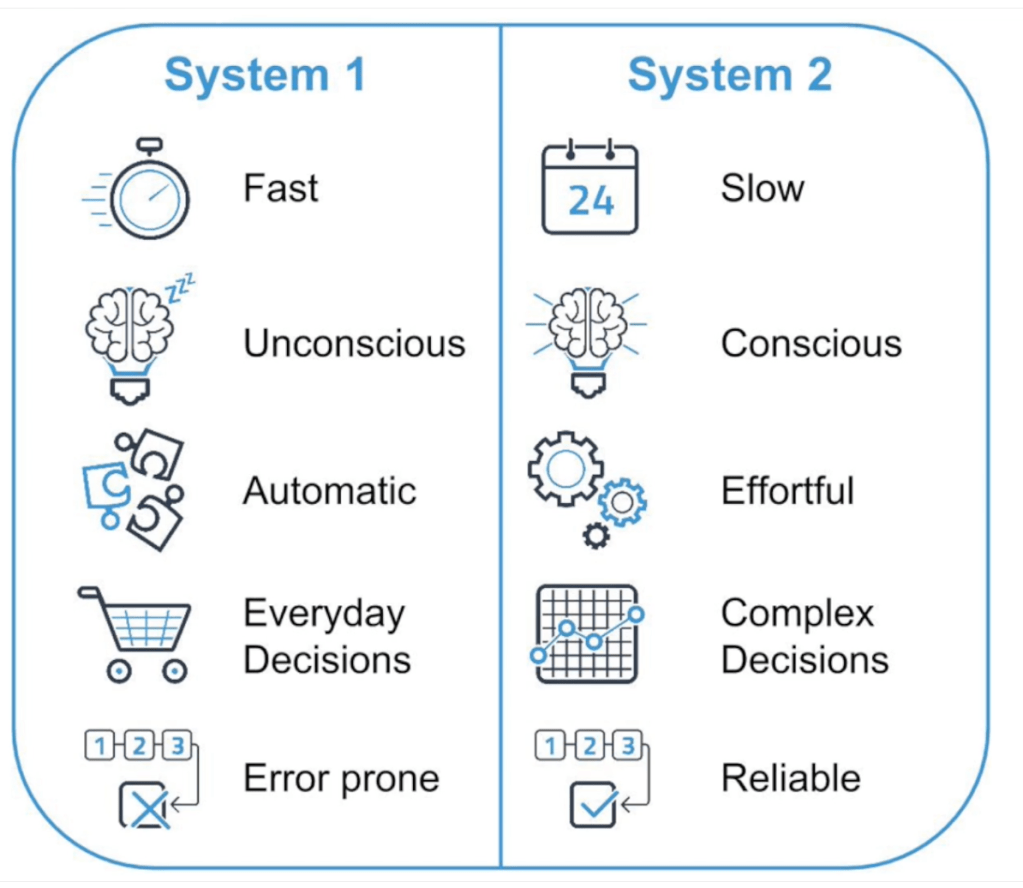
System 1 is more automatic, unconscious, where we are more susceptible to the nudge. Whereas System 2 is our intellectual capacity to reflect, reason and make decisions, but it takes more effort.
Nudge theory is a flexible and modern concept for:
- Understanding how people think, make decisions, and behave,
- Helping people improve their thinking and decisions,
- Managing change of all sorts, and
- Identifying and modifying existing unhelpful influences on people.
In 1900, Sigmund Freud published The Interpretation of Dreams.
“Freud’s iceberg model of the psyche saw our conscious selves as only the visible part of a much larger psychic structure, where the Ego’s job was to act as the mediator between the unconscious desires, the Id, and the prohibition of such desire, the Super Ego. “
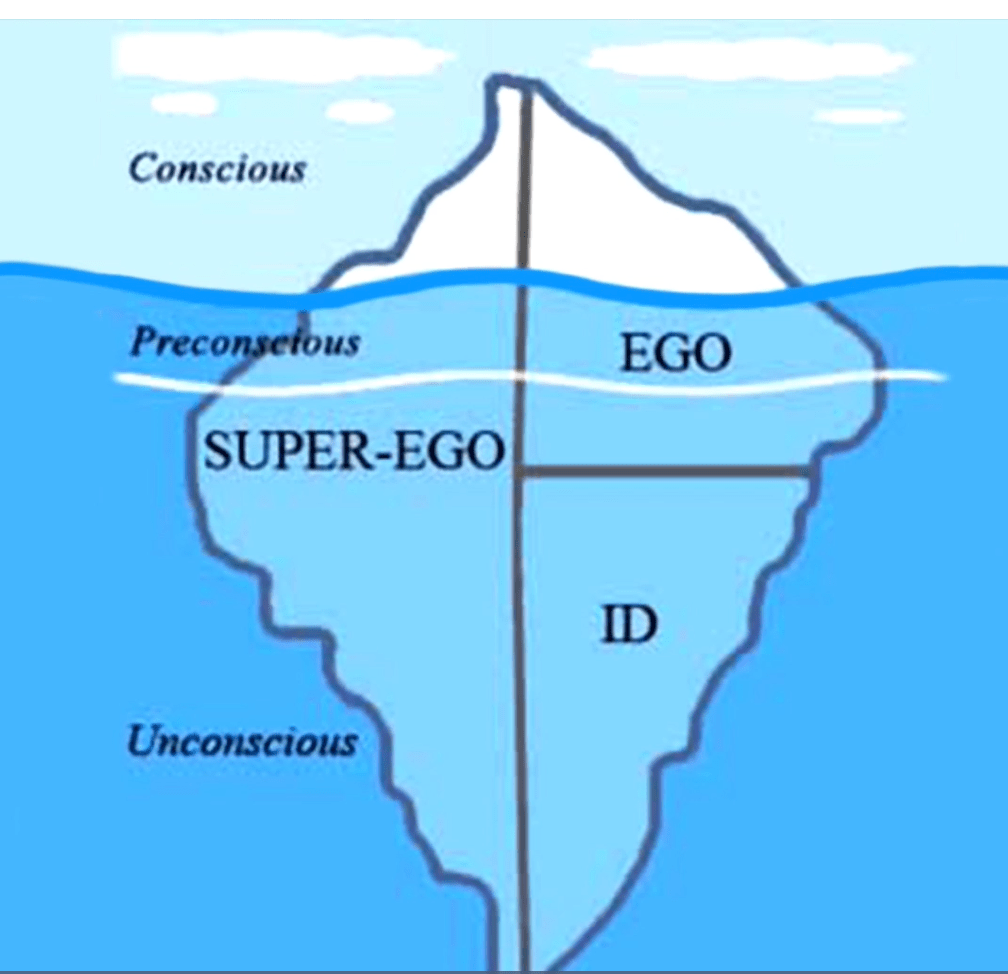
I found another image – little different but easy to understand
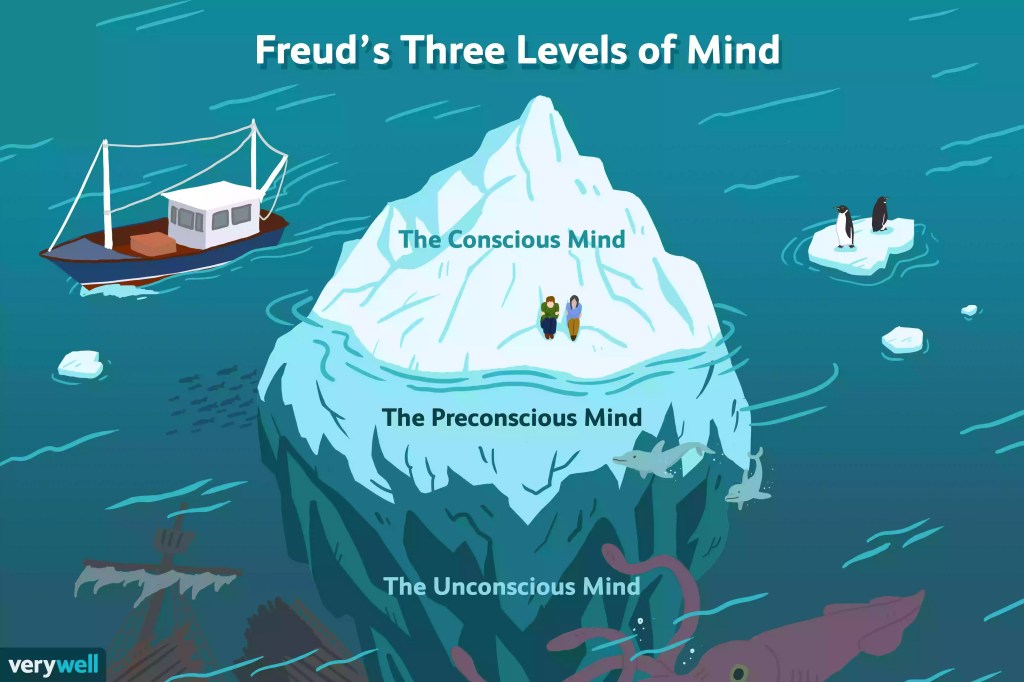
“Freud delineated the mind in the distinct levels, each with their own roles and functions.
- The preconscious consists of anything that could potentially be brought into the conscious mind.
- The conscious mind contains all of the thoughts, memories, feelings, and wishes of which we are aware at any given moment. This is the aspect of our mental processing that we can think and talk about rationally. This also includes our memory, which is not always part of consciousness but can be retrieved easily and brought into awareness.
- The unconscious mind is a reservoir of feelings, thoughts, urges, and memories that are outside of our conscious awareness. The unconscious contains contents that are unacceptable or unpleasant, such as feelings of pain, anxiety, or conflict.”
Here another image about this theory (https://sangkyu.wixsite.com/sigmundfreud/mind-as-an-iceberg)
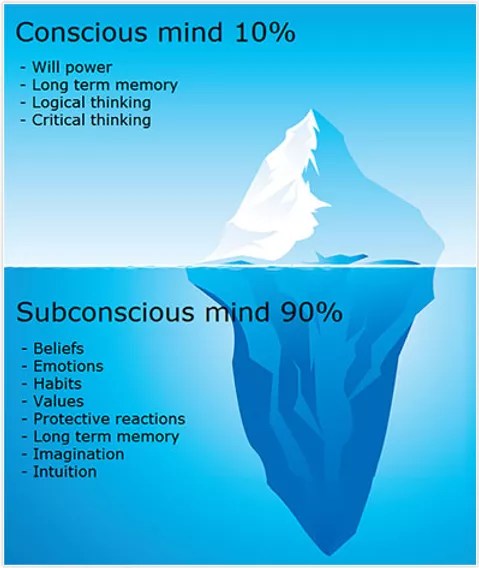
“Freud compares the human mind with an iceberg to be able to describe how the mind actually works. On the tip of the iceberg is seen as the conscious mind, which is all of the actions and processes we are aware of and can control. However, at the bottom of the iceberg is where the unconscious mind is. In the unconscious mind, there is all of the dark and traumatic material that is too threating to be acknowledged. There are some memories that are too painful to be acknowledged, so that is locked in the unconscious mind. This process is called repression. Other things that are in the unconscious mind are dreams.”
It is unbelievable how complicated our mind is and how much is behind our actions or feelings.
Carl Gustav Jung did not agree with Freud’s dogmatic adherence to the sexual urge as the primary mechanism that underpunderpinned human psychology. I also disagree that predominant drive that determined our actions is always the sexual drive . I think there are many other drives that can influence our behavior.
Jung saw the emergence of the ego from the unconscious, as a natural and necessary process that developed and progressed throughout one’s life, and that through an active process of engagement with the unconscious, the individual could find meaning and fulfilment.
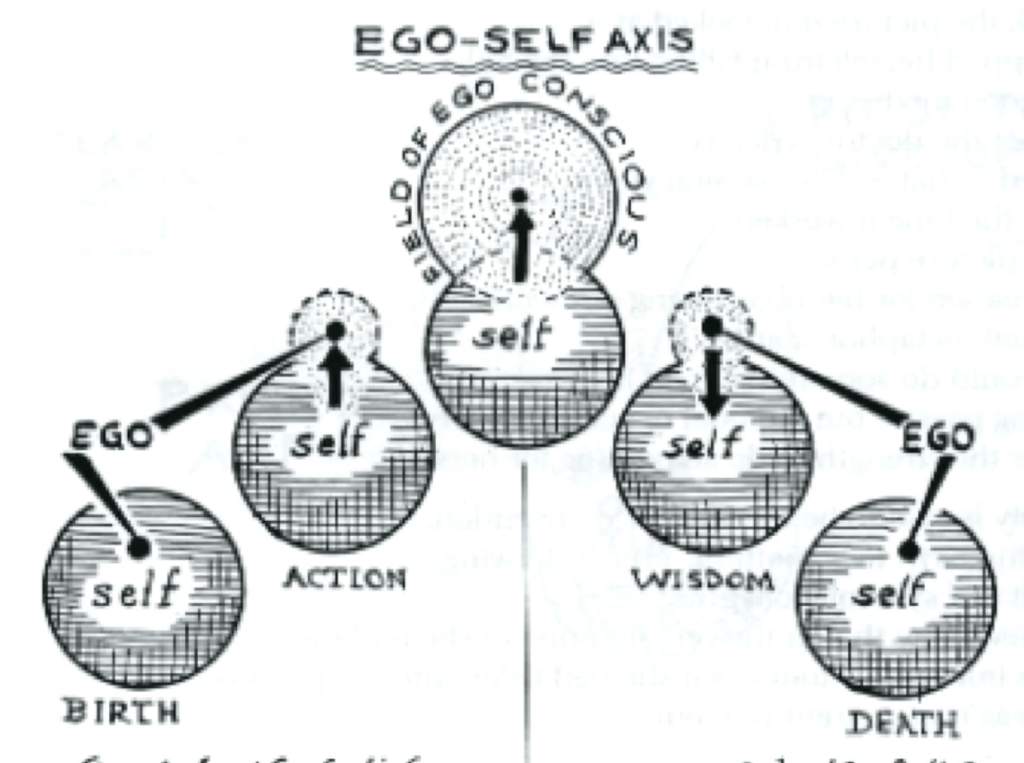
Jung saw The Self as the totality of our personality, conscious AND unconscious
Freud’s nephew Edward Bernays understood that people didn’t make decisions, their desires did. He also was thee first one to use freud’s theory to control the masses.
i like what he said in the video that if we can use propaganda for war, we can use it for peace!
Bernays was amazed from the hidden inside forces of the human beings. There is a lot going on in the process of human deciton making.In thee beginning of the 20 century women did not smoke – only men. The cigar company ask Bernays to help gain the other half of the market – he did a lot of study and came up with the idea to show couple women (part of a parade – in front of many journalist and photographs) smoking. This begun to be a symbol for freedom!


Stewart Ewen said that Bernays is your men if you need somebody to help you find way to appeal to the masses. The corporate world needed to change people’s mind to buy not what they need but what they desire. Bernays could bring to the table a sociological way how to appeal to the masses. He understands what motivates people.
He created the ad campaign for lunching the first women magazine

He also help car companies to sell more cars:
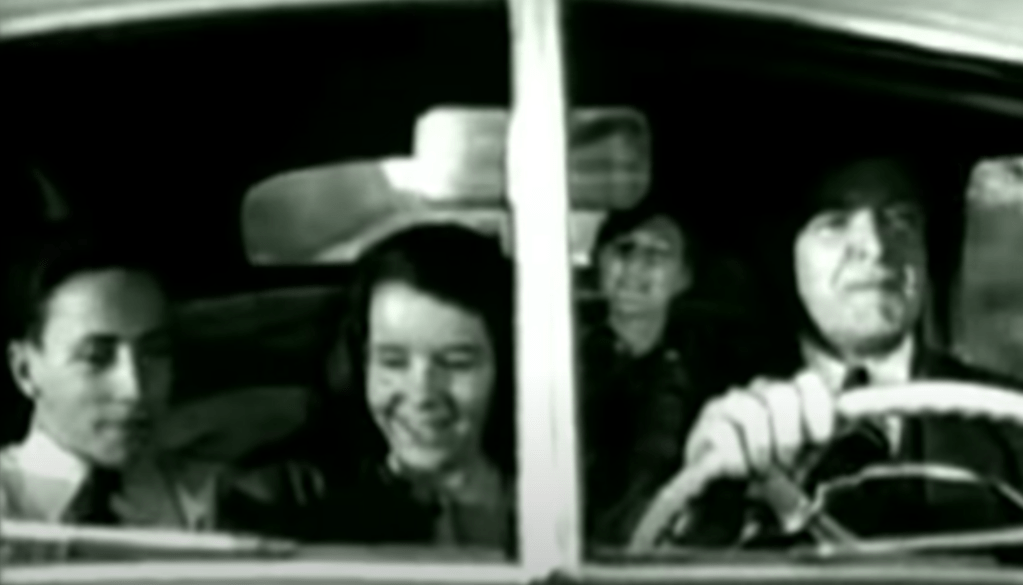
There is also psychology of the dress – we can express ourselves by certain cloches. “Try to express yourself better!”
In 1927 when the stock market open, he help promoting it.
Bernays become famous for understanding the mind of the crowd.
He help his uncle sells its book in United States. Close to his end Freud wrote that he underestimated the agresive instincts of the human beings – they are far more dangerous. He said that civilization is design to control this danger inside of people. “Humans should never be allowed to truly express themeless – it will be very dangerous.” Freud died 1939 in England but his daughter Anna and Bernays continue his work. Anna believe that people can be taught how to control this behavior. We can have better society if wee change the way of thinking.
This is also very interesting video about how to find ourselves
Bernays convinced people that democracy and capitalism go together.
He also invented the idea of group sessions to find out how consumers think. This become the focus group!
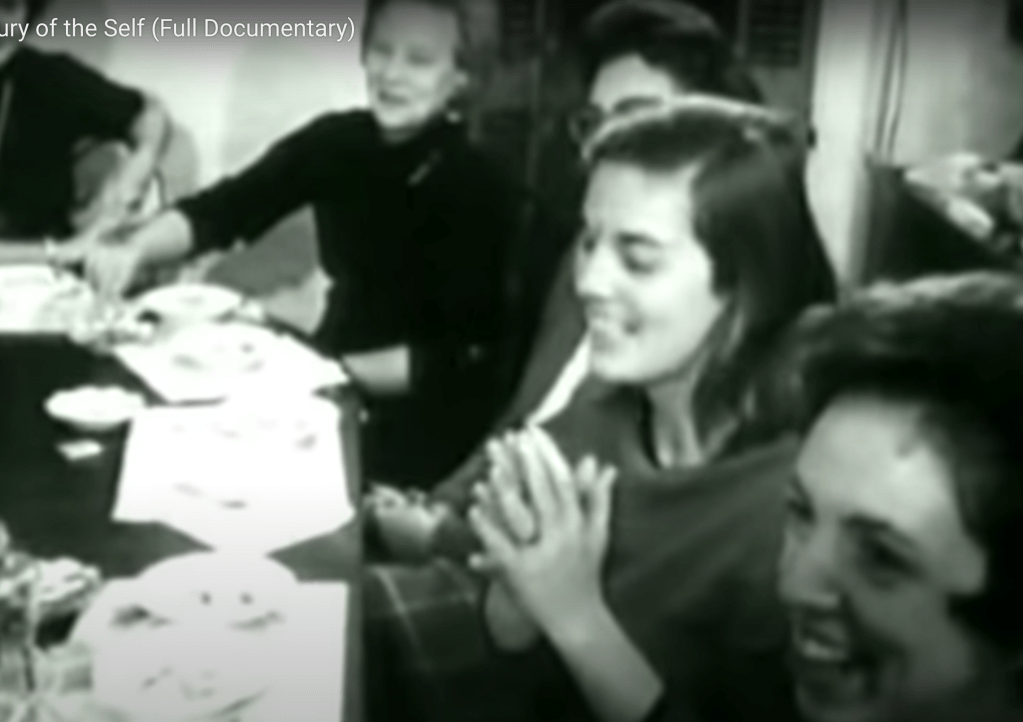
This help him with the Betty Cracker company – he found out that the housewives felt guilt buying the product that doesn’t need much of work. He needed to come up with something that will remove this barrier -so, he just added an egg – he put on the box that needs an egg – this is so smart!
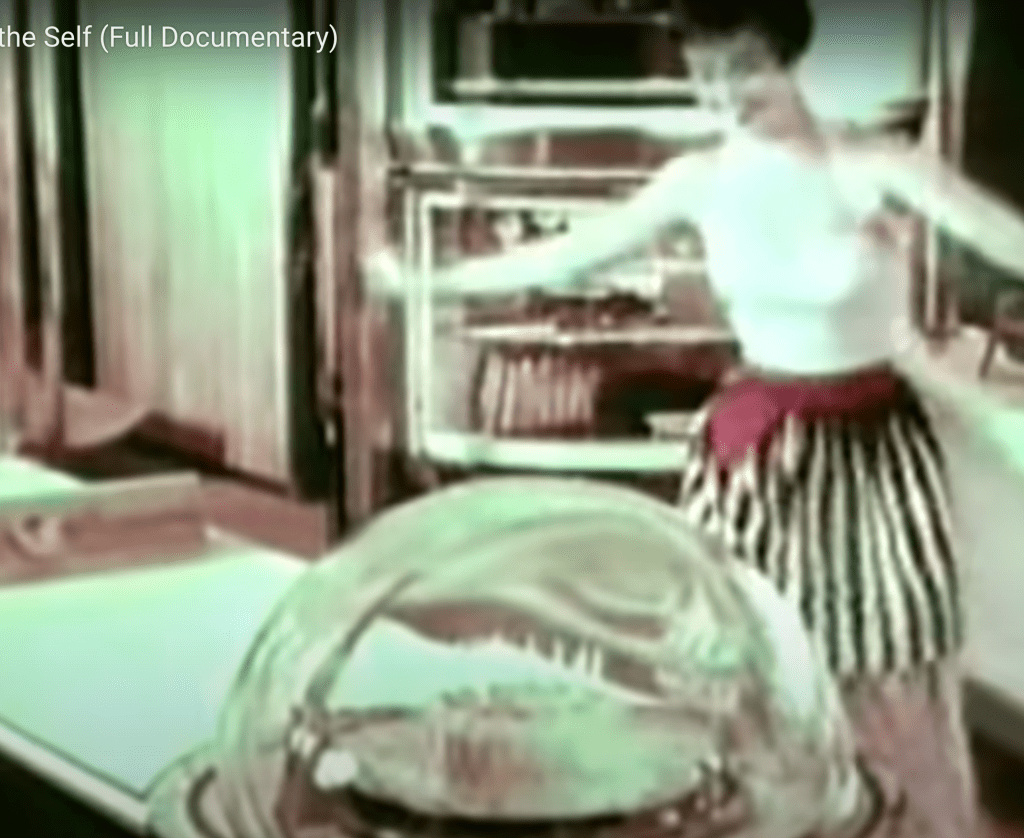
Politics were taking his advise – they wonted to understand the hidden roots of human behavior.
They had to use phycological techniques to control masses irrationality.
What he understood about groups is that you can top in their personal desires or fears and use it.
Bernays could manipulate the American people.
The human mind is so complex – there are no simple solutions.
It was interesting to learn about the Cameron experiment – he was wiping out the memory of people and implanting a new ones.
In his book Propaganda he stated:
“…the conscious and intelligent manipulation of the organised habits and opinions of the masses is an important element in democratic society. Those who manipulate this unforeseen mechanism of society constitute an invisible government that is the true ruling power of this country. We are governed, our minds moulded, our tastes formed, our ideas suggested, largely by men that we have never heard of. In almost every act of our daily lives we are dominated by a relatively small number of persons who pull the wires which control the public mind.”
This is used in the marketing campaigns – “When was the last time you went into the supermarket and came out with exactly what you went in for? ‘
Me – personally – when I go for one specific thing, I leave with at least 10 more.
The Digital Self
“It’s no longer enough to take the picture, we have to take the picture with us and the subject in it to prove that we were there. “
‘
“Identity consists of physical realities and abstract thoughts interacting with a constantly changing world. Our world divides into endless components of culture defined by those living within that culture. The summarization of one’s identity cannot simply be a name, age, or even an archetype of generation. It must grow with the individual, collecting multiplying factors, through life experiences along the way. The impact of these events are seen in both the individual and how that individual addresses society.”
The Trajectory of the Self – A. Giddens (1991)
This is such a great article about the meaning of life – I relate to many of the conclusions that Giddens have came to.
“The ‘art of being in the now’ generates the self-understanding necessary to plan ahead and to construct a life trajectory which accords with the individual’s inner wishes.
Keeping a journal, and developing a notional or actual autobiography, are recommended as means of thinking ahead. The basic purpose of writing autobiographical material is to help you be done with the past . . . Holding a dialogue with time means identifying stressful events(actual events in the past and possible ones to be faced in the future) and coming to terms with their implications.
Dealing with the death is always big issue.
Imagine that you have been told that you have just three years left to live . You will be in good health for these years . . . . What was your immediate response? . . . To start planning how you would spend your time? Or to be angry at how short the time is?
We are, not what we are, but what we make of ourselves. The self forms a trajectory of development from the past to the anticipated future.
This is so true – we shape our future, we determine our success.
Awareness of the body is basic to ‘grasping the fullness of the moment’ , and entails the conscious monitoring of sensory input from the environment, as well as the major bodily organs and body dispositions as a whole . Body awareness also includes awareness of requirements of exercise and diet. Rainwater points out that people speak of ‘going on a diet’ – but we are all on a diet! Our diet is what we eat; at many junctures of the day we take decisions about whether or not to eat and drink, and exactly what to eat and drink. ‘If you don’t like the diet you are on, there is a new minute and a new choice-point coming up, and you can change your diet. You’re in charge!’
We can learn a lot of this approach – especially when come to healthy eating or manny other things that we do daily and is up to us to change them.
I also agree with this: If your life is ever going to change for the better, you’ll have to take chances. You’ll have to get out of your rut, meet new people, explore new ideas and move along unfamiliar pathways. To be true to oneself means finding oneself, but since this is an active process of self-construction it has to be informed by overall goals – those of becoming free from dependencies and achieving fulfillment. The key reference points are set ‘from the inside’, in terms of how the individual constructs/reconstructs his life history.
Lifestyle is not a term which has much applicability to traditional cultures , because it implies choice within a plurality of possible options, and is ‘adopted’ rather than ‘handed down’. Lifestyles are routinised practices, the routines incorporated into habit of dress , eating, modes of acting and favoured milieux fo encountering others ; but the routines followed are reflexivel open to change in the light of the mobile nature of self-identity. Each of the small decisions a person makes every day – what to wear, what to eat, how to conduct himself at work, whom to meet with later in the evening – contributes to such routines. All such choices (as well as larger and more consequential ones) are decisions not only about how to act but who to be. The more post-traditional the ,settings in which an individual moves , the more lifestyle concerns the very core of self-identity, its making and remaking. .
In a world of alternative lifestyle options, strategic life planing becomes of special importance. Life plans are the substantial content of the reflexively organized trajectory of the self. Personal calendars are timing devices for significant events within the life of the individual, inserting such events within a personalized chronology.Life-planning, of course, does not necessarily involve preparing strategically for future life as a whole, although Rainwater’s book makes clear that thinking as far ahead as the imagined end of one’s life, and about each of the major phases likely to intervene in the interim, is fundamental to selfactualisation.
Pure relationships come into existence primarily in the domains of sexuality, marriage and friendship.
One should ‘take time to listen to each other daily ,’ since communication is so central to intimacy…
Parent-child relations are something of a special case, because of the radical imbalance of power involved, and because of their centrality for socialisation processes.Yet in conditions of modernity, the more a child moves towards adulthood and autonomy, the more elements of the pure relationship tend to come into play.
 Vicky Kafkaki - Graphic Design MA Falmouth University
Leave a comment