The ‘evil eye’
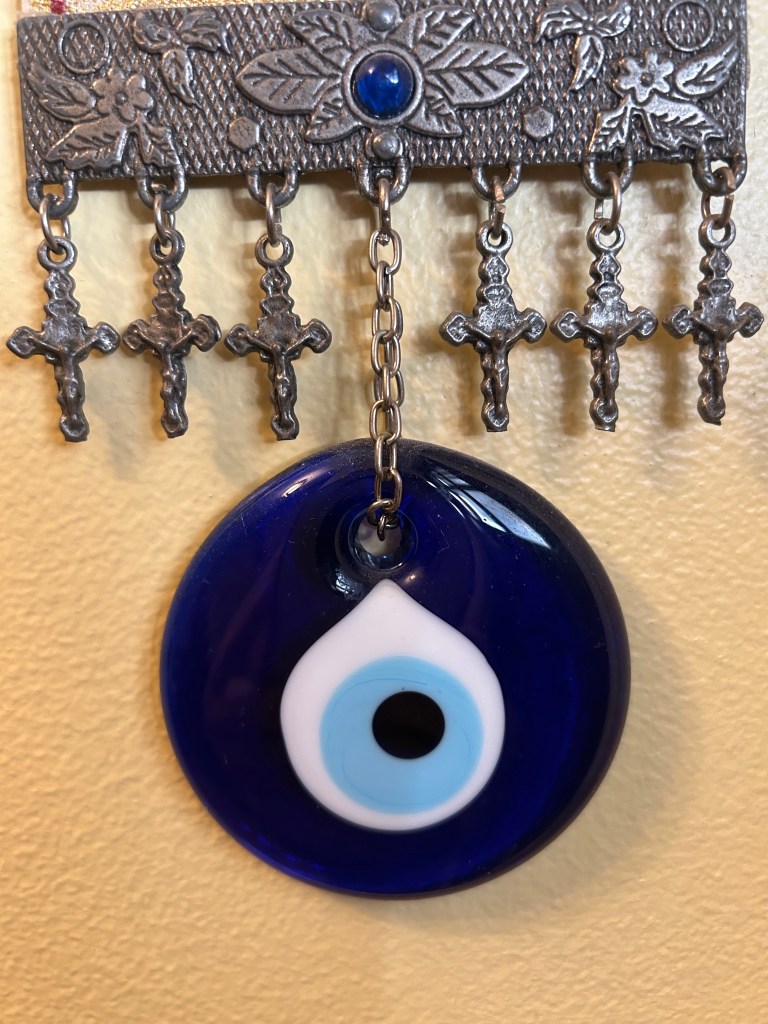
I pick the ‘evil eye’ – I have at least 10 of them in the house (different sizes). We can apply the Ethnography research.
The evil eye is a curse from Greek culture that has been passed through many decades and still exists today. It states that when someone is envious of you, they’ll have the power to give you an ‘evil glare’ and send bad luck your way[1]
I think there is a confusion – the name is ‘evil eye’ but actually works as a protection of somebody that will give you an ‘evil eye’ (wish you bad luck) -so, if somebody is not familiar with the culture of the people that use it, you will get confused by the name.
The symbol of the evil eye dates back as early as 5000 BC in Mesopotamia and has roots in Christian, Jewish, Muslim, Buddhist, and Hindu cultures.
In the Bible: Eyes expressed the innermost feelings and desires of the heart. Therefore a ‘good eye’ revealed morally good and generous intentions, while an ‘evil eye’ exposed an evil heart with wicked intentions of envy, greed and jealousy (Kotze 2007:143).
In the Islamic: Belief in the evil eye is found in the Islamic doctrine, based upon the statement of the Islamic prophet Muhammad, “The influence of an evil eye is a fact…”
In the Jewish culture: In classic Jewish sources, the eye frequently serves as a metaphor to describe God’s metaphysical awareness as well as the interest humans take in each other. In Nyack, Rabbi Eckstein talks about the evil eye: “That’s not a uniquely Jewish concept, he said; “every culture has an evil eye. In Turkey, you can buy jewelry against it that actually is an eye.” That jewelry — usually a necklace — usually is a blue stone with an eyeball, with a pupil centered in it. “The Italians wear a horn, to stick it in the evil eye — they call the evil eye malocchio.” That’s literally “evil eye.” “And Jews wear the hamsa, the hand with the fingers extended, to stick it in the evil eye,” he said.”
In the Hindu: The evil eye also carries a powerful superstition in India, where Hinduism preaches that our eyes are the most powerful part of the body. Because of this, there is a strong fear of the “evil” look from the eye and many believe that it holds a huge amount of power.
So, the common believe in all the cultures is that the evil eye is a talisman that is meant to protect you from the evil spirits. We can do as many researchers we want but I don’t think any of them will prove that the power if this talisman is true fact – how can prove that wearing it, we are lucky and not wearing it, we are unlucky!
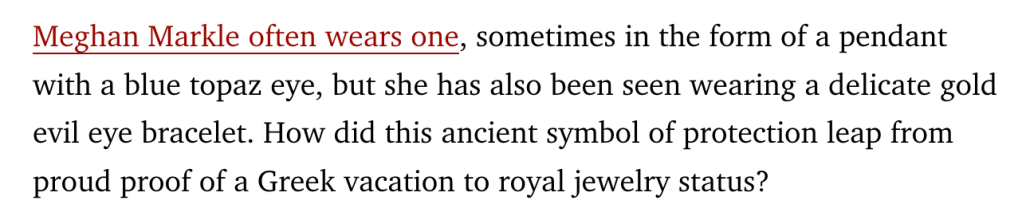
We have famous people wearing it, believing in it but is this enough for evidence:





I think now days this believe has been commercialized (businesses are taking advantage of it to make a profit – well, like most things in life now)
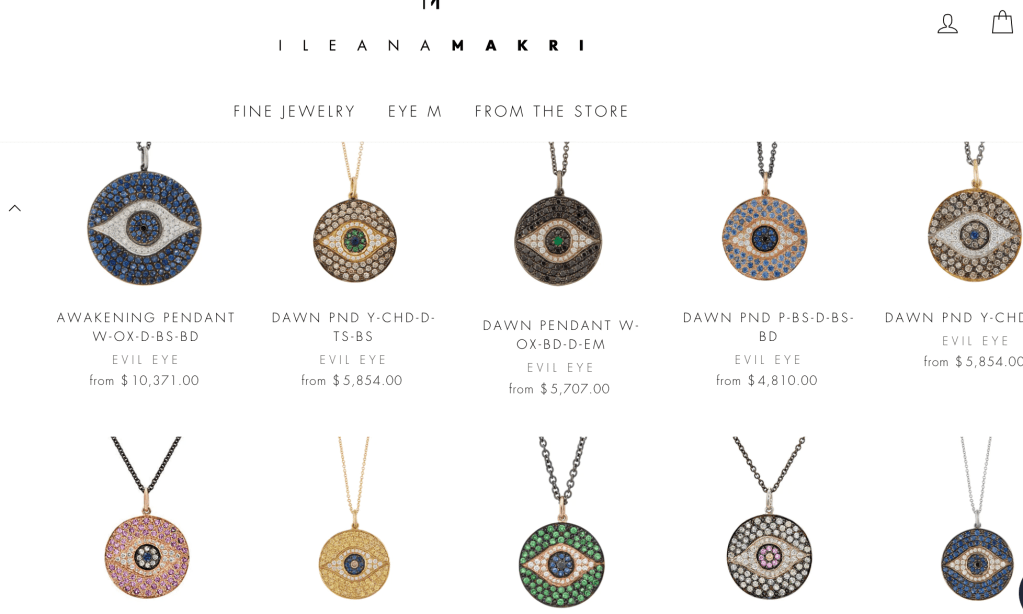

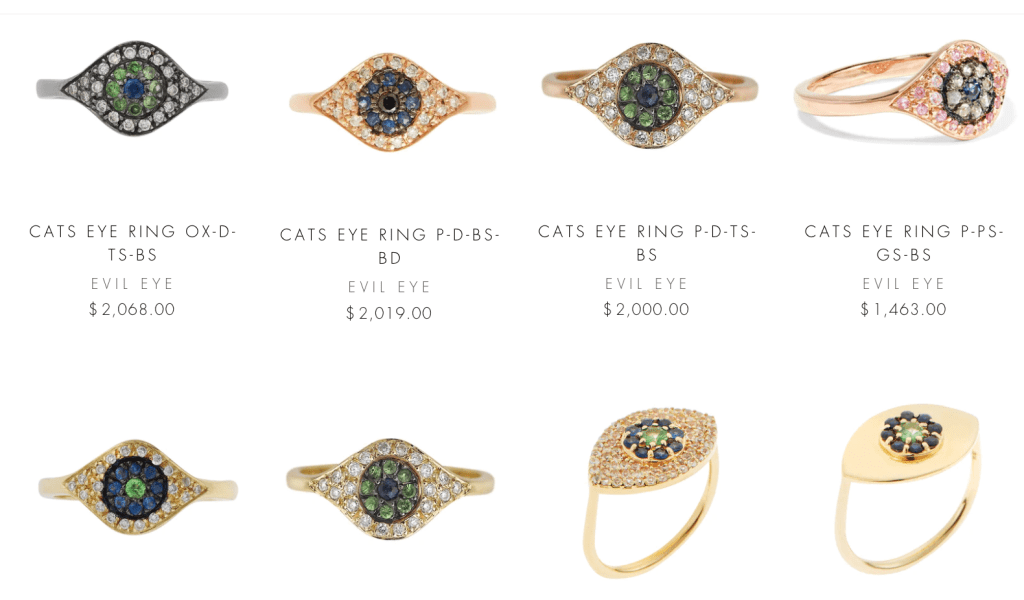
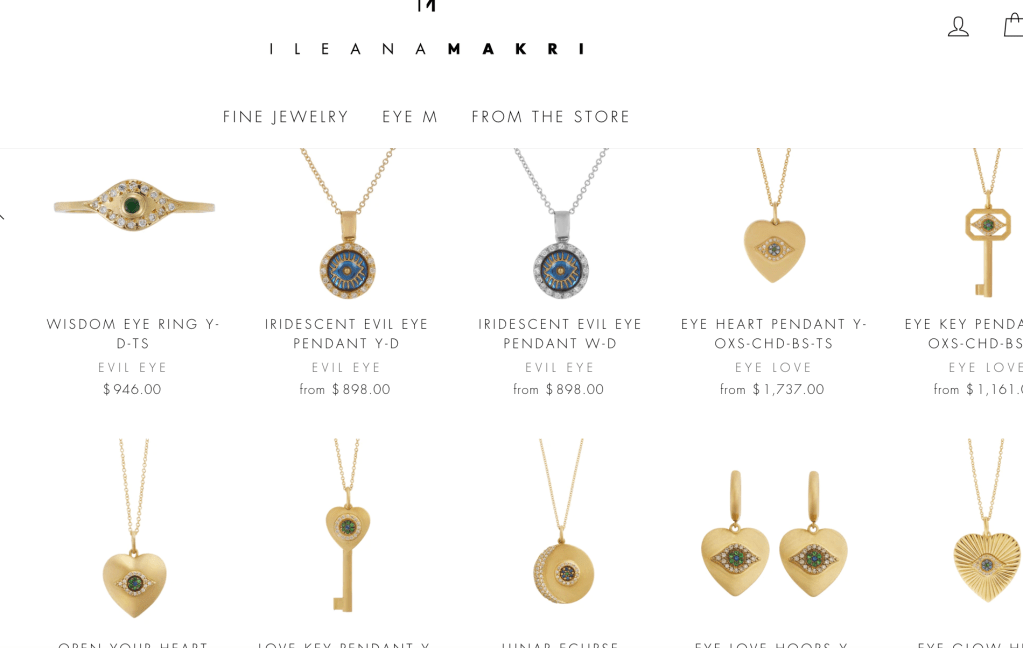
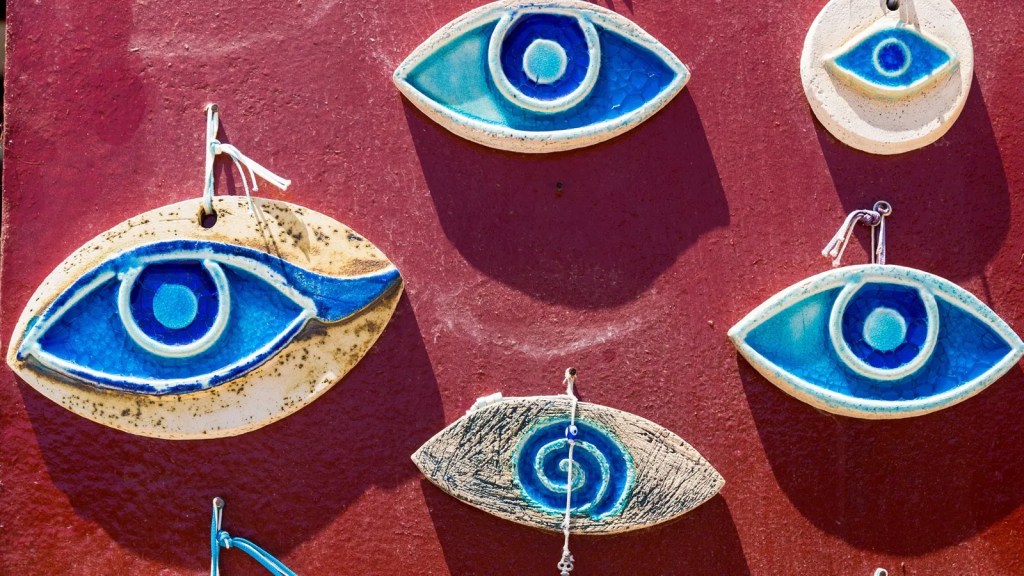


These talismans or evil eye “repellents” come in different shapes and forms as pendants, bracelets, earrings and rings. Or can be hanging in a glass bead form over the main door or entrance of someone’s home to keep the hearth protected.
ANTHONY H. GALT in his study “The evil eye as synthetic image and its meanings on the Island of Pantelleria, Italy”, talks about the Garrison and Arensberg argument about the evil eye: “the argument is made with a rather selective use of evidence and in such a way that validation is impossible. For instance, they assume that the harm caused by the evil eye is of the nature of seizure, expropriation, or destruction. Even among the case studies in the Maloney volume, however, these words by no means always accurately describe the harm caused. Appel (1976:17) states that evil eye victims on the Murgia dei Trulli in southern Italy suffer headaches, sleepiness, exhaustion, depression, hypochondria, and spirit possession, illnesses linked to the sense of being “acted upon by powerful and unknown forces,” but with the exception of “spirit possession” (which would seem a separate category from malocchio pure and simple), are not necessarily clearly characterizable as seizure or confiscation. A similar list is supplied for a pseudonymous Aegean island called “Nisi” by Dionisopoulos-Mass (1976:45), although added to it are sudden death of children and animals, withering of vines, and the splitting of an olive press. Teitelbaum (1976:64-65) reports that only living things are hurt by the evil eye and that the Tunisian Arabic usage for describing the affliction includes the notion of being ”taken by the evil eye.” (https://anthrosource.onlinelibrary.wiley.com/doi/pdf/10.1525/ae.1982.9.4.02a00030)
Why is so popular?
I think that especially today, when life has become so complicated, we need some positiveness, something to believe in that will help us – so, wearing the ‘evil eye’ is one of the things that we believe will bring us good luck.

This is my essay about the ‘evil eye’
 Vicky Kafkaki - Graphic Design MA Falmouth University
Leave a comment