The focus in this lecture to go in details about the operational and functional aspects of design practice and business.
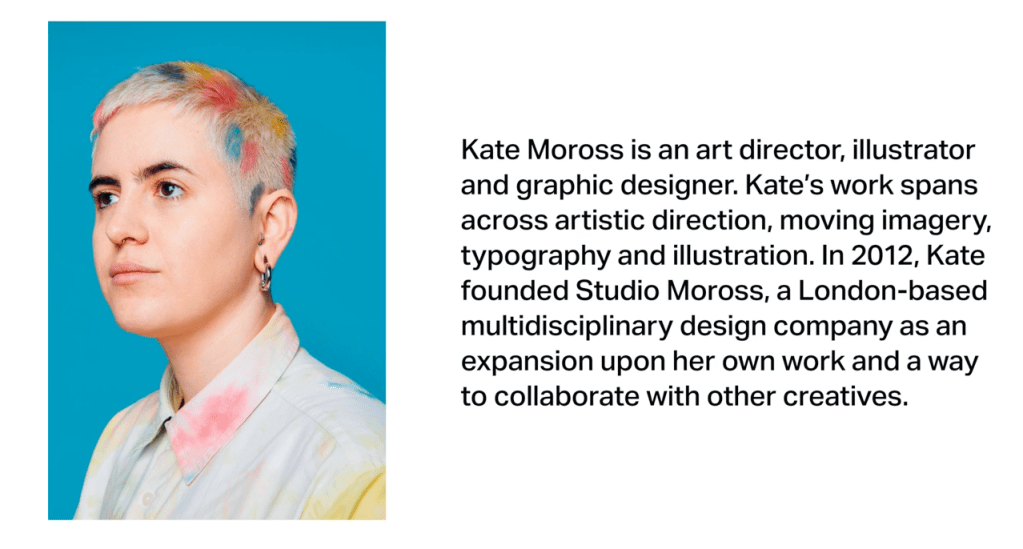
Kate Moross
The first one is Kate Moross. She is founder of studio Moross, which is a design studio based in Stockwell in South.
What made impression on me is the way she started the business – she said that the first thing she did was to decide on name and create a website (of course, you need to have the skills before that)
She explained how the business is structured and how the employment works.
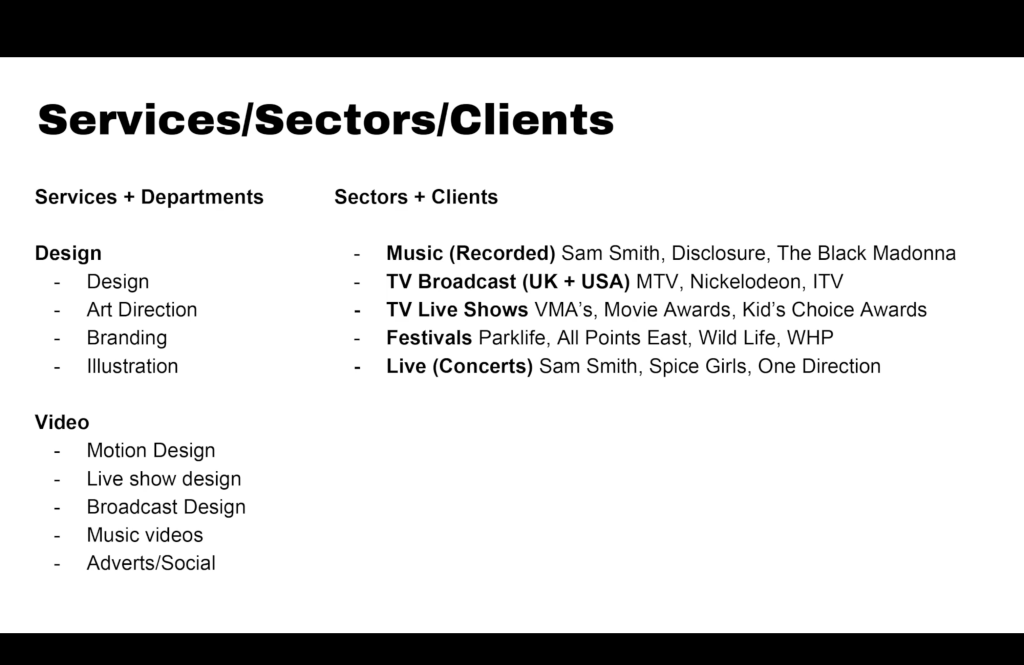
So, they have two departments – Design Department, which is design, art direction, branding and illustration, and Video Department, which is motion design, live show design, broadcast design, music videos, and social media content.
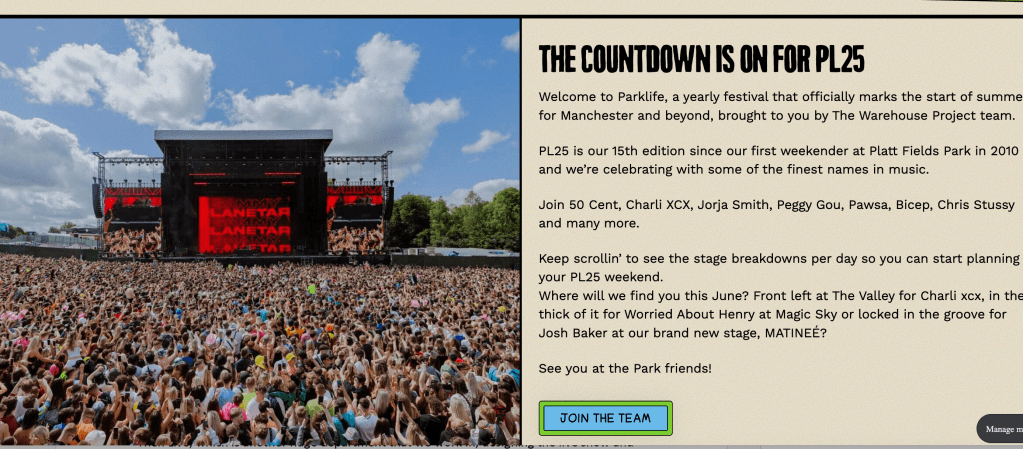
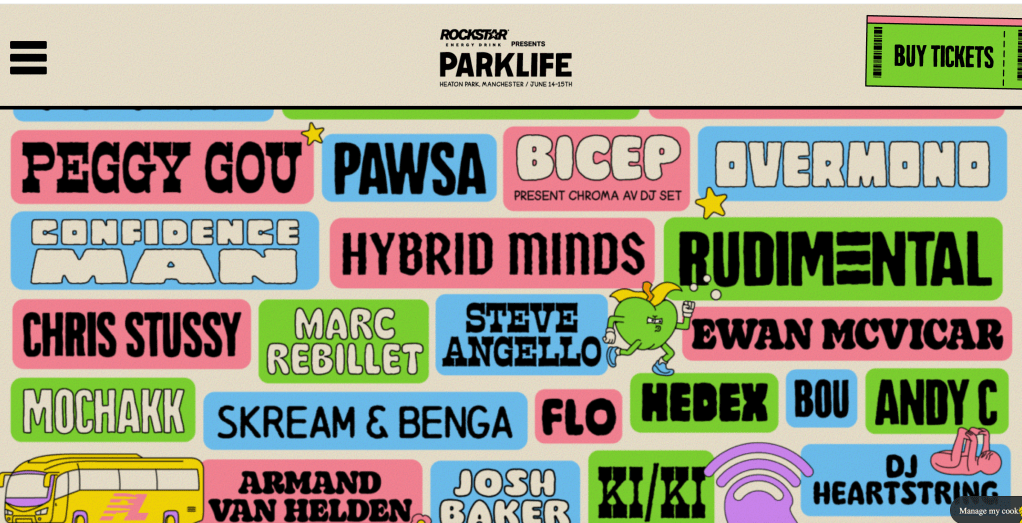
I enjoy going trough the work created by the Moross studio – especially one of their projects about the Parklife festival – the typefaces and the colors that they used are so unique.

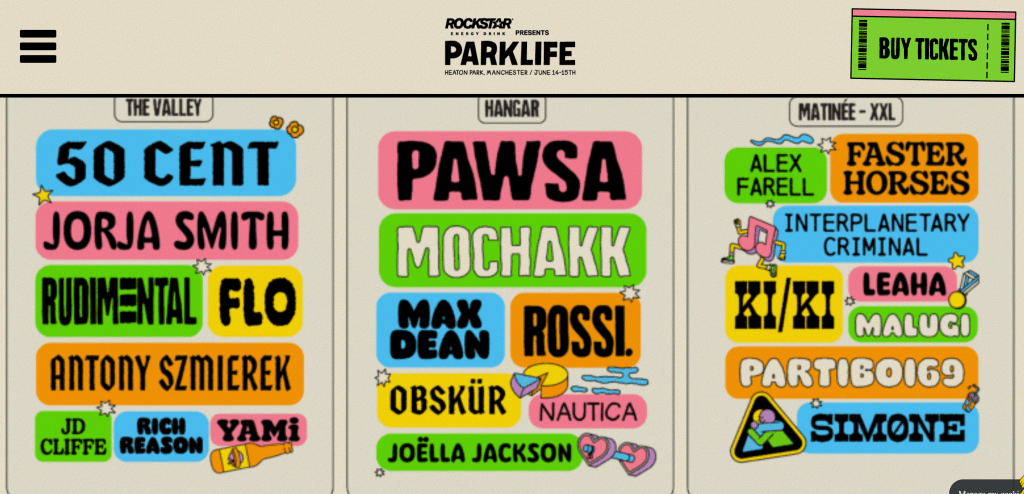
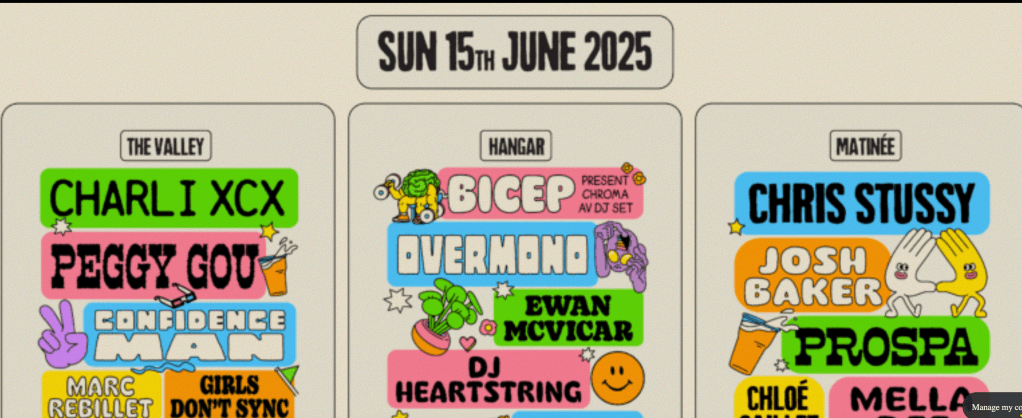
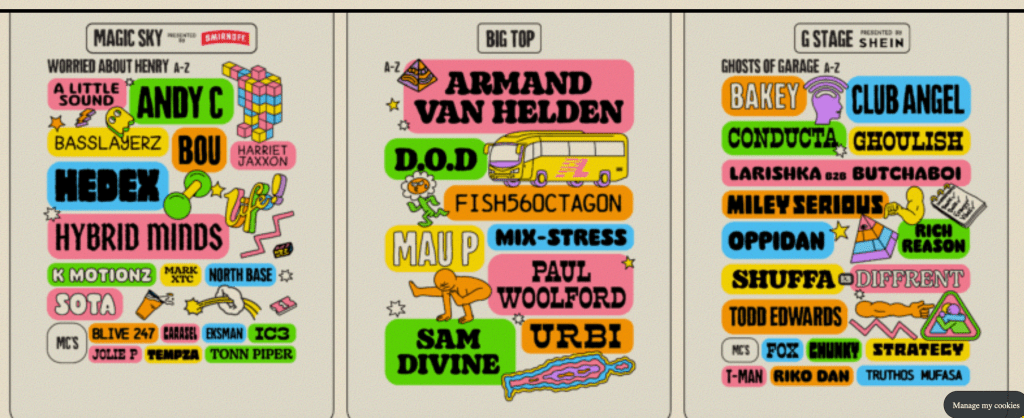
Another festival is All Points East Festival ( https://www.allpointseastfestival.com/)
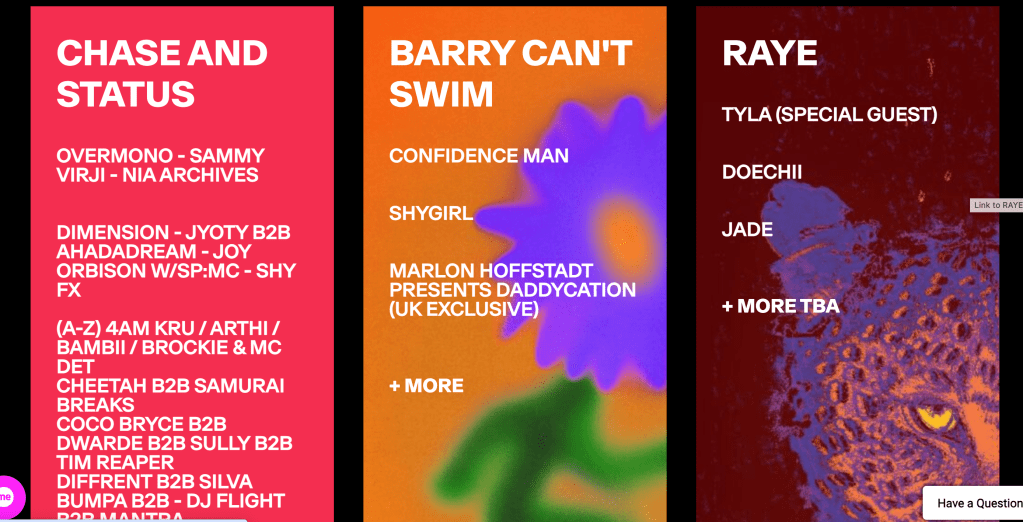
I think that the festivals are big opportunities for designers – I see more and more festivals around my area.
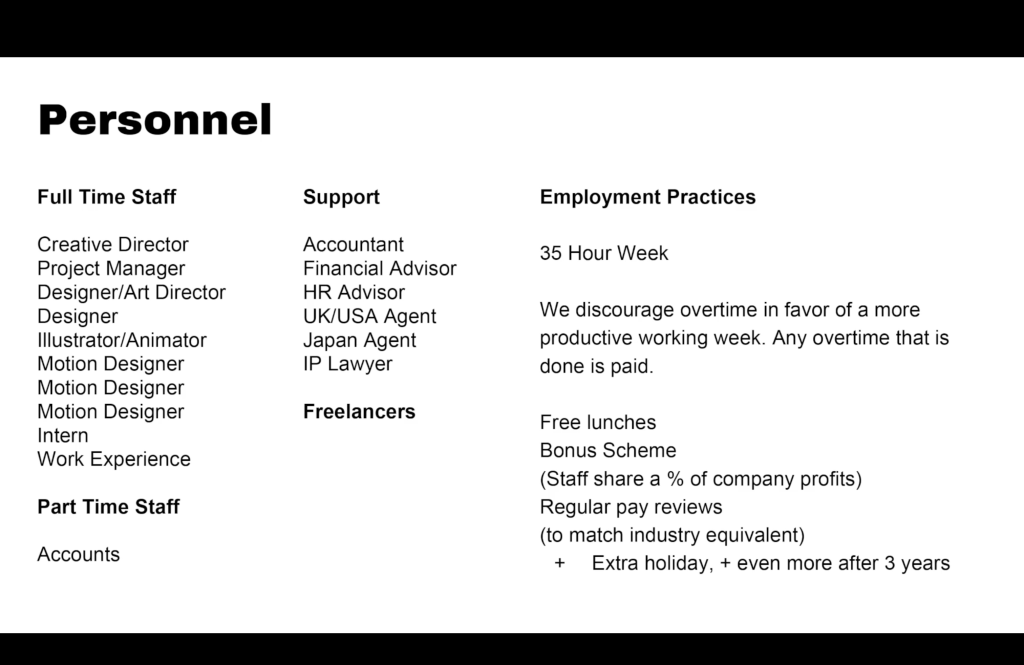
Kate oversees the whole business and here she explains the structure of it: “the way the personnel is run, and this has been pretty consistent for the last three years, is there’s me, so I operate as the creative director. I’m assisted by a project manager, which is becoming more of a full-time role. In the past, and still regularly to this day, most of the team managed their own projects with the support of a project manager, rather than the project manager exclusively running the projects. Then we have two more designers, an illustrator, animator, three motion designers and then we have a permanent intern position and a permanent work experience position. The intern position is usually a graduate or someone who is looking for a full-time career in design or motion design. Our work experience placements are for two weeks and they are for a young person that is curious about the industry and wants to gain some experience. The main difference between those are an internship is paid, and the work experience is part of the course or part of that student’s practice within their college or university. We also have support from the part-time accounts department, who make sure we get paid, and make sure people who work for us get paid.
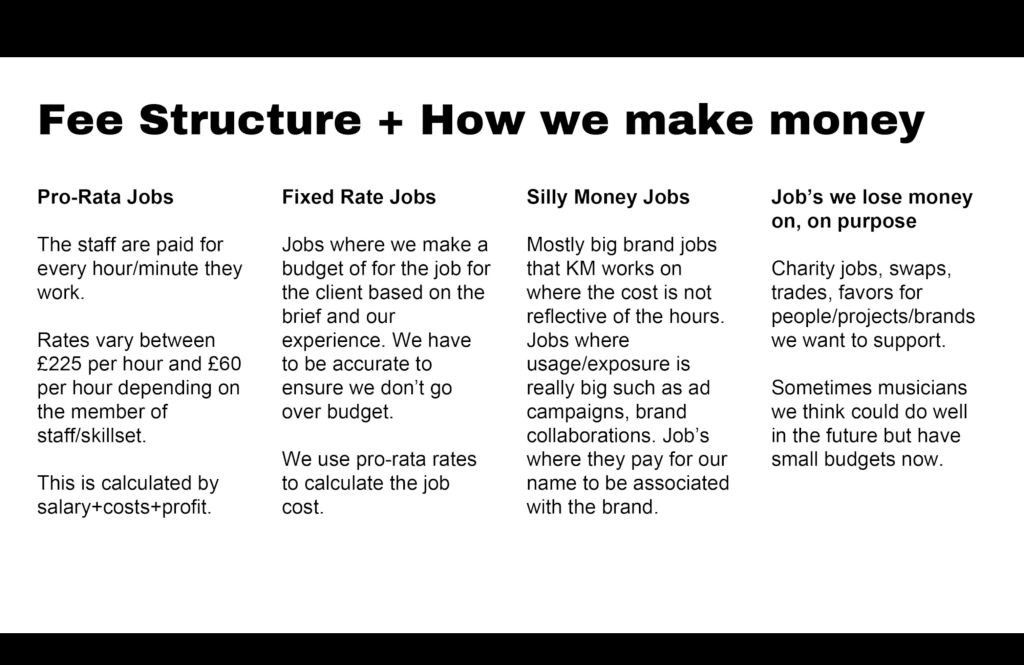
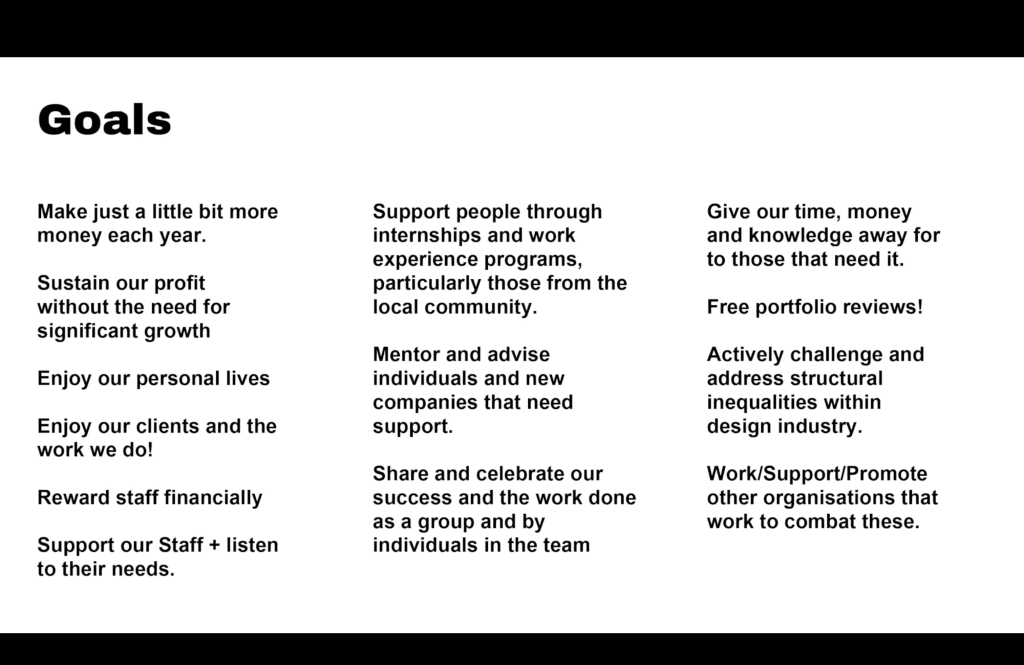
We try and make a little bit more money each year, but that is quite small, we don’t push ourselves super far to double our turnover or whatever. We try to sustain our profit without growth, so we don’t feel like we need to keep hiring in order to keep earning. Our aims are to enjoy our personal lives, enjoy our clients and the work we do, to reward our staff financially, support our staff and listen to the needs that they have, and incorporate them if needs be, into the studio and the studio systems.
We give our time, money and knowledge away for free for those who need it. We review portfolios for free and we actively challenge and address any structural qualities within the design industry ”
Kate encourages people not to work overtime and have time for personal life – this way they will be rested and more productive. She also provides lunches for her employees – this shows such a good care for the people working for her.
The conclusion is that even we have many people working for us and big clients, on order the business to be successful, we have to stay on top of it – not just relying on other people doing most of the work.
There are three ways that jobs come into the studio:
- Kate or the employees go and look for it;
- People look for them online;
- Repeat clients (80% of their clients are repeat clients)
So, is very important to have satisfied customers – because they can come back and give you more work.
What happens after the job comes in:
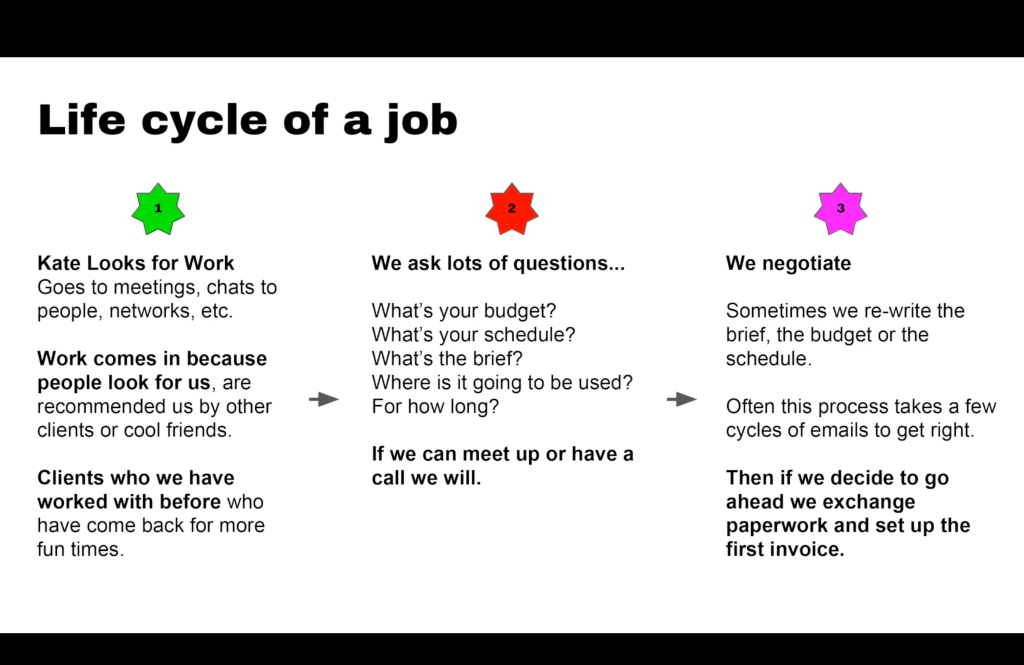
“The process after we have those jobs come in. We ask lots of questions about budget, schedule, brief, how long the work is going to be used for, where it’s going to be used? We try and dig as deep as possible and have a phone call, or a meeting if necessary. Then we negotiate. Sometimes we rewrite the brief, the budget or the schedule. This can take a few cycles between stage two and three, and then at that point we decide if we want to go ahead. Then we exchange paperwork and we set up our first invoice to be paid. “
USTWO
USTWO studio started 15 years ago only with 2 people – Matt Miller and John Sinclair. Now they have seven studios around the world, 250 employees across those studios and they’re from 29 different countries.
Amazing how much they achieved in such a short time frame! This comes to tells us that hard work pays off! It is impressive how the company uses different revenue models – income comes from not only design work, but also game design and investment on other people work.
“Broadly, at the top level of ustwo, across every facet of the group, we have this one mission where we want to launch products, services and companies that make a meaningful impact on the world. We do that in three main ways, through working with clients, through launching our own ventures and through investing in companies that we think are doing really impactful, creative work.
In the last five years however we’ve been experimenting with other ways to leverage the creative talent that we have in-house to build products and services. Most famously we launched Monument Valley (https://www.monumentvalleygame.com/mv3).
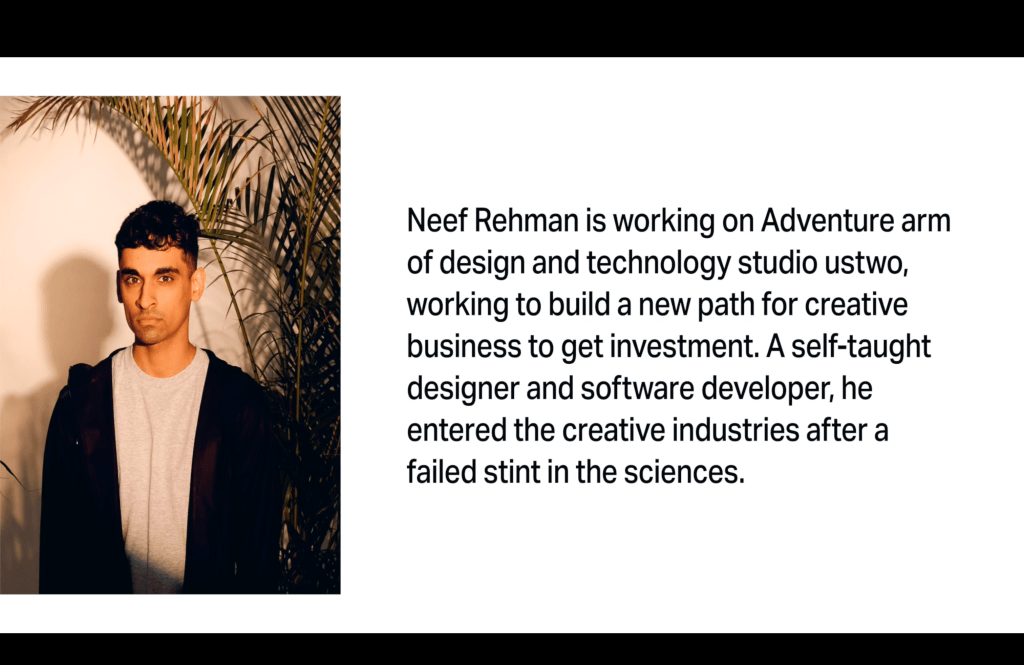
Adventure, which is our newest arm of ustwo, where I work, is our investment fund. In the last five years we’ve been investing in creatively aligned companies that often are creating digital products. The founders gel well with the kind of culture that we think about when it comes to building companies aa ustwo. “
Lovers
Lovers is a design collective based in London working internationally.
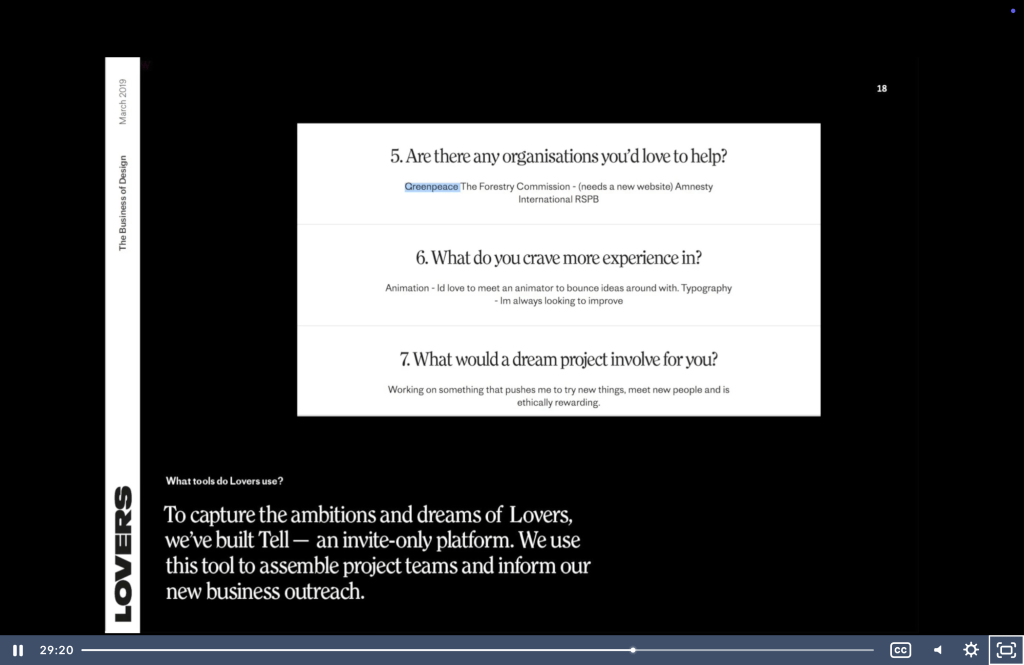
“We call ourselves a creative super group that helps brands. We’re called Lovers because we only work on projects we love, which we hope keeps our work special.
In the model we’ve got a small central team that provides creative direction and project management support, and then we have this huge network of freelance Lovers, which comes together on a project by project basis, depending on the skill set needed or the challenge at hand. In that network we’ve got designers, art directors, strategists, film makers, illustrators, artists, which we bring on a project by project basis.
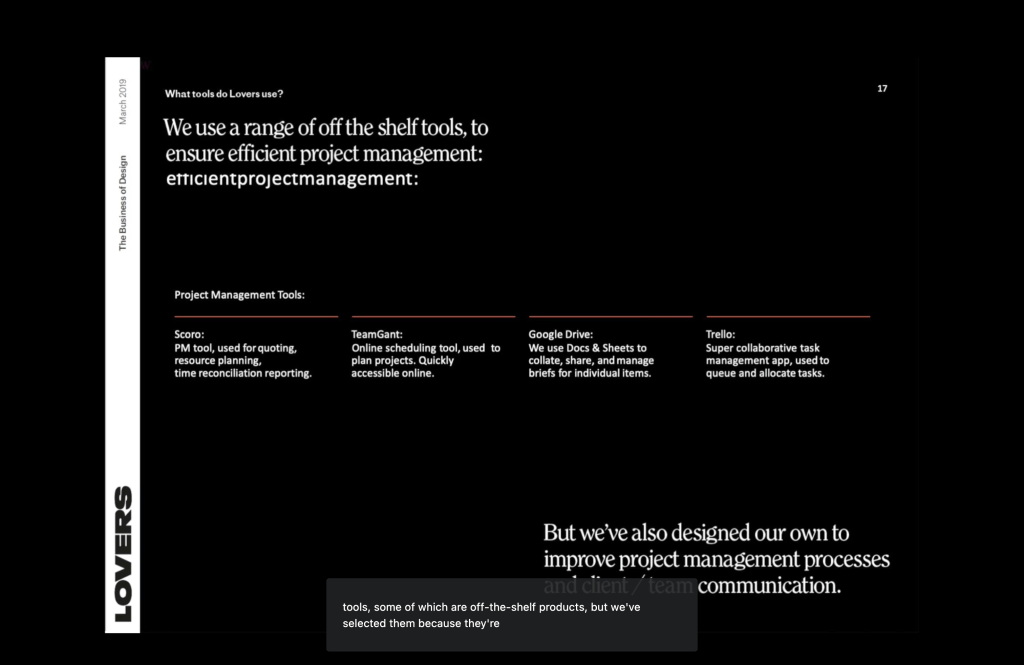
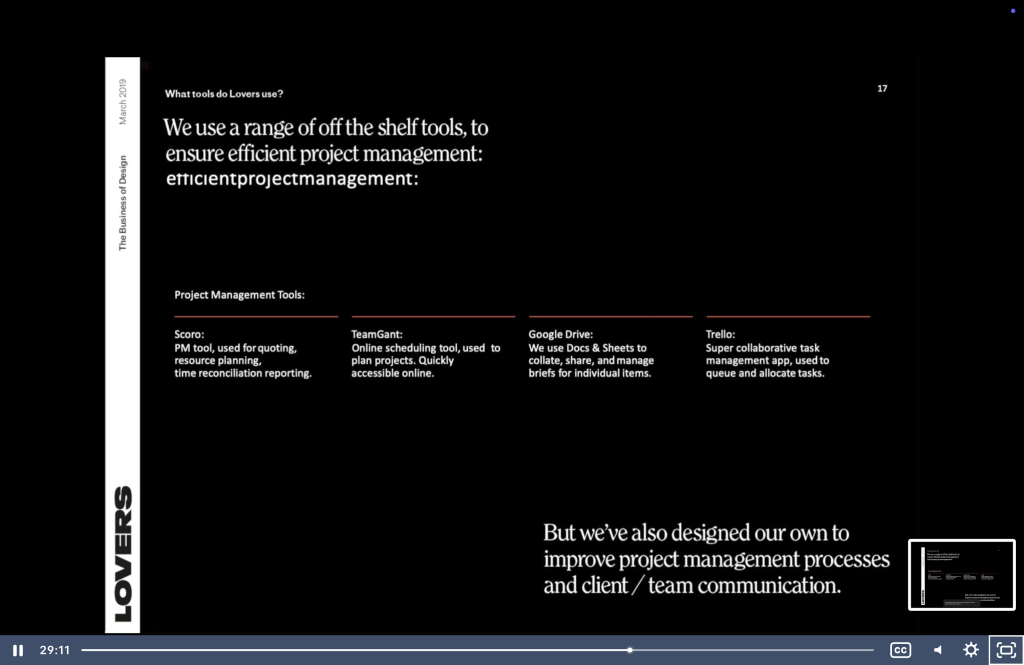
We’ve also designed a bespoke project tracker, which is a way to keep clients in check regarding how much resource they are using on a project versus what was quoted.”
So, I learn that is very important to like what you do and also when the work comes in you have to crate a project tracker to stay focus, organized and finish on time.
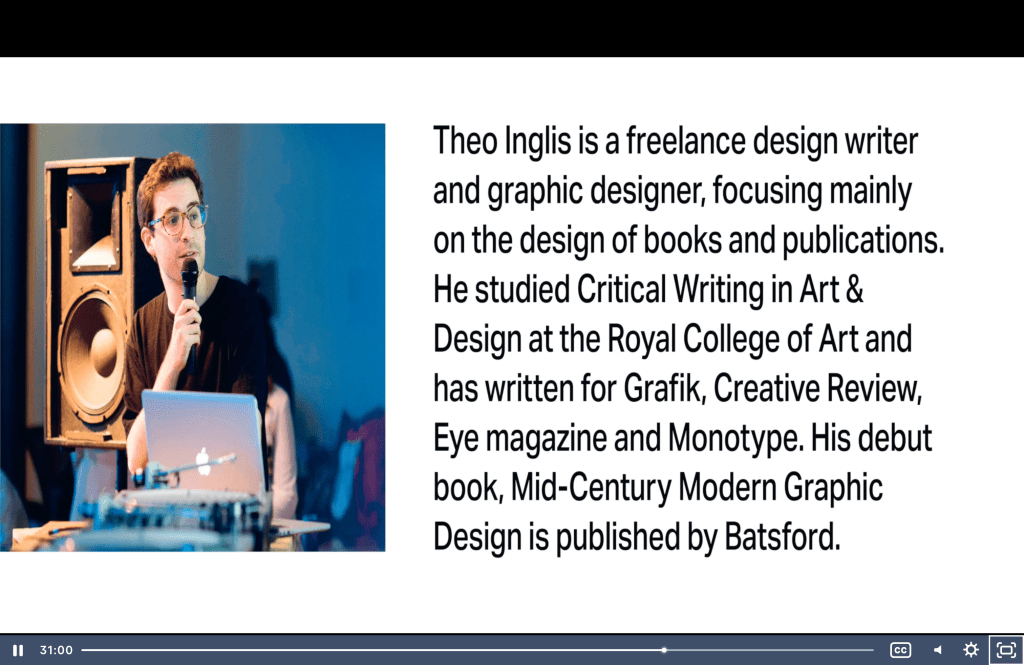
Theo Inglis
He worked couple years in a design studio but then he become a freelancer.
“Pitching can be good, even if you don’t win, because you meet people, make connections. It doesn’t necessarily have to be bad, even if you do lose. When you find clients they usually lead to more work and the best projects. Also, to look for sectors where people need designers. I didn’t necessarily think when I got the pitch in the first place, that I really wanted to work with poets but this ended up being a really exciting place to work and somewhere with quite a lot of projects, and people appreciate working with you. “
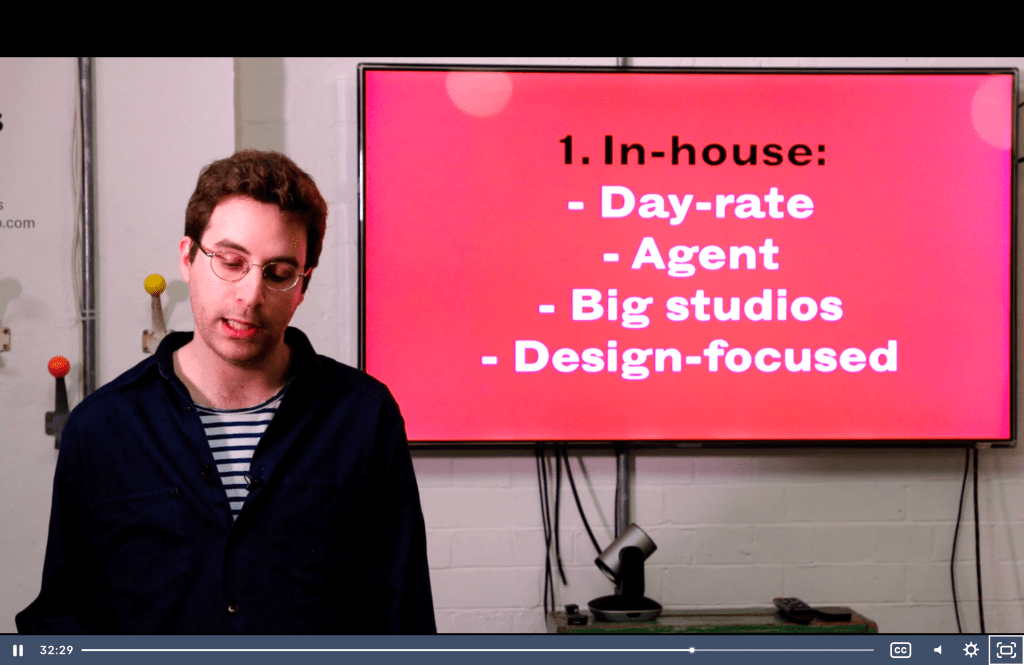
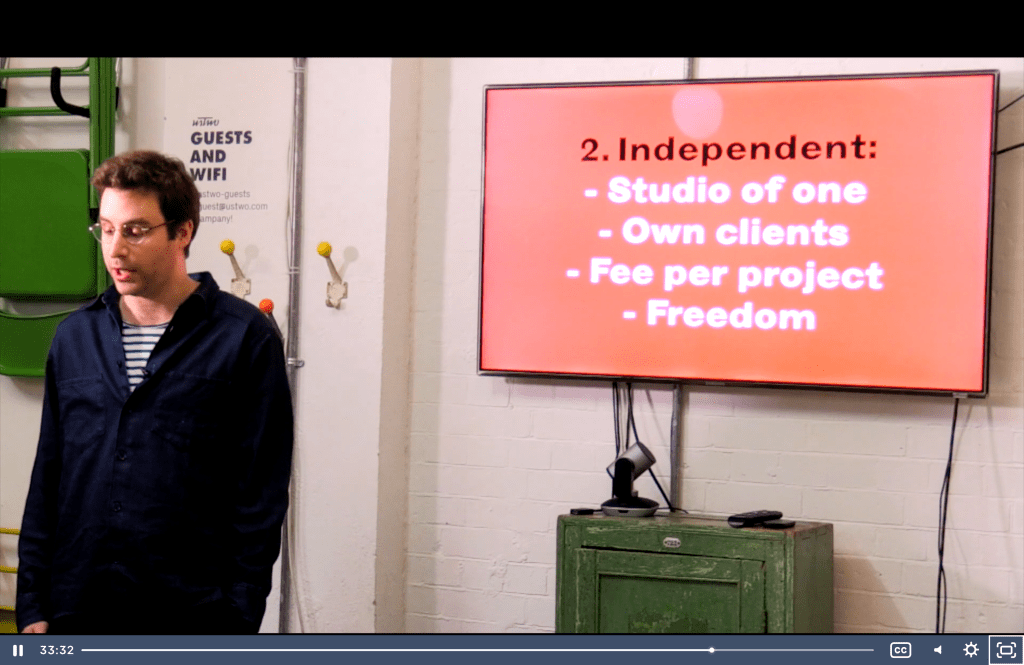
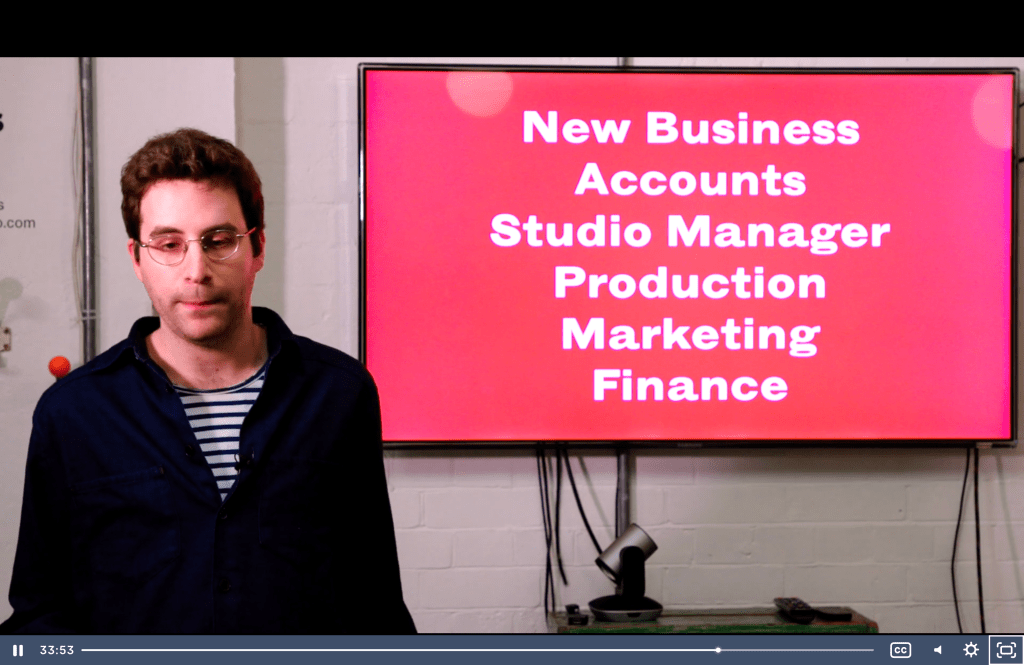
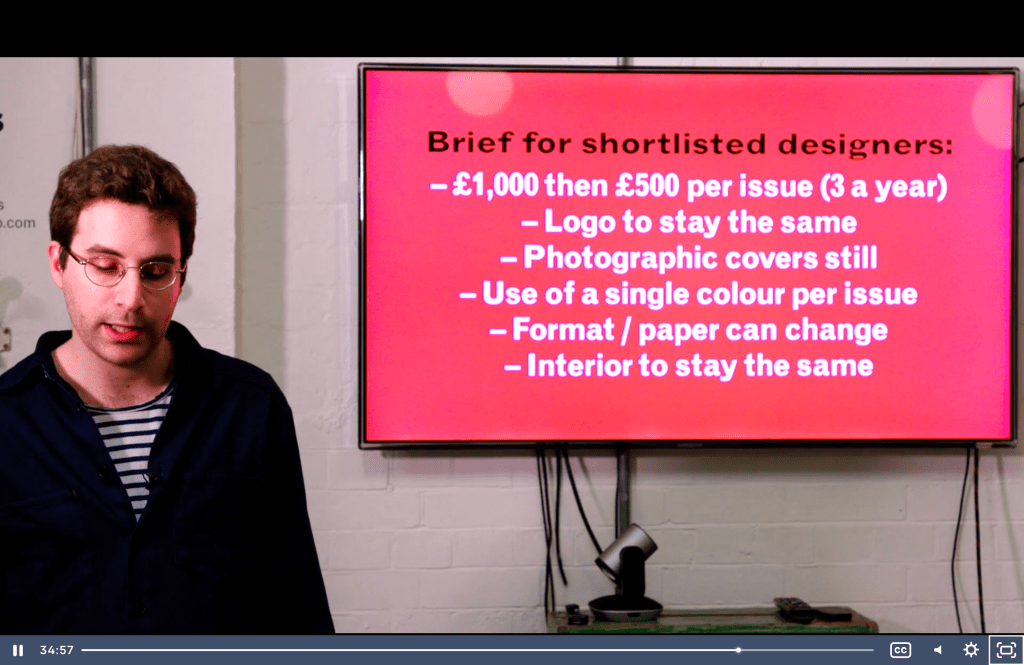
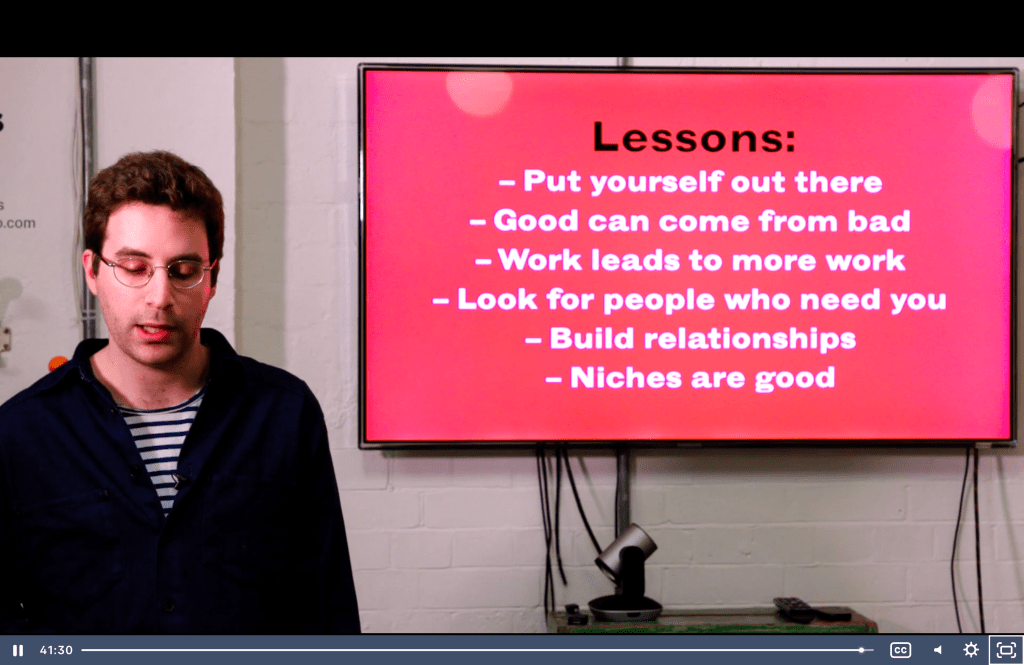
I especially like his advice to believe that good things will come after trying and working hard, to build relationships and look for people that need our services.
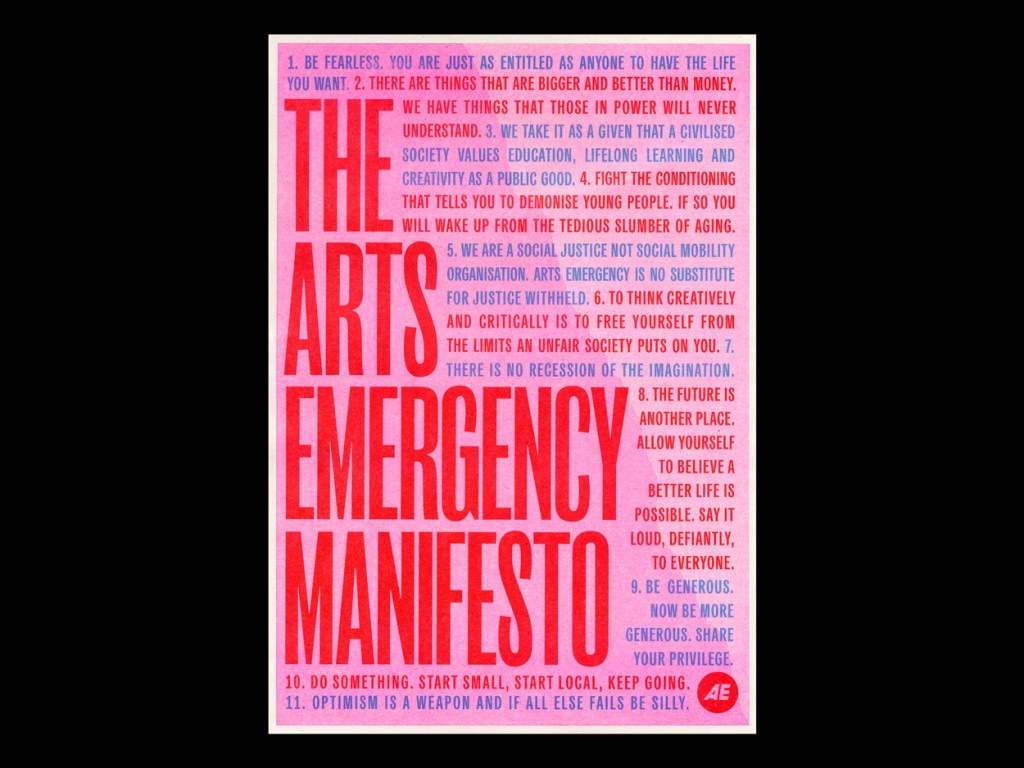
Panel Discussion
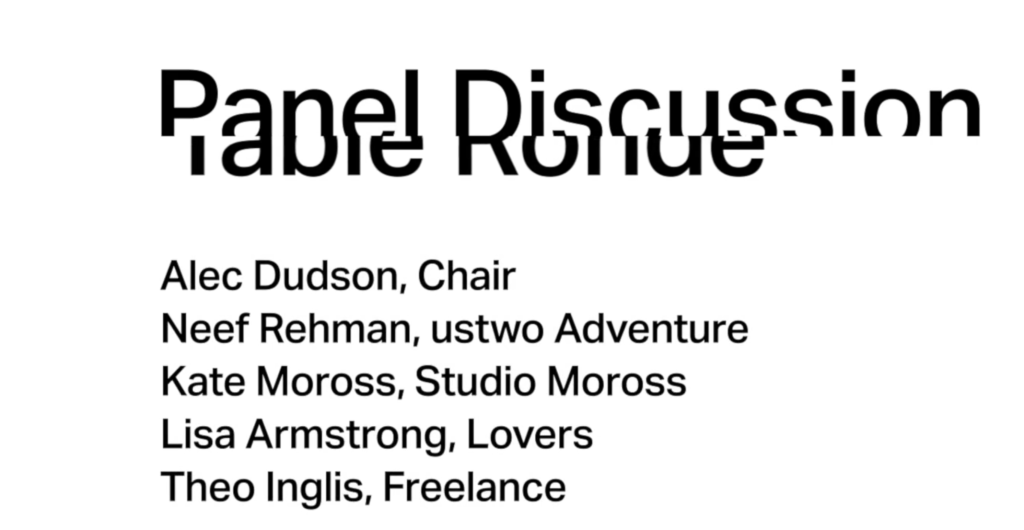
Very interesting and informative discussion.
Neef Richmen share that sometimes disadvantage with working with big clients is that changing even small bits of design, you have to go through multiple layers of approval, and multiple stakeholders before you do it.
Kate Morros share her worries that if she is not well or for some other reason absent, that will affect the functions of the studio because she is the one that has to overlook everything and approve everything. She also try not to take. too much work (just enough to keep the business and the employees financially stable). “If we’re really comfortable in a month, I won’t push harder to take on projects that might use up more resources. I’ll just say no to those jobs. But we have quite a significant amount of money, for us anyway, that we have to turnover to reach our budget every month and that affects our workflow. We always have some months that we know are quiet and some months that we know are busier.
I read a great quote recently that was, “Your business isn’t your family. A good business lets you go home to your family.” This slightly toxic idea that your business is your family, I think we definitely push back on that heavily. We are a collection of humans with mental health problems and challenges and lives and experiences and we are very open in talking about those and accommodating those things.
I think the main reason I started a business was because I didn’t want to work alone. I’ve always felt much more comfortable with a group of people and found myself to be more creative with a group of people, let alone all the creative things those people can bring to your business. “
I think that working with other people makes you more motivated and gives you the energy to to more work.
For Lisa Arsmtrong the biggest challenge is the amount of paperwork (they have many people working on different projects from many places in the world – it is complicated). They use the project manager tool called Scoro, She also said “I do get a bit conflicted that every night everyone does what they want. If they want to go home, they go home. If they want to stay and stick around and hang out, they do. We all get plenty of opportunities for people to do either, so I think that flexibility is really useful. But in terms of mental wellbeing as well, there’s this company called, Full Disclosure, we have invested in, that provide mental health coaches inside the workplace. We work with them quite a lot in our London studio and they’re always there on hand to deal with any issues that, privately, that any of our employees have. One thing that’s actually been really important is to have an independent third party come in and be really respectful, and help our employees take care of their mental health in a different way, that is removed from the day-to-day working, sort of people. That’s been really important from the mental health
perspective. “
What I learned from the discussion is that you can start with certain type of buisness but afterwords, you can change direction to something that is on demand and you find that you are able to do it. For example Kate said “I started mostly in just graphics and working in visual design for the first I’d say two or three years. Then there was a more of a demand as music became more digital, as YouTube became more of a platform for music. Then we moved into motion, music videos etc. Now screens and LED are affordable, people take them on tour, and now we’ve got loads of that to do. But I think the biggest changes for our business have been in TV. We hadn’t worked in TV before, in broadcast design, and it was mostly something done by big post houses and we realised we could undercut these big expensive post houses by quite a large amount of money and do the same work with four people, that they were maybe doing with four people but pretending they were doing it with 40 people, or charging like they were doing it with 40 people.”
Standards of Professional Practice
According to the AIGA, the graphic designer has to have integrity to the profession, the other designers, the clients and the society as whole.
We should on the client’s best interest but if there is something unethical about a project, we should refuse to take it.
If another designer has been working an a project before us, we should notified him and try not to create a conflict.
Professional designers should not exaggerate about their competence, experience, or professional capabilities.
If a project is done as a result of collaboration with others, the designer should not claim credit for it. Team work should be shown as such.
We should refuse to engage in discrimination on the basis of race, age, religion, sex, national origin, or disability. Always work with care about the communities and the environment.
Title: AIGA professional practices in graphic design pp. 7–14
Name of Author:
David C. Baker & Crawford, Tad & American Institute of Graphic Arts.
Name of Publisher: Allworth Press
How clients want to be treated
Basically, he is explaining that if we put more efforts and make the clients come back to us for more work, we will make profit and also avoid expenses to find new clients. So, good customer service is essential skill for designers.
“Keeping clients long-term will enable you to do more effective work for them. It will also contribute to increased profitability, as well as reduce the acquisition costs of new clients.”
We should always try to gather feedback from our clients – we learn from the mistakes and focus on things that need to be improve.
Communication Elements
“Create an orientation kit that includes contact information , sample
forms , places to store project updates , and typical procedures.
Provide the client with proactive updates (as in “unprompted “).
Preferably these will occur weekly , in writing , and will emerge from
management · software.
Watch for information in the news that would interest your client and
send an occasional fax or email to demonstrate that you are thinking on
his behalf.
Be sure that the client has ready access to someone who knows the status of his projects . If that person is not available , indicate when she will be and provide a backup contact if the client can’t wait.
Conduct organized, agenda driven meetings that indicate a sensitivity to
the client ‘s busy schedule .
Confirm the results of those meetings in writing. This will preserve organization and communicate that the details are being handled.
Manage deadlines and budgets. That doesn’t necessarily mean meeting them, but rather anticipating which ones will be met, and then arriving at a plan suitable to the client for those that will not be met.
If you use an auto attendant for your phone system, make sure that calling for the operator (pressing “zero”) always results in someone answering the phone . The caller may not be able to talk to her first choice, but she, she should always get a real person if she wants to.
Keep the client ‘s work confidential.”
Leadership Elements
“Know the client’s field.
Have an opinion. Express your point of view. Don’t just take orders.
On the other hand, be collaborative. Let the client win whenever he should.
Surprise clients by doing more than you promise.
Personal Elements·
Support client causes, even if only to a limited extent.
Ask the client how you are doing. Your performance is not as important as your interest in getting the client’s perspective.
Be human, but not too human. Be vulnerable with personal stories, dress comfortably, and use first names. But don’t share more than clients need to know, and don’t pursue client friendships.
Be likable. No client will tolerate an unusually difficult person unless there is no other choice.
Stay sober at any function where there is alcohol present. A client will quickly lose confidence when control is absent.
Don’t get involved in client politics.
Be passionate about the client brand, contributing enthusiastically for· great collaborative results.
Don’t neglect out of town clients, assuming that in person visits are not expected.
Pay your bills so that word of your financial difficulty doesn’t work its way back to the client. There are no good explanations in the client’s eyes.“
Title: AIGA professional practices in graphic design pp. 31–36
Name of Author:
Eva Doman Bruck & Crawford, Tad & American Institute of Graphic Arts.
Name of Publisher: Allworth Press
The process of setting fees
“THERE ARE THREE fundamental conditions to consider during the process of setting fees . One is the cost of staying in business (overhead), second is a best estimate of the nature and complexity of the proposed project ( variable costs), and third is knowing the intrinsic value of the final product (market conditions).
Included in the overhead category are rent, utilities , equipment leases , office supplies , business insurance, salaries, taxes an d benefits, accounting and legal services , and the cost of nonbillable time devoted to self-promotion and administrative chores . Don’t forget to include profit in this equation ; a healthy business should aim to generate about 20 percent of annual profit after all expenses have been paid.

Some design companies want to know how much time is spent on every aspect of an assignment, from briefing meetings to print/fabrication supervision. This information is useful in tracing the relative levels of job costs phase by phase and can also be used to help price similar assignments in the future.
All outside services need to be documented . Whether it ‘ s for retouching, illustration and photography, model making, outputting, or independent contractors and freelance personnel, there has to be a written record of what is being requested , by when , at what price.
The difference between a good estimate and a bad estimate is the difference between profit and loses. The key to an accurate estimate is a thorough understanding of the project specifications as well as the production process.
Negotiation is an ancient human activity (hobby to some people) and the nature of it is such that one always expects to get a little more for a little less.
Title: AIGA professional practices in graphic design pp. 14–153
Name of Author:
Leonard D. DeBoff & Crawford, Tad & American Institute of Graphic Arts.
Name of Publisher: Allworth Press
Legal structure for the design firm
Sole proprietorship
“The simplest form of business is a sole proprietorship. This is the name given to a business that is owned and controlled by a single individual. Little need be done to create a sole proprietorship. All you have to do is obtain a business license if it is required in your jurisdiction and, if you are using a name for your business other than your own, register that as an assumed business name or fictitious name. This simple business form has a major downside though. Sole proprietors have full personal liability for all debts of the business. This means that your house, car; personal bank accounts, and the like will be exposed to the risks of your business.“
If we hire employee under the sole proprietorship, and the employee does something wrong, we as a business owners will be liable for the actions of the employee. I think this is one of the biggest disadvantage of this business model.
Partnerships
“When two or more individuals join together for purposes of engaging in a business, then the relationship between them is known as a partnership. No formal acts are necessary to form a partnership, although it is always a good idea to put
all of the parties’ agreements regarding the business into writing so misunderstandings can be avoided.”
Limited partnership
“A type of partnership that can afford so file partners’ limited liability is known as a limited partnership”
Corporation
“One of the most popular business forms is the corporation. It is a separate legal entity apart from its owner(s), even if it is owned by one individual. The corporation is responsible for all of its business activities and the owner generally is not.”
Title: AIGA professional practices in graphic design pp. 291–293
Name of Author:
Allan Haley & Crawford, Tad & American Institute of Graphic Arts.
Name of Publisher: Allworth Press
Use of fonts
“FONTS ARE CREATIVE, intellectual property, similar to designers’ creative work or a proprietary business product.
There are four good rules that guide ethical practice in font licensing:
If you are using a font, whether it’s on your computer or that of someone else, make sure you have a license to use the font.
If you want to use a font that is not installed on your computer, you must ensure that you or your employer has a license to install the font on your computer, or else acquire a license to use it.
If you have any questions about your font license, contact the foundry or supplier of the font. (If you do not know the foundry or supplier, almost any foundry or supplier can help you identify the source.)”
This site has information about all the creative agency in England. Has a information about how many employees they have and what is the focus of the companies.
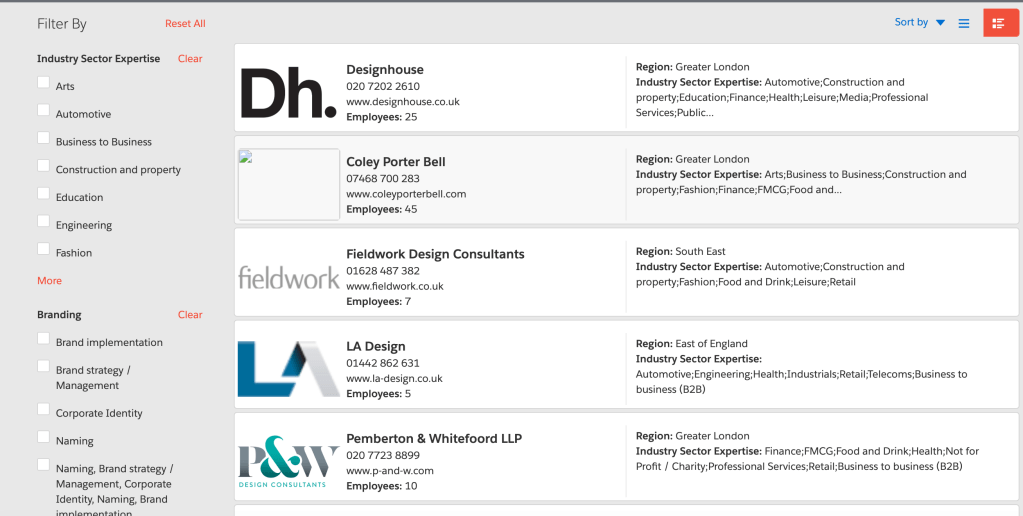
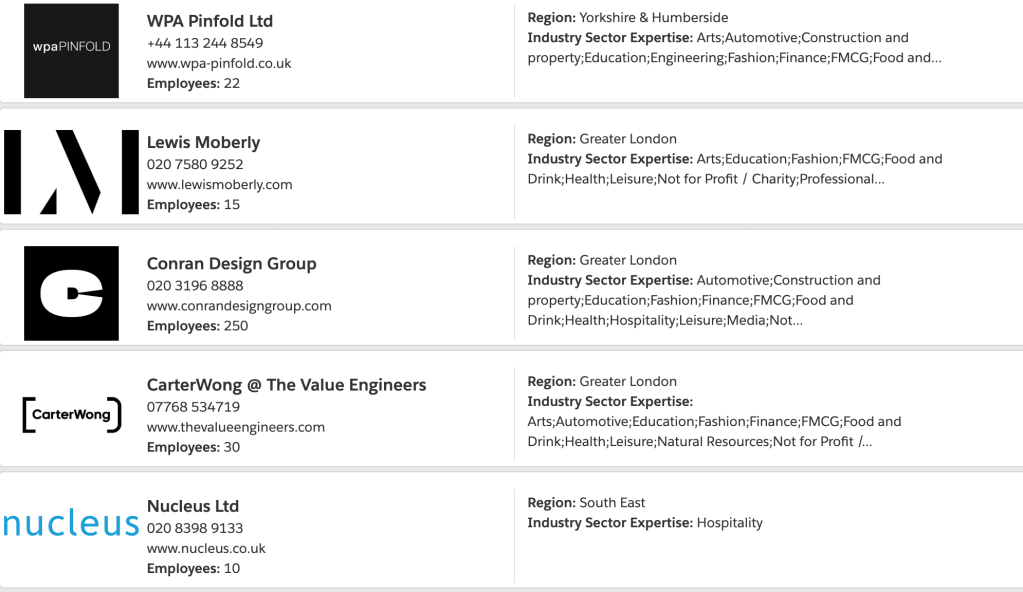
https://fo.am/activities/ibex/
Week 2
Assessing the core operational aspects of a design studio, organization or freelance business. Mapping out a hypothetical resourcing model for a new business which utilizes your unique design expertise.
Project 1
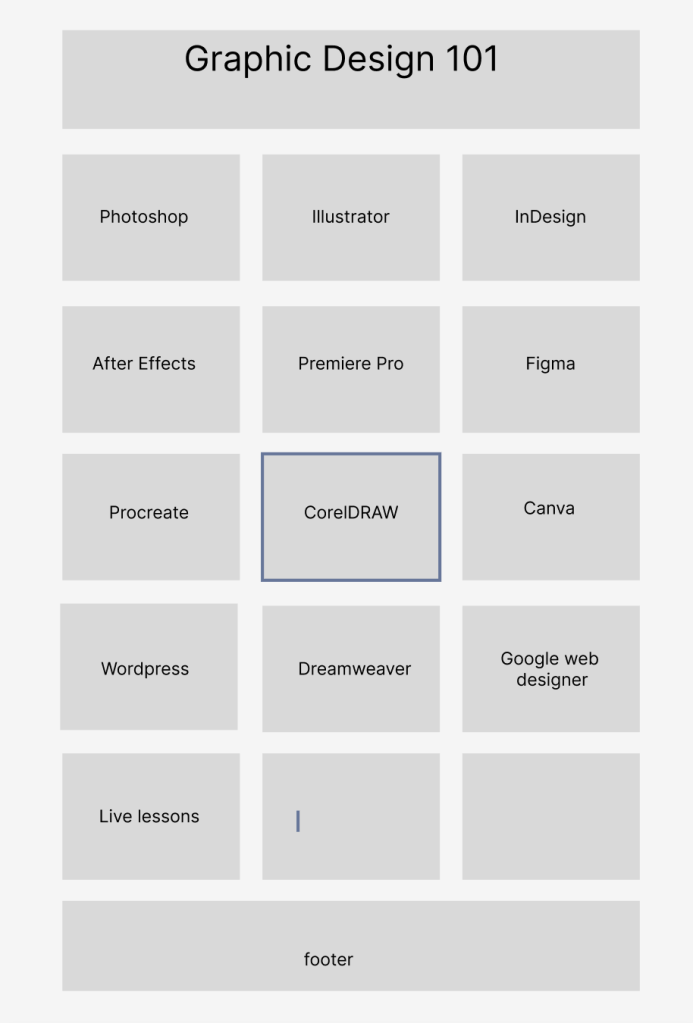
I think I want to explore the idea of creating a website for learning the basic tools of the Graphic Design software.
The name should be “Graphic Design 101”. I have been to couple schools for graphic design courses and we always jump to some kind of projects (sometimes having briefly description of some of the main futures of the Adobe software – mainly Photoshop, Illustrator and InDesign) but never going deeper to the tools of each one of them. I know there are many sites out there, where you can learn by yourself but most of them don’t go to details and I think this is important. I think if we know the abilities of the tools better, we will be creating much better designs.
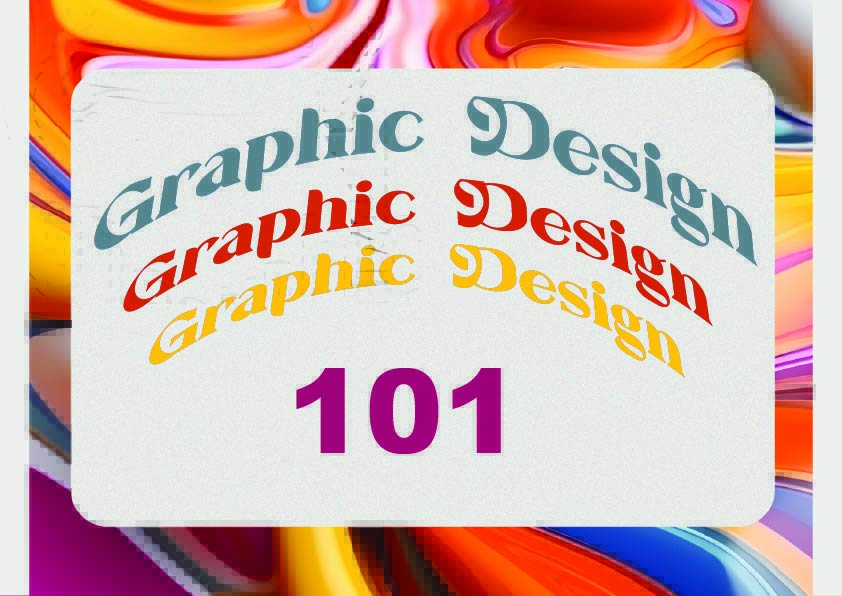
this is idea for the first page
I think the website can be subscription based – but maybe just 2$ a month (I know is very little but is going to be for beginners -so, I don’t think most of them can afford much).
This is a link to the Figma framework file (how the landing page will look like)

 Vicky Kafkaki - Graphic Design MA Falmouth University