Symbolism and Semiotics – The Theory and Symbolism Behind a Message –
Martin Hosken
” With the rise of the global communication platforms and commercial markets, the place of graphic advertising as a medium by which messages that promote product, service or idea has become increasingly competitive, complex and sophisticated.
This is our second problem: images carry meaning that is dependent on context and this meaning can change.
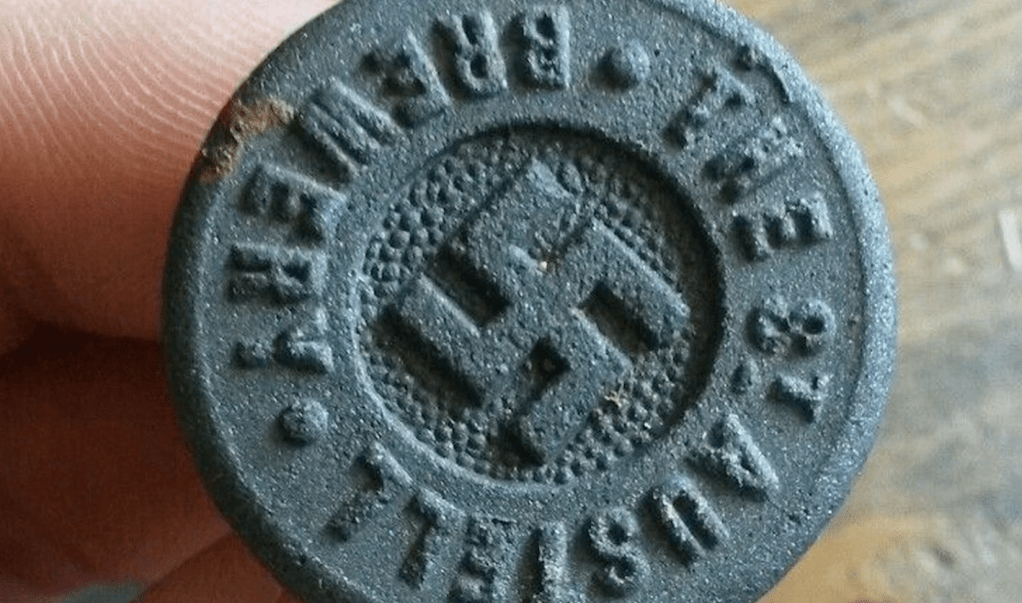
Semiotics is the study of signs and symbols, their use and interpretation. Founded by the Swiss linguist Ferdinand de Saussure, who in 1918 published his book, Semiotics – A Course in General Linguistics. Semiotics has become an established academic staple that can be used to universally map the communication of meaning through different mediums.
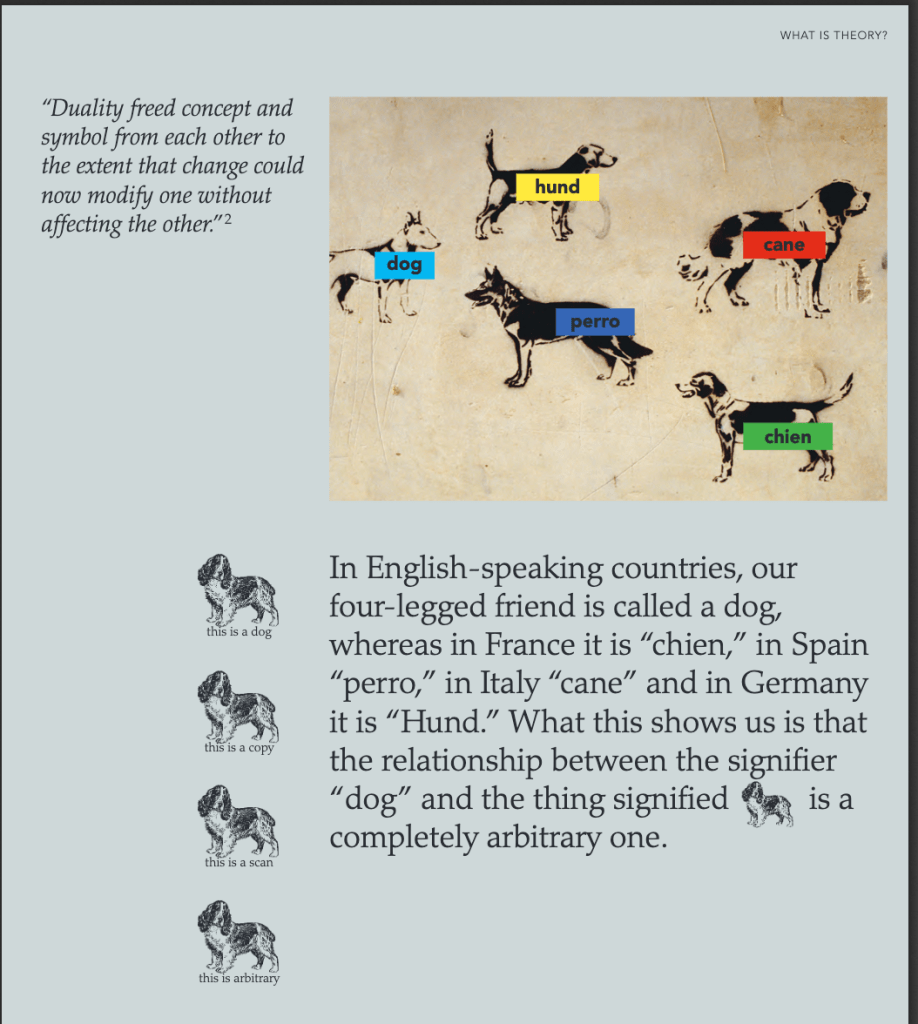
Signs can be made up of language, pictures, body language, artefacts, objects. In simple terms, a sign can be anything that conveys a meaning or a message. But the way that the sign works is through the interaction of the two other elements – the signifier – the thing itself, and the signified – the concept conveyed.
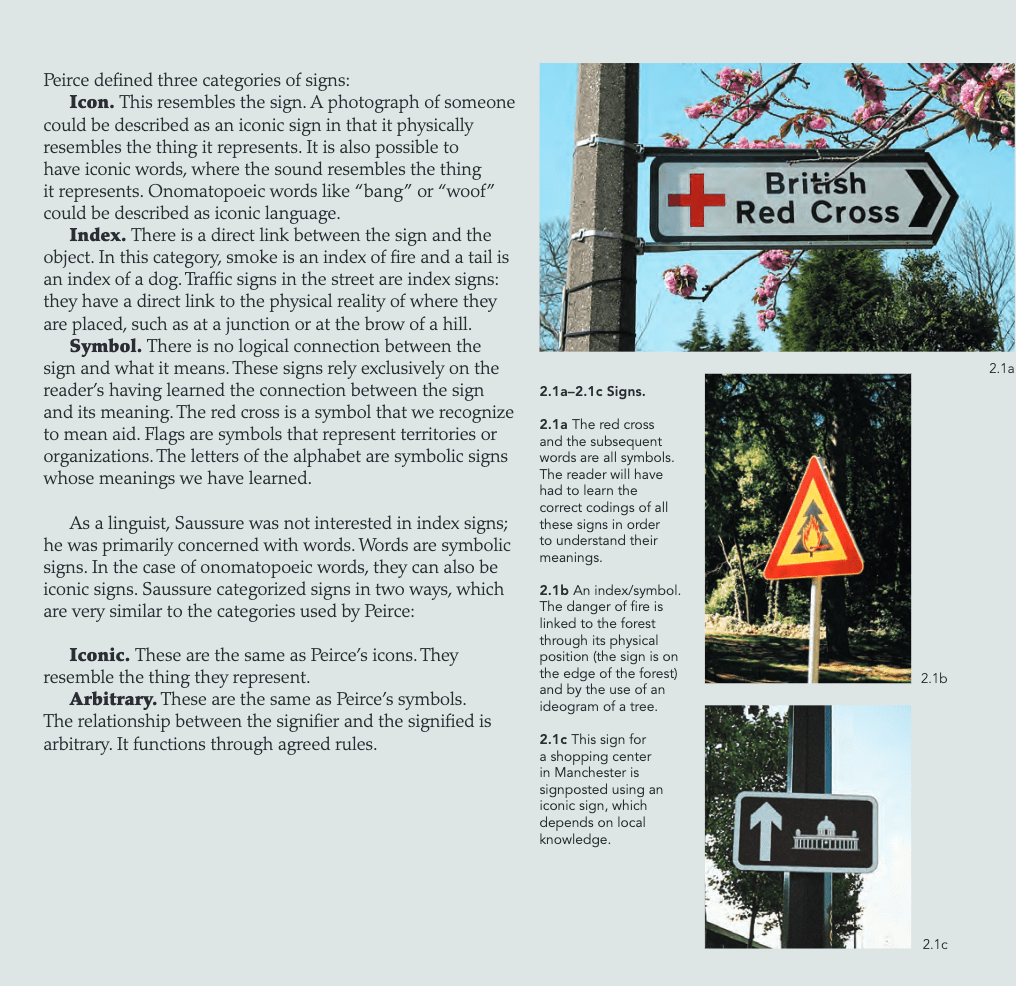
Furthermore, signs can be ordered into three further categories: icon, index and symbol.
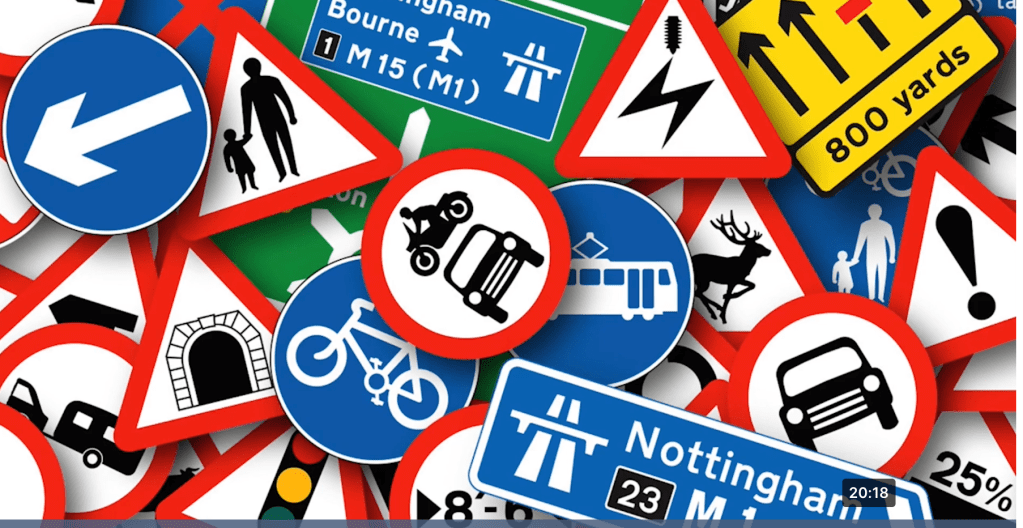
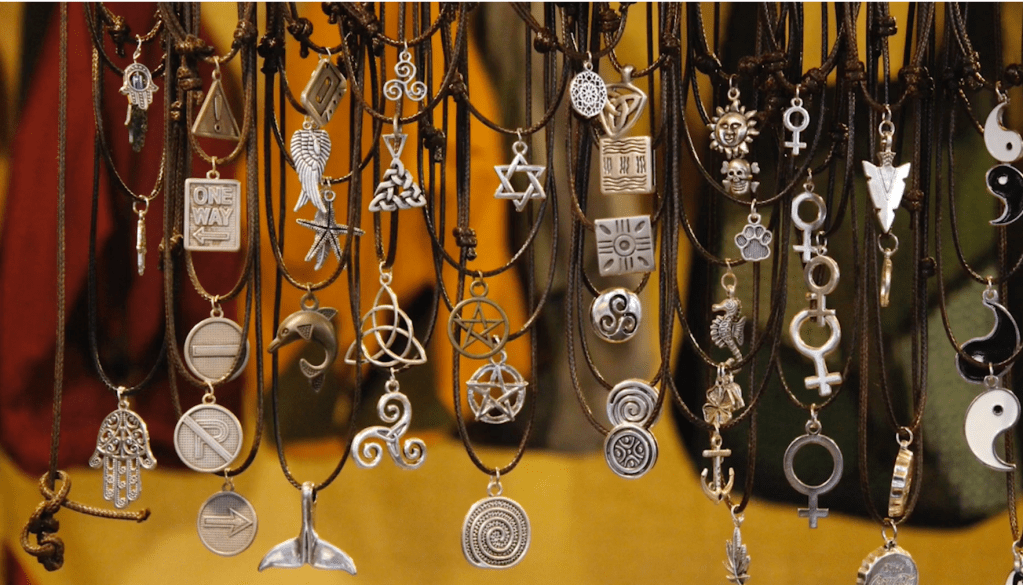
Case Study by Tom Finn, Regular Practice
The Olympics is really the visual thing that’s displayed is not so much about the Olympics itself, but more about the country.
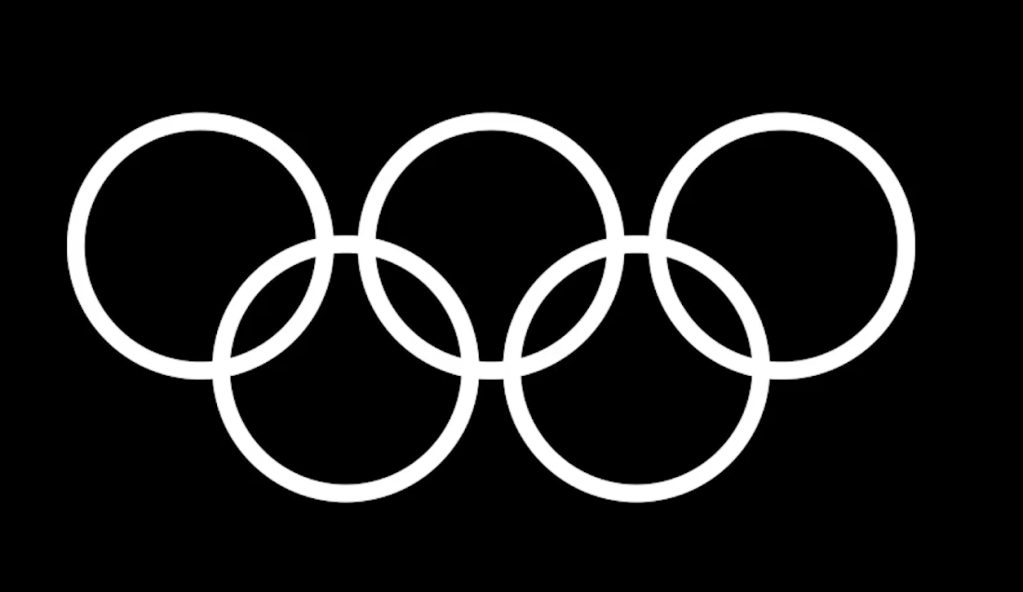
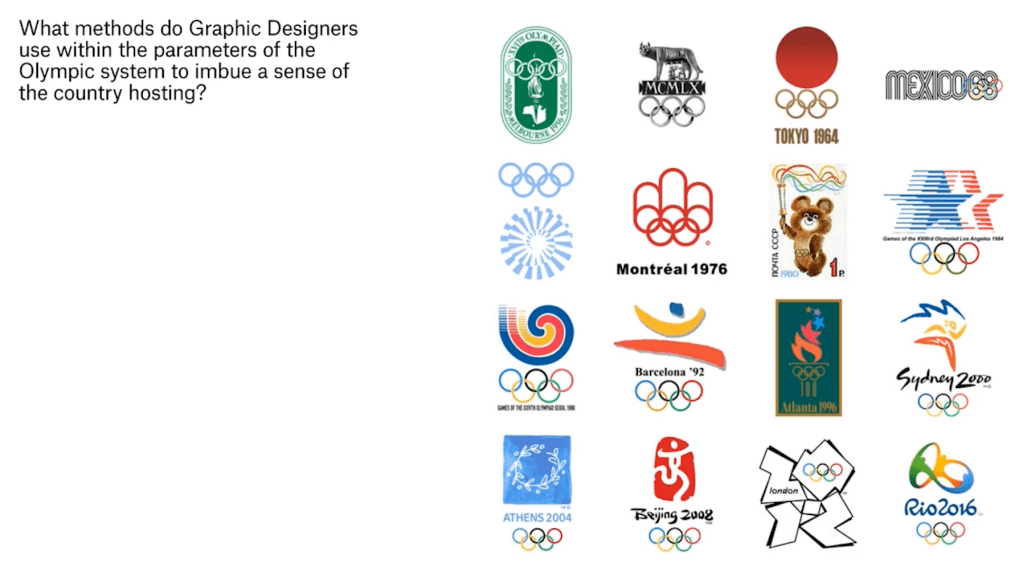
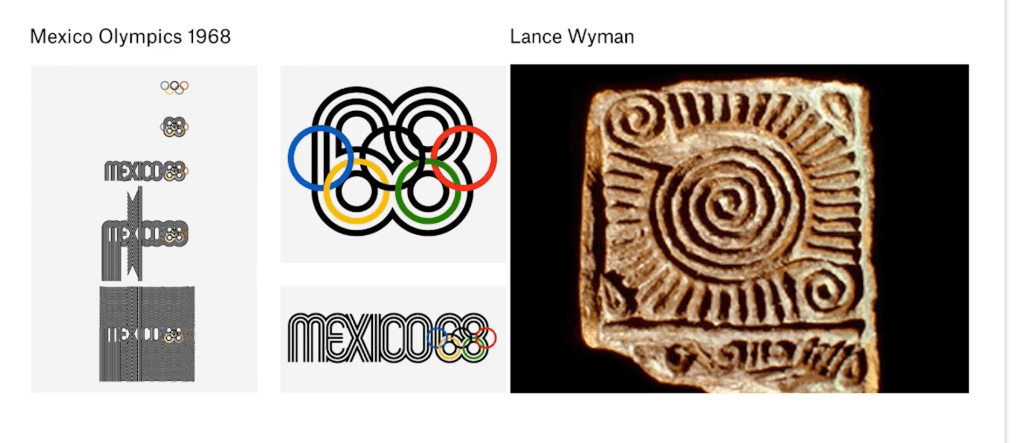
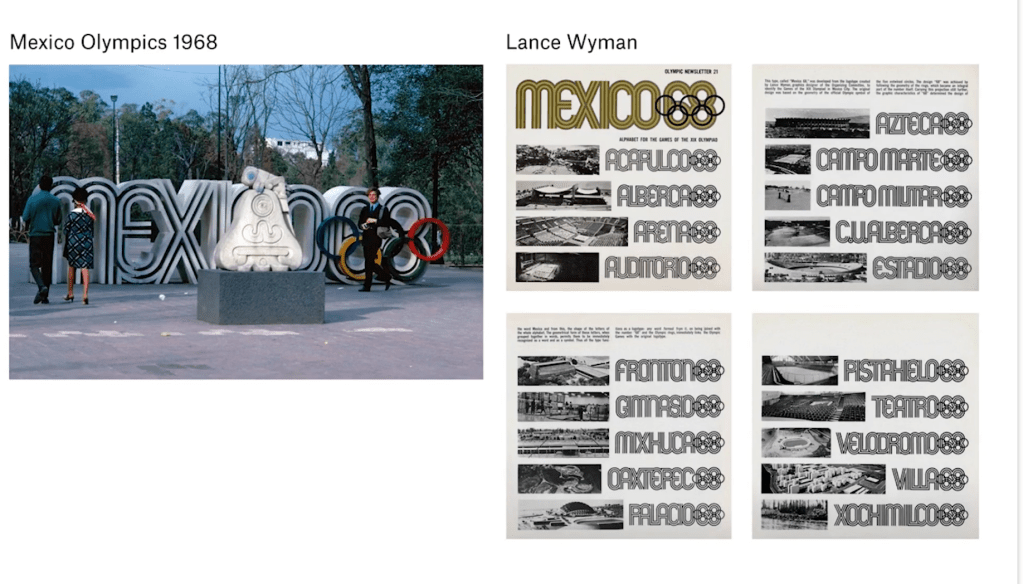
The first example was designed by Lance Wyman in 1968 and this was the Mexico Olympics. Arguably, this was one of the first examples where people really started to lift their heads and appreciate the graphic design that goes into the identities, the Olympic identities.
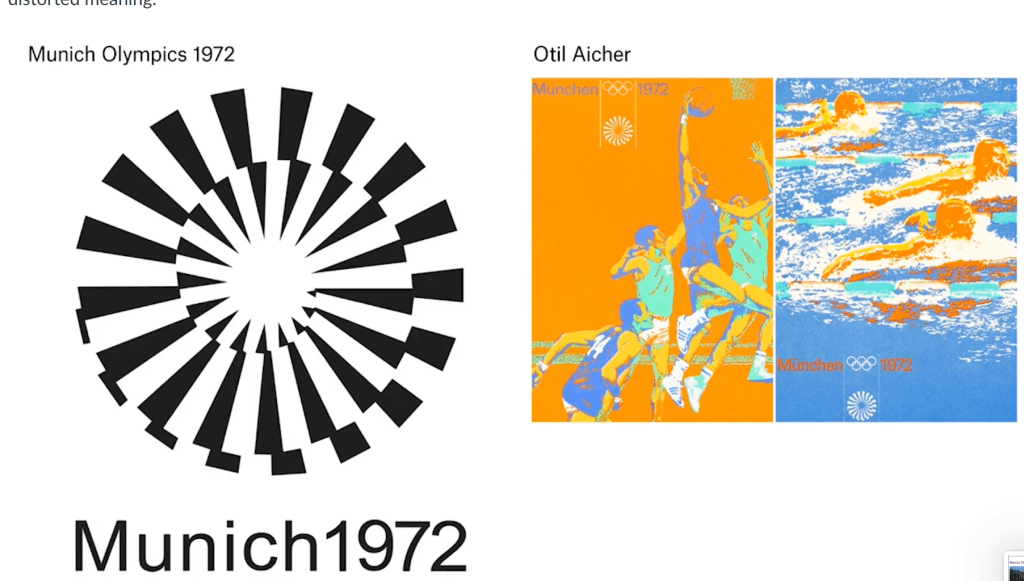
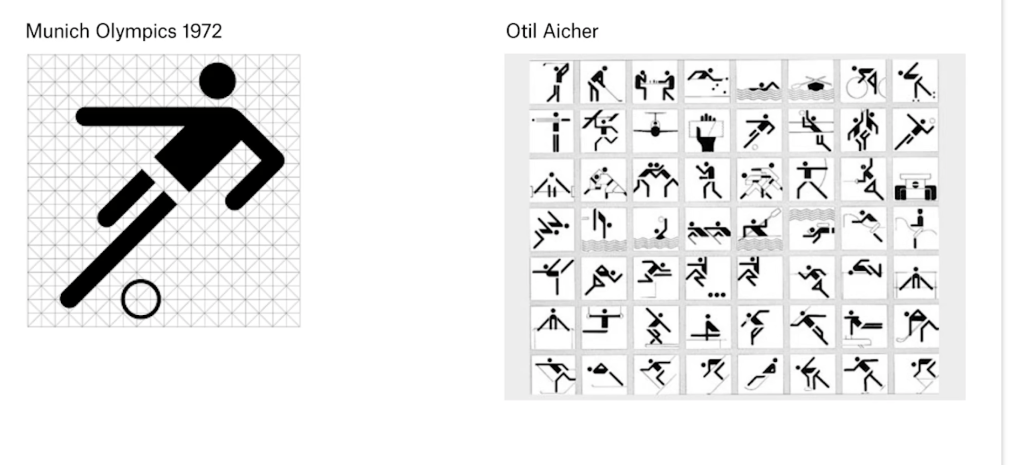
Another interesting example of this is the Munich Olympics, designed by Otil Aicher. This pushed this idea of the system being pushed even further, where Otil Aicher’s very modernist aesthetics are what informed the entire identity.
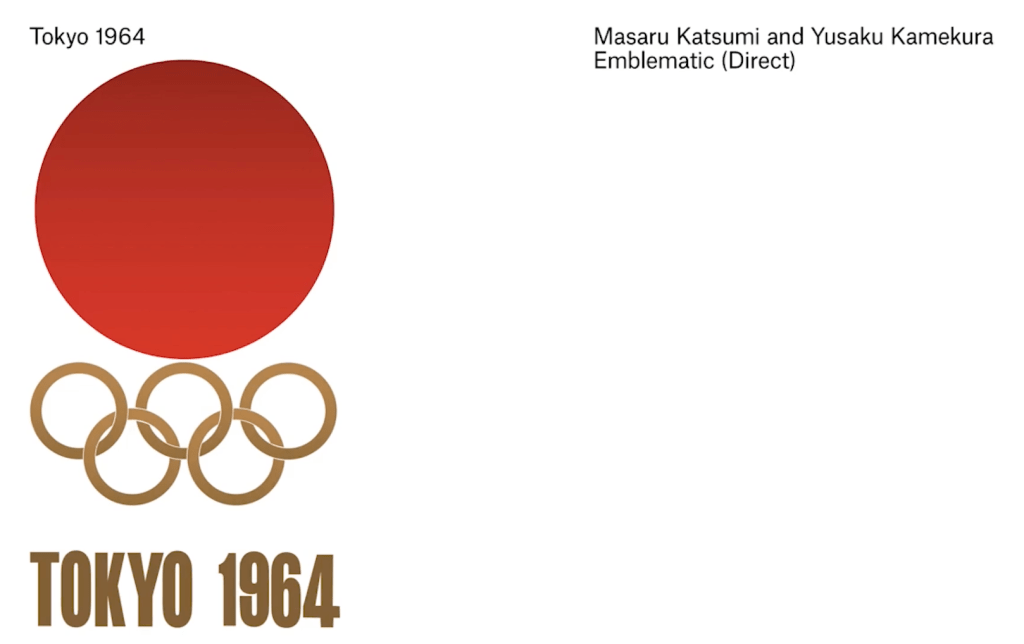
The next examples to look at are this design by Masaru Katsumi and Yusaku Kamekura for Tokyo 1964.
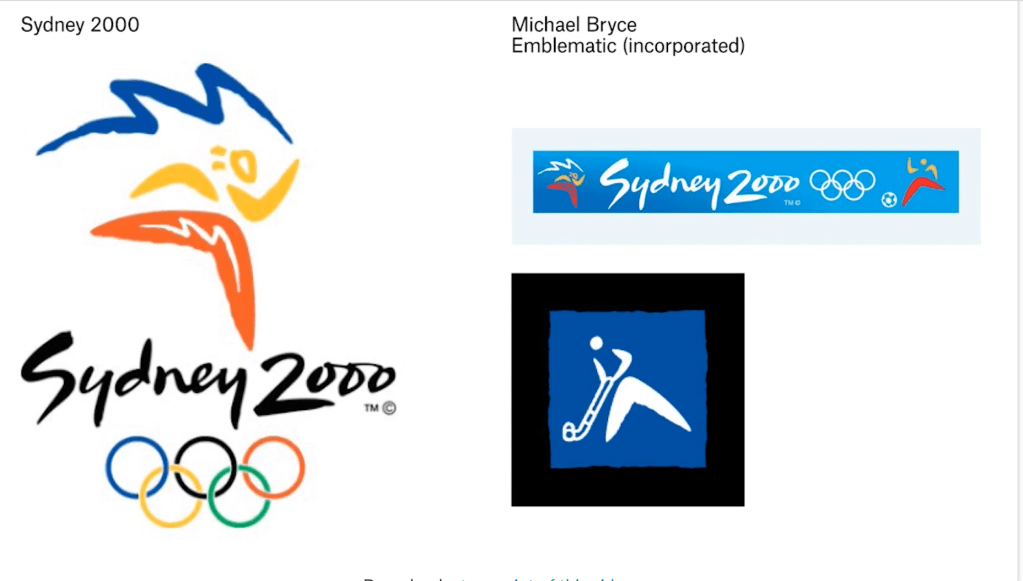
This is by Michael Bryce for the Sydney Olympics where this emblematic approach is much more grabbing lots of things. You can see a boomerang here, a person made out of a boomerang, and the Sydney Opera House; the person is drawing the Sydney Opera House. There’s this illustrative feeling that’s used to suggest things about Sydney. Then the typography, this script-based typography, it still feels incorporated, it still feels like one thing but it’s very emblematic, it’s very suggestive of what the country is supposed to be.
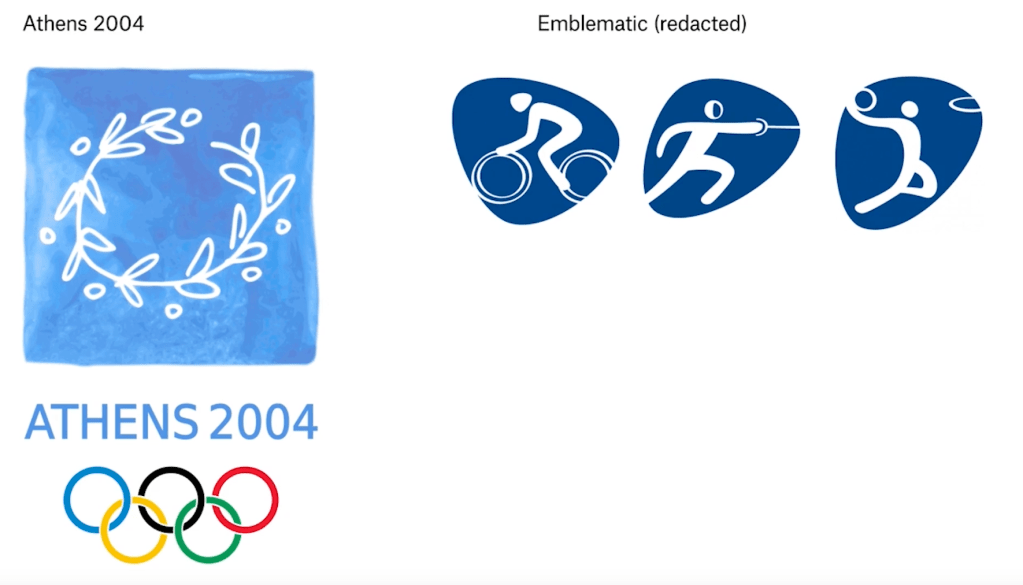
I think that this next example of the Athens Olympics in 2004, this idea of it being emblematic where you see the wreath, is there.
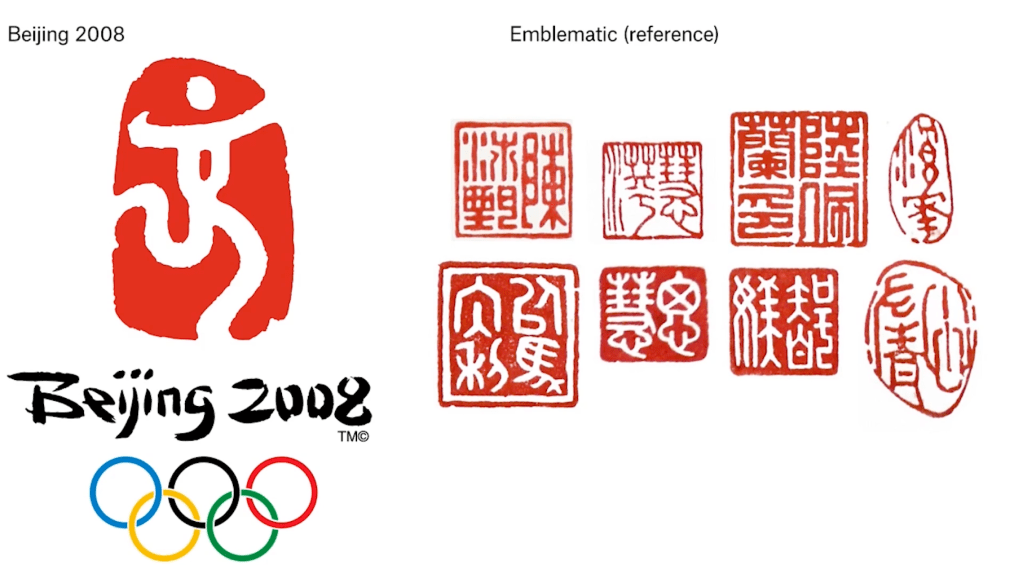
Beijing Olympics – it’s referring to these stamps that are used in Chinese postage but also marks on the outside of things.
London Olympics is designed by Wolff Olins. This one is an interesting approach because it doesn’t so directly look at anything that links with London, it’s not like Big Ben, but the abstract nature of it gives it the identity.
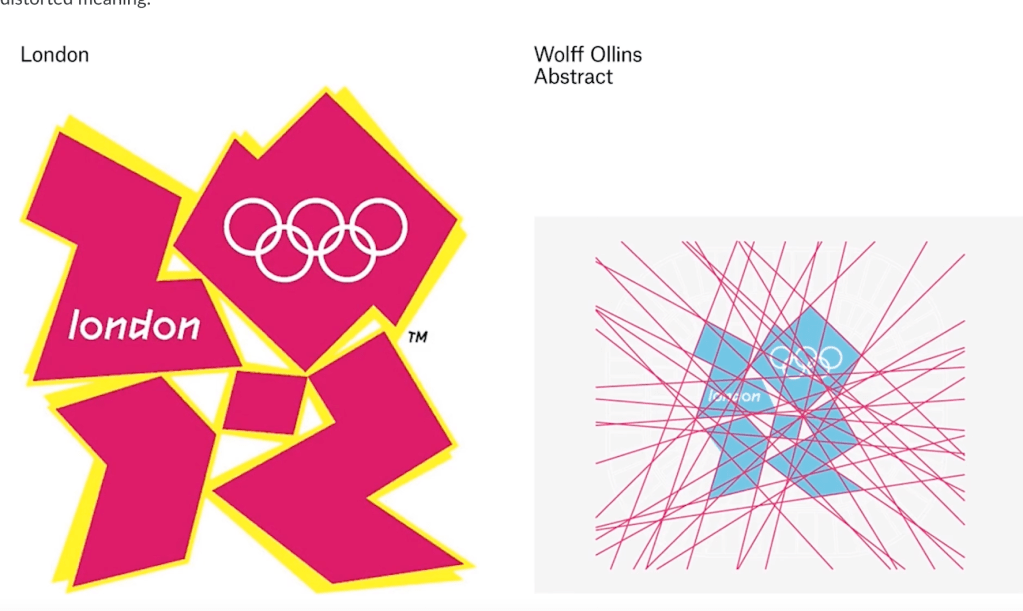
This caused enormous controversy because obviously the Olympic logos are so much in the limelight that people are going to criticise it, and people are expecting it to have Big Ben and a full English breakfast or something, there’s very much of London.
Then finally, just as a point of comparison, when we’re particularly in this week talking about semiotics and letting that influence, if we look at the early examples of the Olympics, this one was actually the first one in London in 1908, the visuals that had to sit with it had to be showing what the Olympics was. It had to say, look here’s an arena, here’s all the countries that are participating, here’s someone jumping over a high jump, because people didn’t have an understanding, a basis to understand, what the Olympics was. So now that we understand over a long period what the Olympics is, it allows the design to not be so literal because we have a semiotic basis that we can build from.
This was just an example to say the variables remain the same. It’s a sporting event, that doesn’t change, but the thing that shifts is the global context, the place that the event is situated.
Breaking News 2.0 Installation at the London Design festival
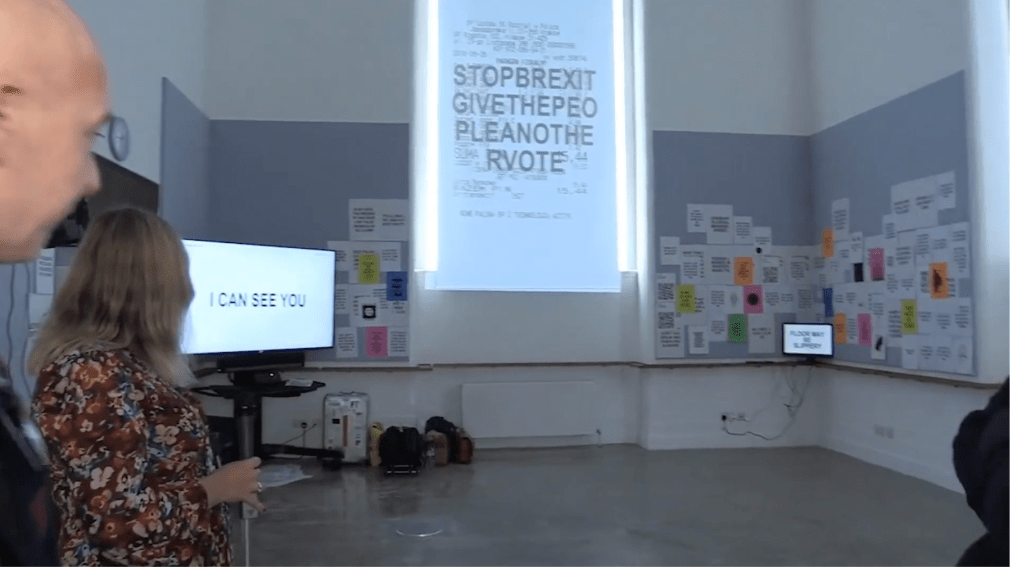
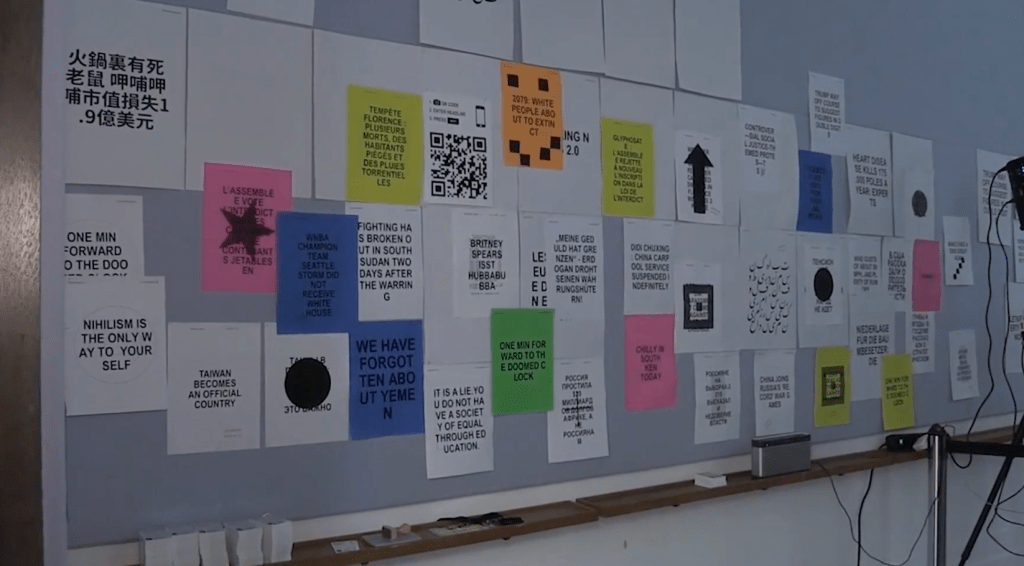
Patrick Thomas said “we’re interacting with breaking global headlines that we’re pulling in off the internet via RSS feeds. We’re also asking for locals, visitors to the museum can also join in, they can type in headlines, invent things, nonsensical, serious whatever they want to get off their chest.
After Manchester I take it to Serbia, to Novi Sad, which is the second city in Serbia. I then take it to Barcelona. Berlin, where I’m based, and my ultimate ‘dream’ I suppose with the project, is to take it to the States. We’re talking with people in New York. “
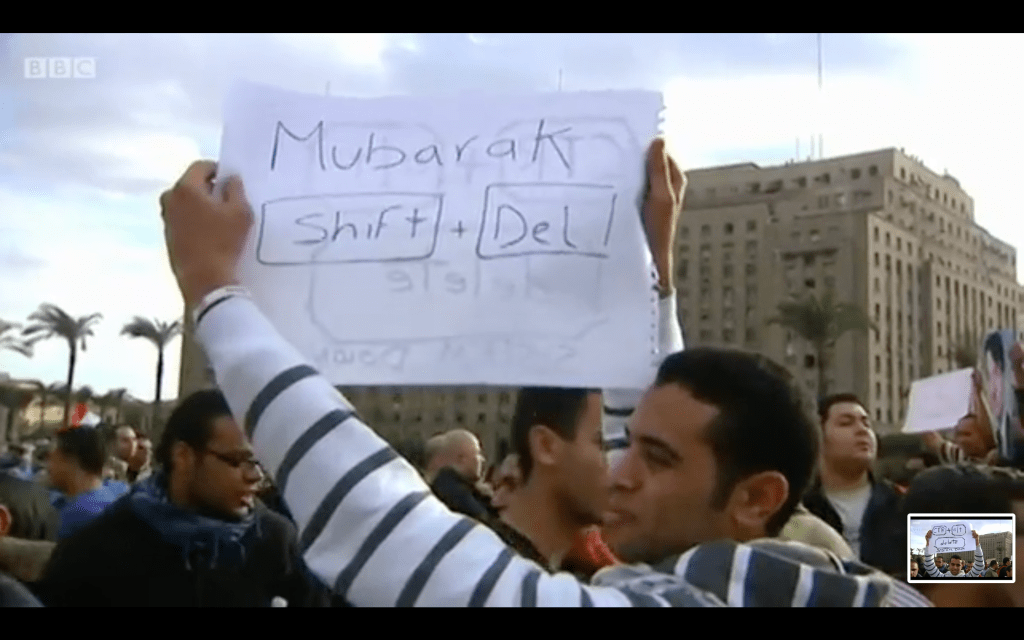
Adam Bhala said that “There were a group of people in Russia (Putin and his friends) that saw the the lock of believe in politicians and dark uncertainty about the future can work for their advantage. What they have done is to turn the politics to a strange theater, where nobody knew what was true and what was fake any longer. They use the media to manipulate and control. Reality was something that could be manipulated and shapes to anything you want it to be. Is a strategy of power to keep any opposition confused.”






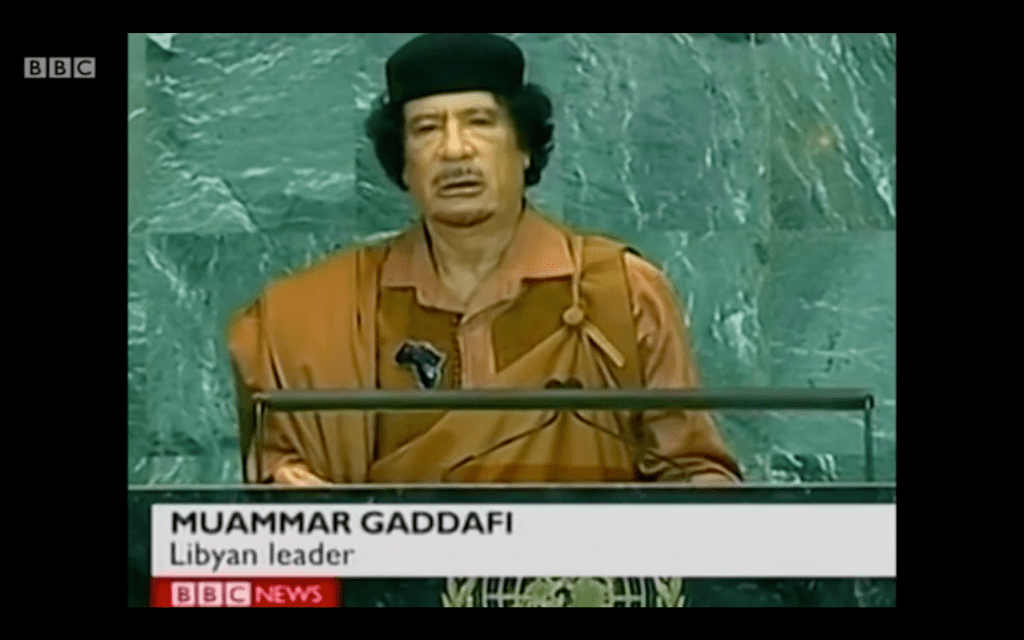
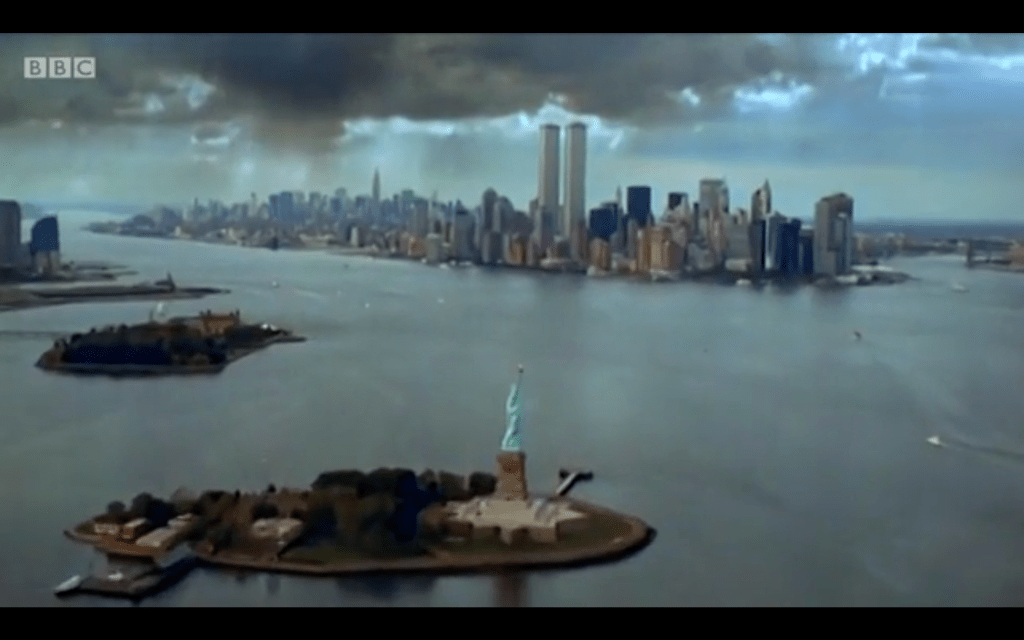
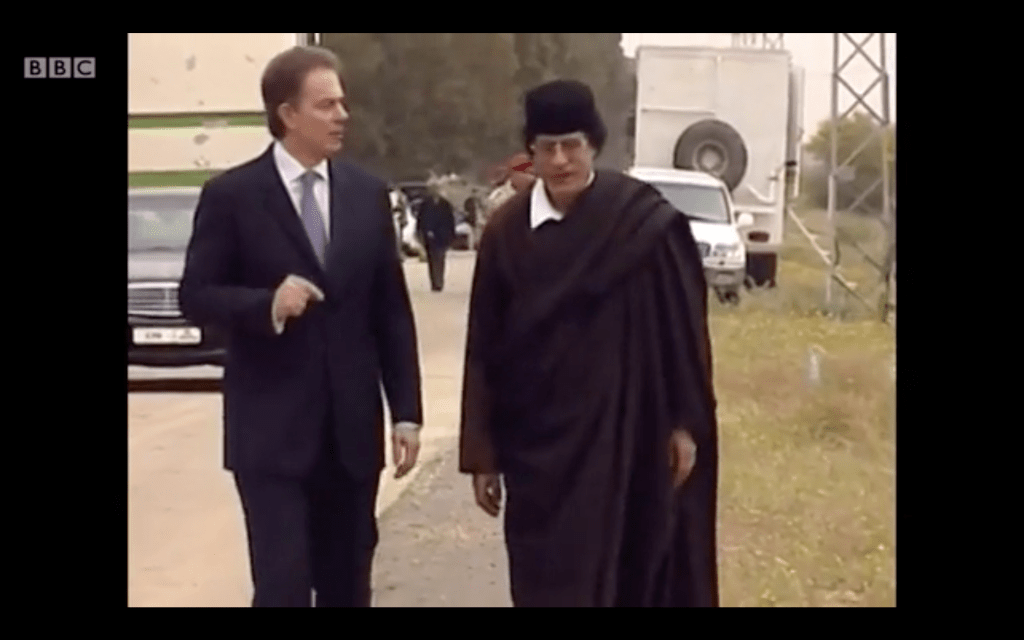
I wanted to research some more about the relationships between Gaddafi and USA
“After Muammar Gaddafi‘s 1969 coup, U.S.-Libyan relations became increasingly strained when Gaddafi removed the American oil companies by nationalizing the oil industry.[7] In 1972, the United States recalled its ambassador. Export controls on military and civil aircraft were imposed during the 1970s, and U.S. embassy staff members were withdrawn from Tripoli after a mob attacked and set fire to the embassy in December 1979. The U.S. Government designated Libya a “state sponsor of terrorism” on December 29, 1979. Throughout the 1970s Gaddafi was a vocal supporter of the Palestinians and anti-Israeli Arab governments and he supported the Arab states during the Yom Kippur War and the Arab Oil Embargo.
On August 19, 1981, the Gulf of Sidra incident occurred. Two Libyan Sukhoi Su-22 jets fired on U.S. aircraft participating in a routine naval exercise over international waters of the Mediterranean claimed by Libya. The U.S. planes returned fire and shot down the attacking Libyan aircraft. On December 11, 1981, the U.S. State Department invalidated U.S. passports for travel to Libya and, for purposes of safety, advised all U.S. citizens in Libya to leave. In March 1982, the U.S. Government prohibited imports of Libyan crude oil into the United States and expanded the controls on U.S.-origin goods intended for export to Libya. Licenses were required for all transactions, except food and medicine. In March 1984, U.S. export controls were expanded to prohibit future exports to the Ras Lanuf petrochemical complex. In April 1985, all Export-Import Bank financing was prohibited………………
After its public announcement of December, 2003, the Gaddafi government cooperated with the U.S., the U.K., the International Atomic Energy Agency, and the Organization for the Prohibition of Chemical Weapons toward these objectives. Libya also signed the IAEA Additional Protocol and has become a State Party to the Chemical Weapons Convention.
Libyan National Security Adviser Mutassim Gaddafi with Hillary Clinton in 2009
In recognition of these actions, the U.S. began the process of normalizing relations with Libya. The U.S. terminated the applicability of the Iran and Libya Sanctions Act to Libya and the President signed an Executive Order on September 20, 2004 terminating the national emergency with respect to Libya and ending IEEPA-based economic sanctions. This action had the effect of unblocking assets blocked under the Executive Order sanctions. Restrictions on cargo aviation and third-party code-sharing have been lifted, as have restrictions on passenger aviation. Certain export controls remain in place.”
https://en.wikipedia.org/wiki/Libya%E2%80%93United_States_relations
Visible Signs: An Introduction to Semiotics in the Visual Arts
by David Crow
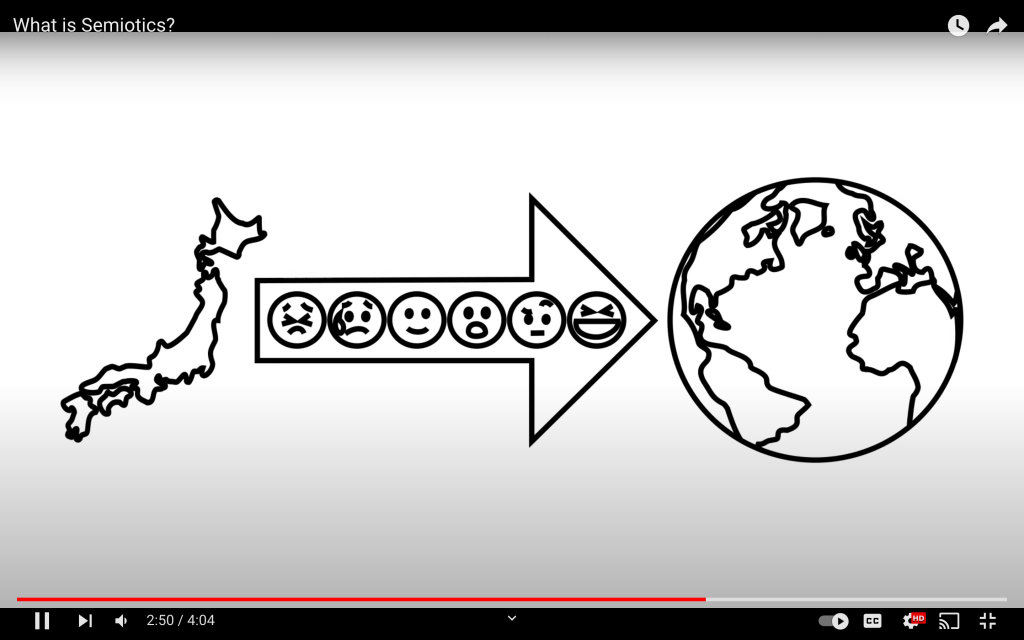
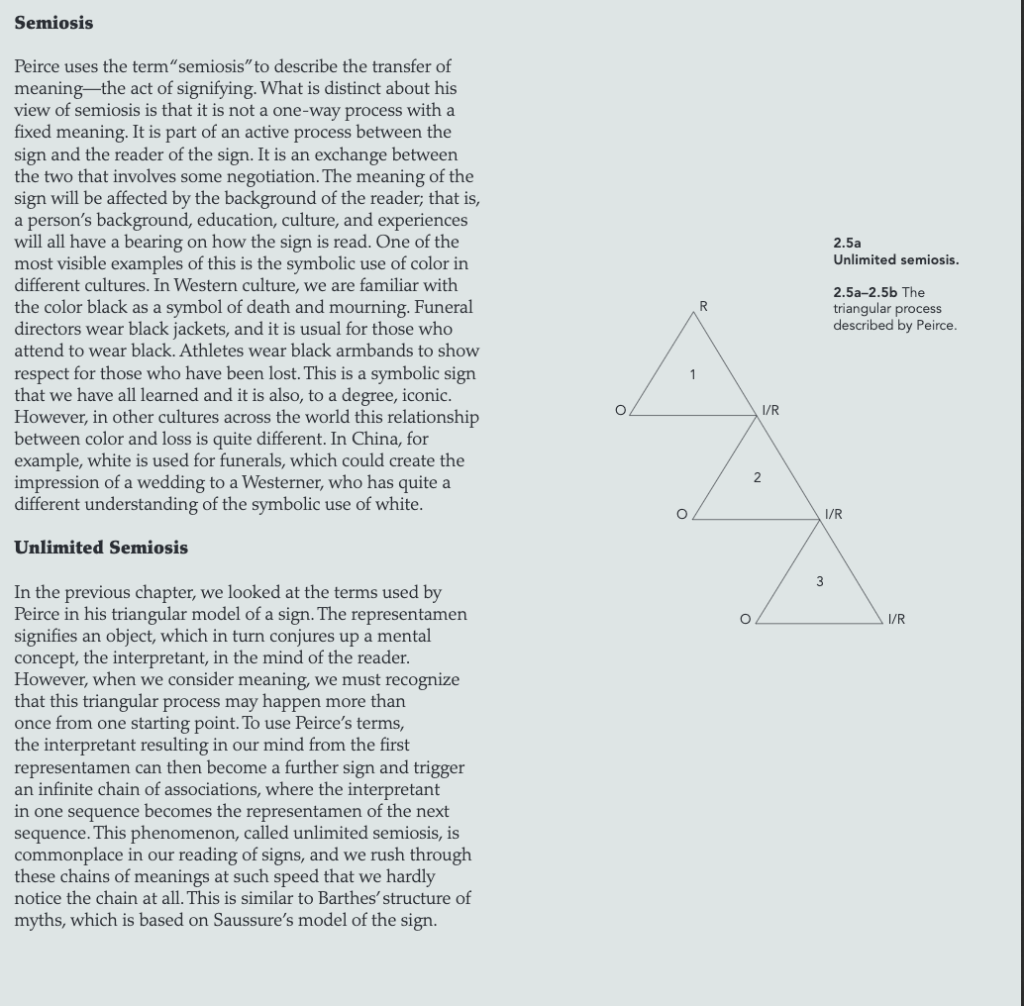
Peirce uses the term “semiosis” to describe the transfer of meaning—the act of signifying. What is distinct about his view of semiosis is that it is not a one-way process with a fixed meaning. It is part of an active process between the sign and the reader of the sign. It is an exchange between the two that involves some negotiation. The meaning of the sign will be affected by the background of the reader; that is, a person’s background, education, culture, and experiences will all have a bearing on how the sign is read. One of the most visible examples of this is the symbolic use of color in different cultures. In Western culture, we are familiar with the color black as a symbol of death and mourning. Funeral directors wear black jackets, and it is usual for those who attend to wear black. Athletes wear black armbands to show respect for those who have been lost. This is a symbolic sign that we have all learned and it is also, to a degree, iconic. However, in other cultures across the world this relationship between color and loss is quite different. In China, for example, white is used for funerals, which could create the impression of a wedding to a Westerner, who has quite a different understanding of the symbolic use of white.
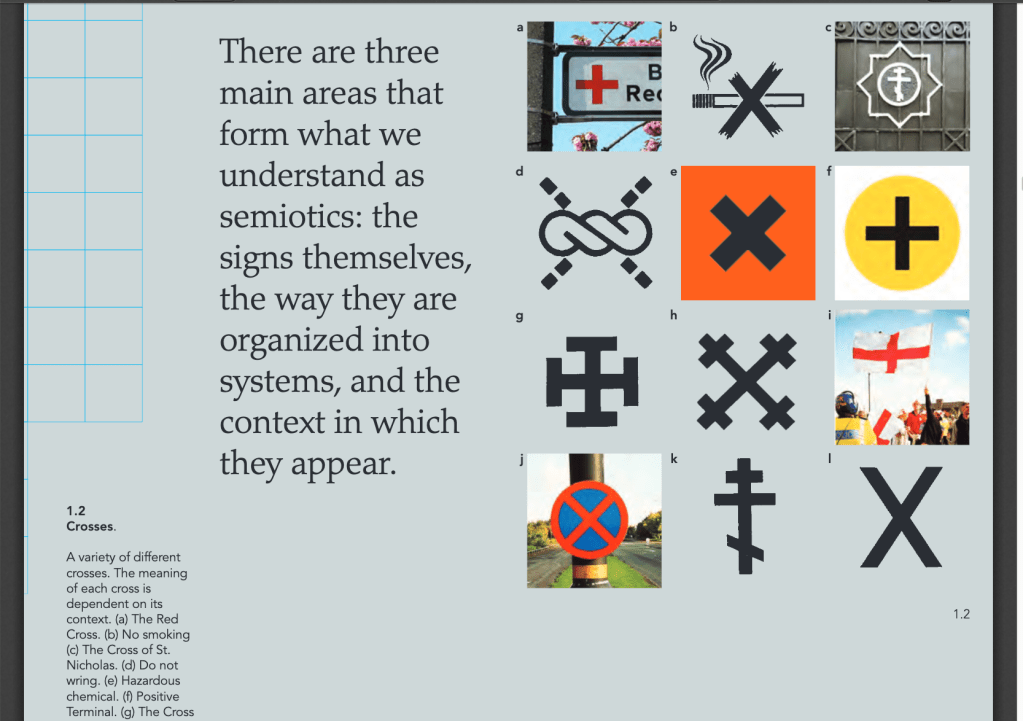
There are three main areas that form what we understand as semiotics: the signs themselves, the way they are organized into systems, and the context in which they appear.
Metaphor and Metonym
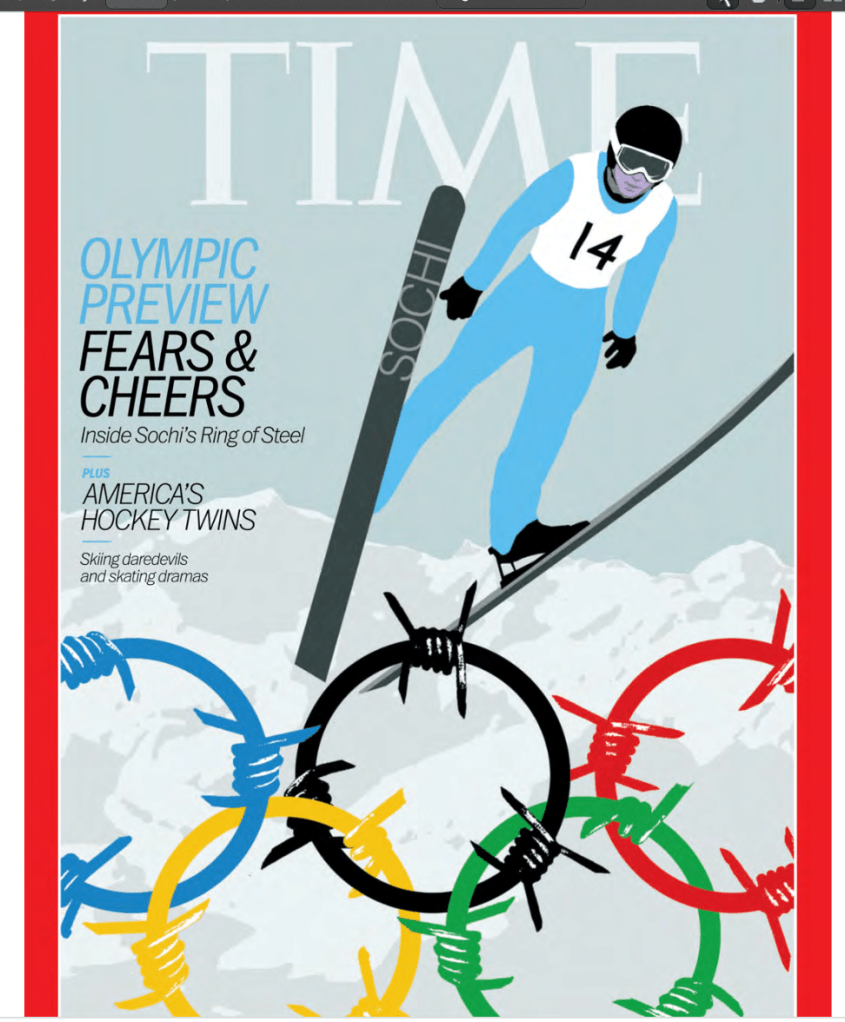
Understanding the practical application of paradigmical choice may be easier using the terms metaphor and metonym 8. When we substitute one word or image in a sequence for another, we can transfer the characteristics of one object to another. This use of metaphor is very common in advertisements, where a product is imbued with particular properties it is not readily associated with. We can also apply this type of metaphoric substitution to other forms of media. The paradigmical choice to remove the sleeves from a Savile Row pinstripe suit and refasten them using safety pins, would entirely change the way the suit is read. We would naturally make assumptions about the individual wearing the suit based on this change. The pins are part of a paradigm of fasteners. That they are not normally used as the conventional way of fastening a well- tailored suit can be used to change the meaning of the suit. The irreverence and immediacy of the pins is transferred to the suit and would become part of our overall reading of the garment and the statement that it makes.
A metonym works in a similar way except that it is used to represent a totality. When we want to signify reality in some way, we are forced to choose one piece of that reality to represent it. For example, if we want to represent all children, we might use an image of a child. In this case, the image of one child is being used as a metonym to represent the whole, all children. With all these paradigmical choices, meaning comes largely from the things we did not choose. There is not necessarily any fixed number of options in a paradigm; meanings of words, images, and gestures change over time through the natural evolution of social change. The important thing to remember is that where there is choice, there is meaning.
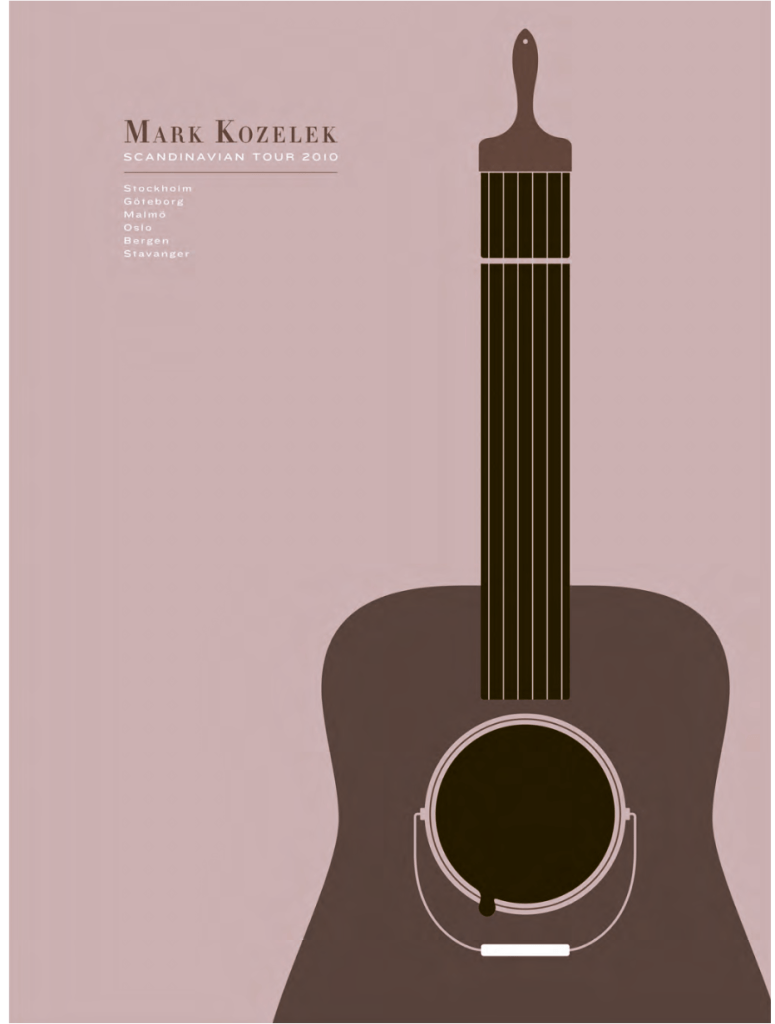
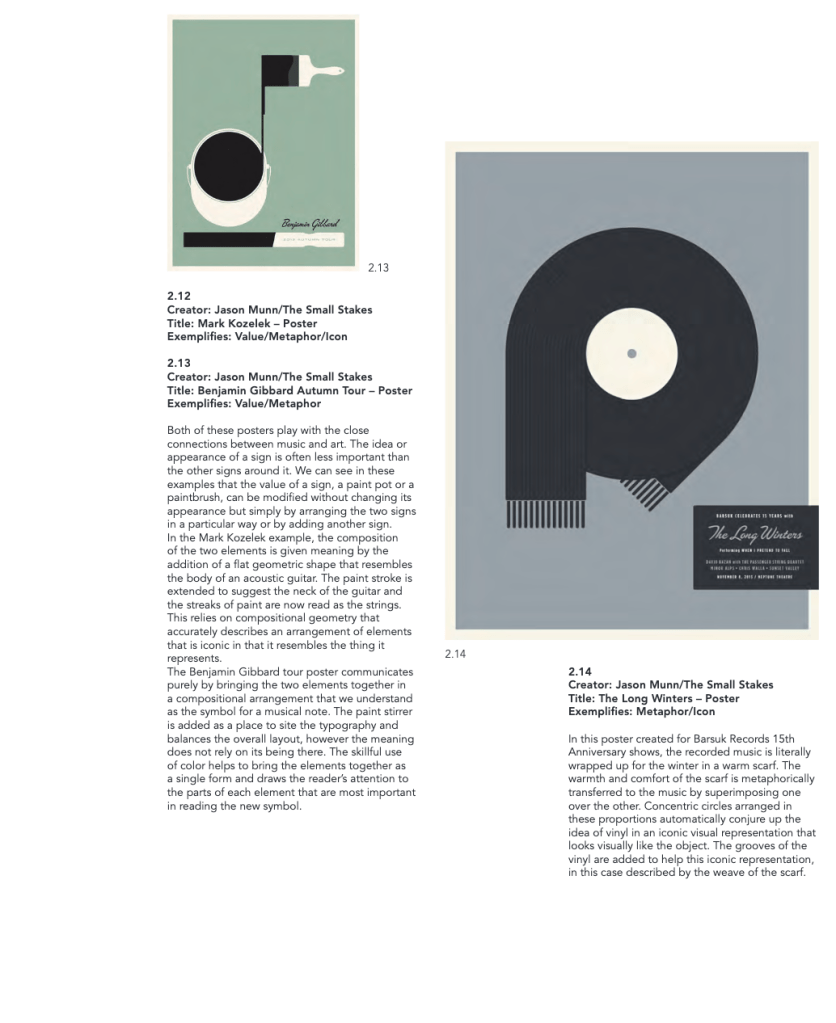
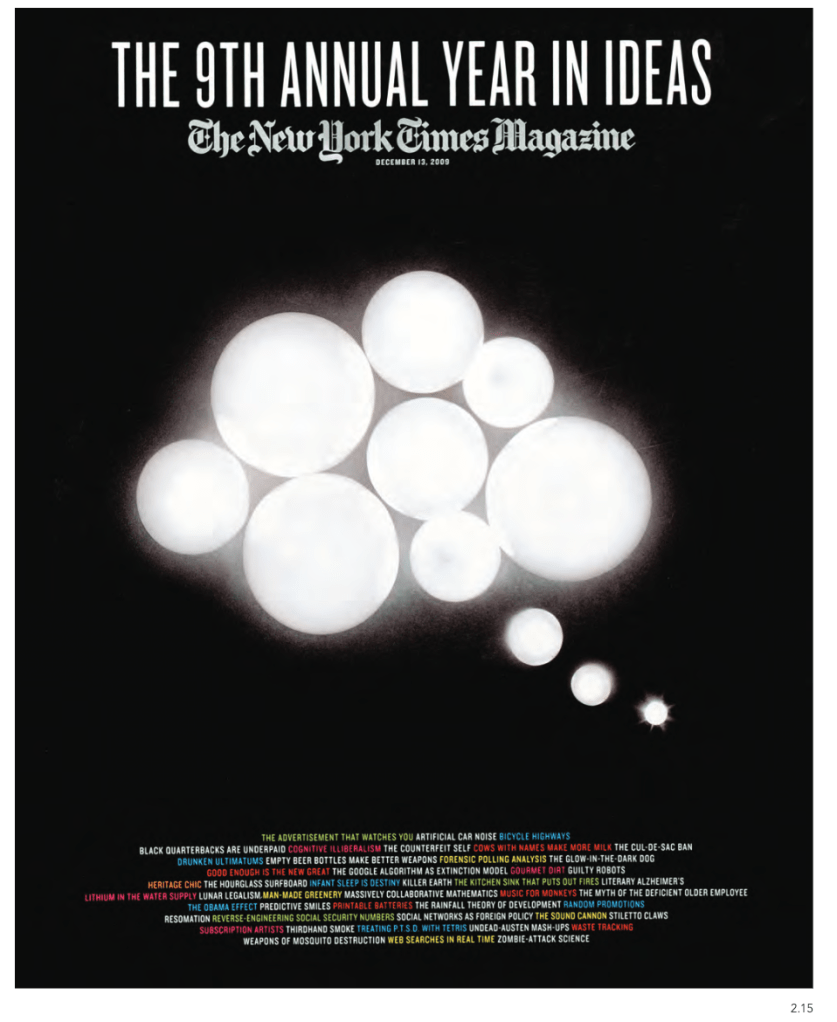
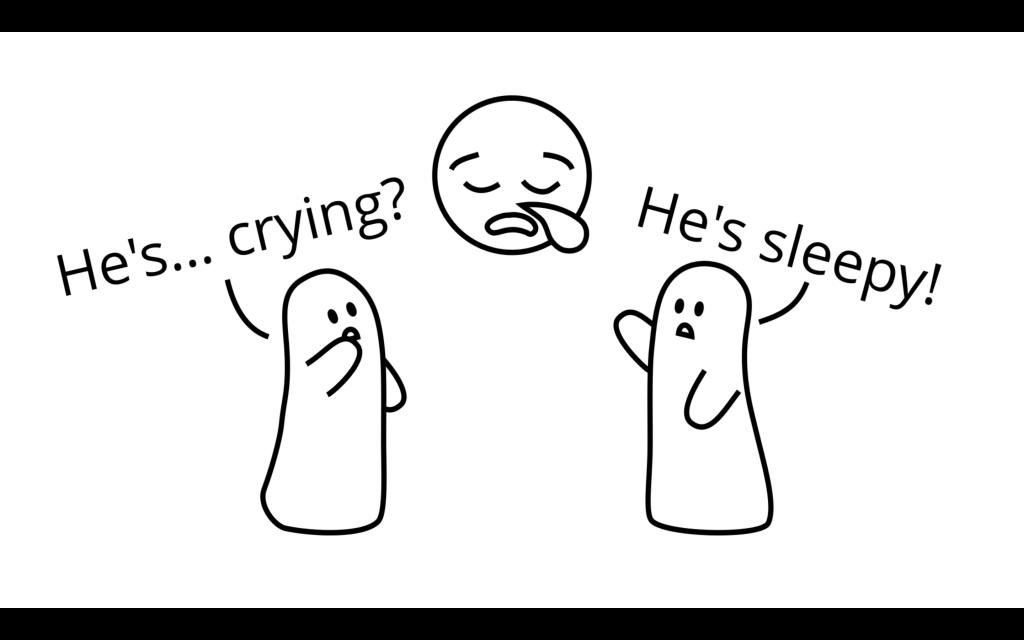
The meaning of any sign is affected by who is reading that sign.
Peirce recognized a creative process of exchange between the sign and the reader.
 Vicky Kafkaki - Graphic Design MA Falmouth University

Leave a comment