Winterthur
Winterthur is the premier museum of American decorative arts, with an unparalleled collection of nearly 90,000 objects made or used in America since 1640. The collection is displayed in the magnificent 175-room house, much as it was when the family of founder Henry Francis du Pont called it home.
Winterthur is also 1,000 acres of protected meadows, woodlands, ponds, and waterways. The 60-acre garden, designed by du Pont, is among America’s best, with magnificent plantings and massive displays of color throughout the year. The graduate degree programs and extensive research library make Winterthur an important center for the study of American art and culture.
In his later years, du Pont wrote:
“I sincerely hope that the Museum will be a continuing source of inspiration and education for all time, and that the gardens and grounds will of themselves be a country place museum where visitors may enjoy as I have, not only the flowers, trees and shrubs, but also the sunlit meadows, shady wood paths, and the peace and great calm of a country place which has been loved and taken care of for three generations.”H. F. du Pont
We invite you to visit and explore this exceptional place of learning, history, and beauty.
Henry Francis du Pont (1880–1969) was born at Winterthur and, in his words, “always loved everything connected with it.” A member of Delaware’s industrialist du Pont family, he studied at Bussey Institution, Harvard’s college of practical agriculture and horticulture, then spent the rest of his life managing the estate and its farm, perfecting his gardens, amassing one of the most significant collections of historic and decorative objects in the world, and, finally, creating a museum.
Gardener and Farm Manager
In1906, du Pont assumed responsibility for supervising the Winterthur Garden from his father. Du Pont developed and improved the formal garden areas near the house and created the March Bank, the first area of the garden with a naturalistic design. In the years before World War I, he traveled extensively to study the great gardens of Europe.
Du Pont took over management of the entire estate in 1914, developing Winterthur’s farmland and raising a prize-winning herd of Holstein-Friesian cows. By 1925, Winterthur encompassed turkey, chicken, sheep, hog, and dairy farms, as well as vegetable and flower gardens, greenhouses, a sawmill, a railroad station, and a post office. At Winterthur’s height, the property exceeded 2,500 acres. More than 250 workers tended the property and livestock. In addition to managing the farms, du Pont continued designing new areas and perfecting the Winterthur garden throughout his life.
Collector and Museum Founder
Until his death in 1969, du Pont divided his time among other homes in Southampton, Long Island; Boca Grande, Florida; and New York City. It was Winterthur, however, that he called home—the place where he lived with his wife, Ruth, and two daughters—and it became the center of his work.
In the 1920s he developed a passion for collecting historic American furniture, art, and decorative objects. To accommodate his burgeoning collection, du Pont greatly enlarged Winterthur and installed architectural elements from other early-American houses. For more than 20 years, the du Pont family often lived with the sounds of construction as their home was transformed.
Winterthur Museum opened in 1951. In 1961, at the invitation of Jacqueline Kennedy, du Pont led the First Lady’s Fine Arts Committee, which oversaw restoration of the White House. Fully recognizing the significance of the stories of art, craft, design, and history that his own collection could tell, du Pont also established graduate programs for the study of material culture and art conservation.
Today the museum, garden, graduate study programs, and a library that is recognized as a research center for material culture, are a legacy that provides constant beauty and insights into America past and present.
The du Pont family (English: /duːˈpɒnt/)[1] or Du Pont family is a prominent American family descended from Pierre Samuel du Pont de Nemours (1739–1817). It has been one of the richest families in the United States since the mid-19th century, when it founded its fortune in the gunpowder business. In the late 19th and early 20th centuries, it expanded its wealth through the chemical industry and the automotive industry,[2][3] with substantial interests in the DuPont company, General Motors, and various other corporations.
Several former du Pont family estates are open to the public as museums, gardens or parks, such as Winterthur, Nemours, Eleutherian Mills, Longwood Gardens, Gibraltar, Mt. Cuba, and Goodstay.[4] The family’s interest in horticulture was planted in the United States by their immigrant progenitors from France and was also nourished and cultivated in later generations by avid gardeners who married into the family. As early as 1924, the du Ponts were recognized by Charles Sprague Sargent, the famed plantsman and director of Harvard’s Arnold Arboretum, as “a family which has made the neighborhood of Wilmington, Delaware one of the chief centers of horticulture in the United States.”[5]
The family’s first American estate, Eleutherian Mills, located at Hagley Museum and Library, was preserved and restored by Louise E. du Pont Crowninshield. She also helped to establish the National Trust for Historic Preservation in 1949. In recent years, the family has continued to be known for its association with political and business ventures, as well as philanthropic causes.
Two family members were the subjects of well-publicized criminal cases. John Eleuthère du Pont was convicted of murdering wrestling coach Dave Schultz in 1996,[6] and Robert H. Richards IV was convicted of raping his 3-year-old daughter in 2009.[7] The family is depicted in the 2014 biographical film Foxcatcher, with Steve Carell playing John Eleuthère du Pont and Vanessa Redgrave playing Jean du Pont, the wife of William du Pont Jr.
As of 2016, the family fortune was estimated at $14.3 billion, spread across more than 3,500 living relatives.[3]
History
Éleuthère Irénée du Pont, founder of the du Pont business dynasty.
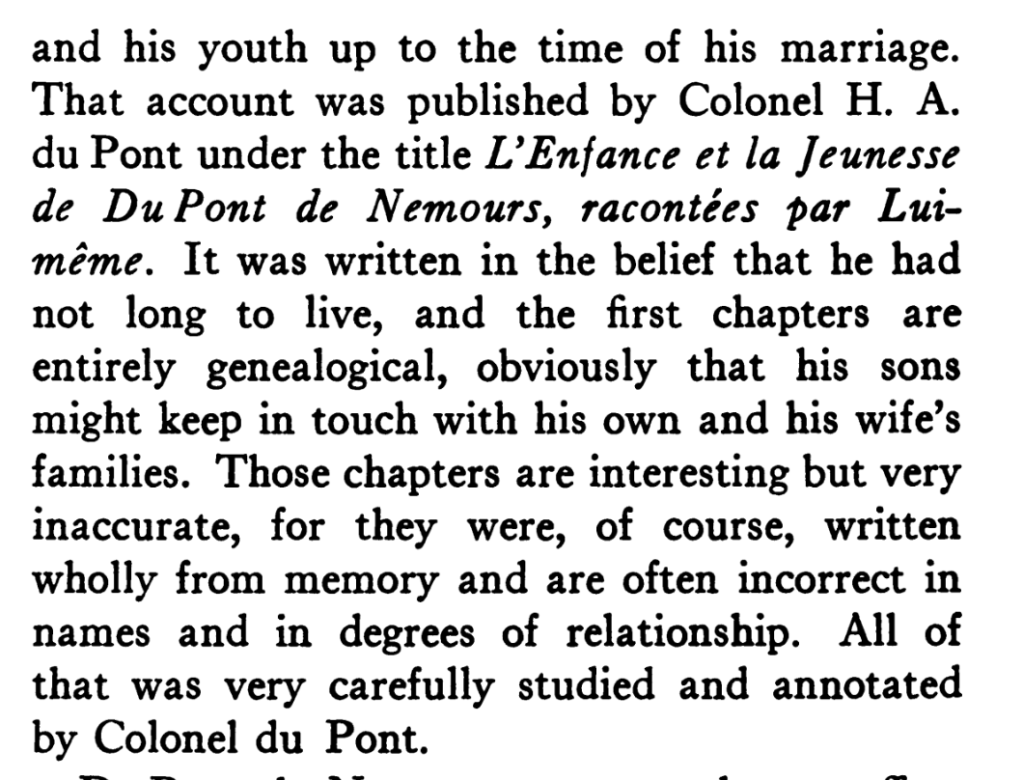
Pierre Samuel du Pont de Nemours was the son of a Parisian watchmaker and a member of a Burgundian Huguenot family, and descendant of a minor noble family on his mother’s side. He and his sons, Victor Marie du Pont and Éleuthère Irénée du Pont, migrated from France in 1800 to the United States and used the resources of their Huguenot heritage to found one of the most prominent of American families, and one of its most successful corporations, E. I. du Pont de Nemours and Company, initially established by Éleuthère Irénée as a gunpowder manufacturer.
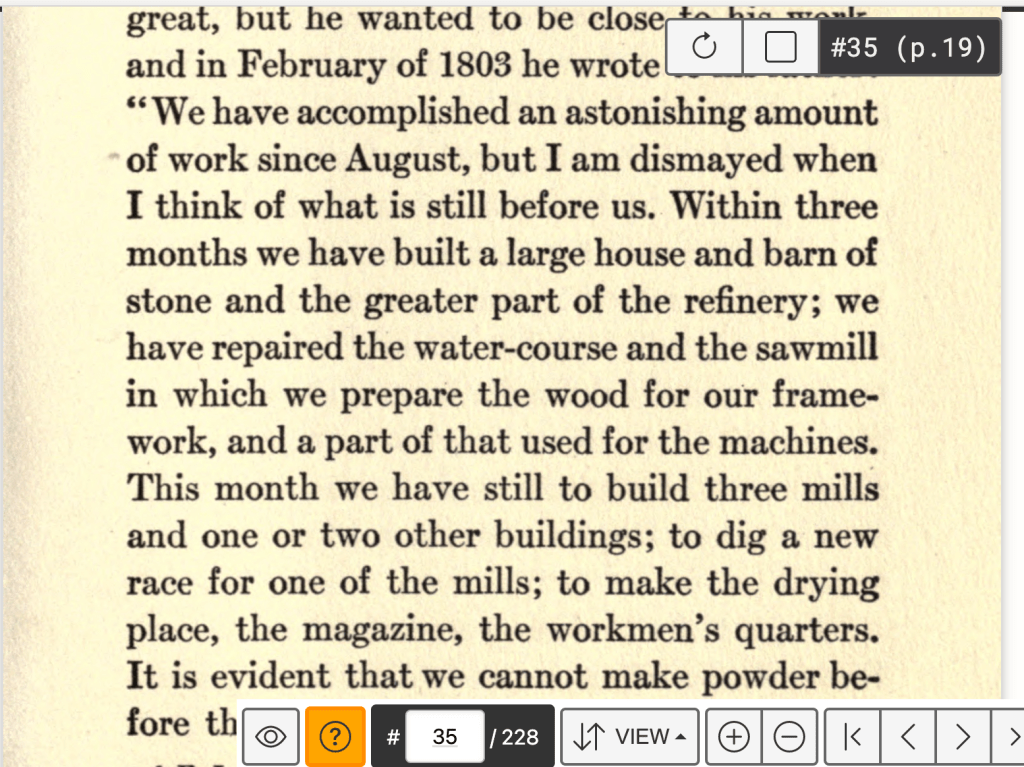
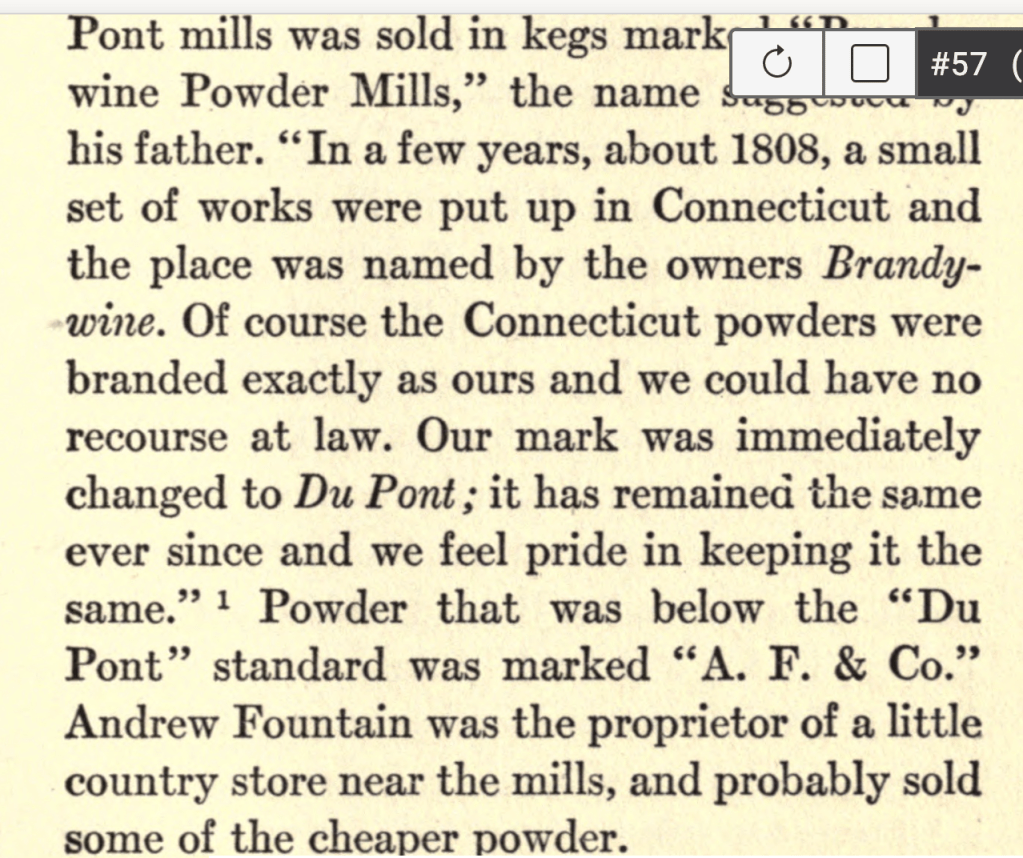
In 1802, Éleuthère Irénée du Pont established a gunpowder mill on the banks of the Brandywine River near Wilmington, Delaware. The location (named Eleutherian Mills) provided all the necessities to operate the mill: a water flow sufficient to power it, available timber (mainly willow trees) that could be turned into charcoal fine enough to use for gunpowder, and close proximity to the Delaware River to allow for shipments of sulfur and saltpeter, the other ingredients used in the manufacture of gunpowder. There were also nearby stone quarries to provide needed building materials.[8]
Over time, the Du Pont company grew into the largest black powder manufacturing firm in the world. The family remained in control of the company up through the 1960s,[9] and family trusts still own a substantial amount of the company’s stock. This and other companies run by the du Pont family employed up to 10 percent of Delaware’s population at its peak.[10] During the 19th century, the Du Pont family maintained their family wealth by carefully arranged marriages between cousins[11] which, at the time, was the norm for many families.
The family played a large part in politics during the 18th and 19th centuries and assisted in negotiations for the Treaty of Paris and the Louisiana Purchase. Both T. Coleman and Henry A. du Pont served as U.S. senators, and Pierre S. du Pont, IV served as Governor of Delaware.
The family has also played an important role in historic preservation and land conservation, including helping to found the National Trust for Historic Preservation, preserving President James Madison‘s home Montpelier, and establishing numerous museums such as Winterthur and the Delaware Museum of Natural History. The Brandywine Conservancy founded by family member George Alexis Weymouth owns around 2,350 acres (951 ha) of land in Pennsylvania and Delaware, and owns permanent conservation easements on an additional 37,000 acres (14,973 ha).[12][13] In 2013, Lammot du Pont Copeland‘s Mt. Cuba Center contributed over $20 million to purchase land for donation to the federal government to form the First State National Historical Park.[14]
Beginning with William du Pont, Jr. and his sister, Marion duPont Scott, many members of the Du Pont family have been involved in the breeding and racing of thoroughbred racehorses, as well as establishing racehorse venues and training tracks, including Delaware Park and Fair Hill, MD.[15] While most Du Ponts are members of the Episcopal Church,[16] Éleuthère Irénée du Pont was a Huguenot.[17]
Spelling of the name
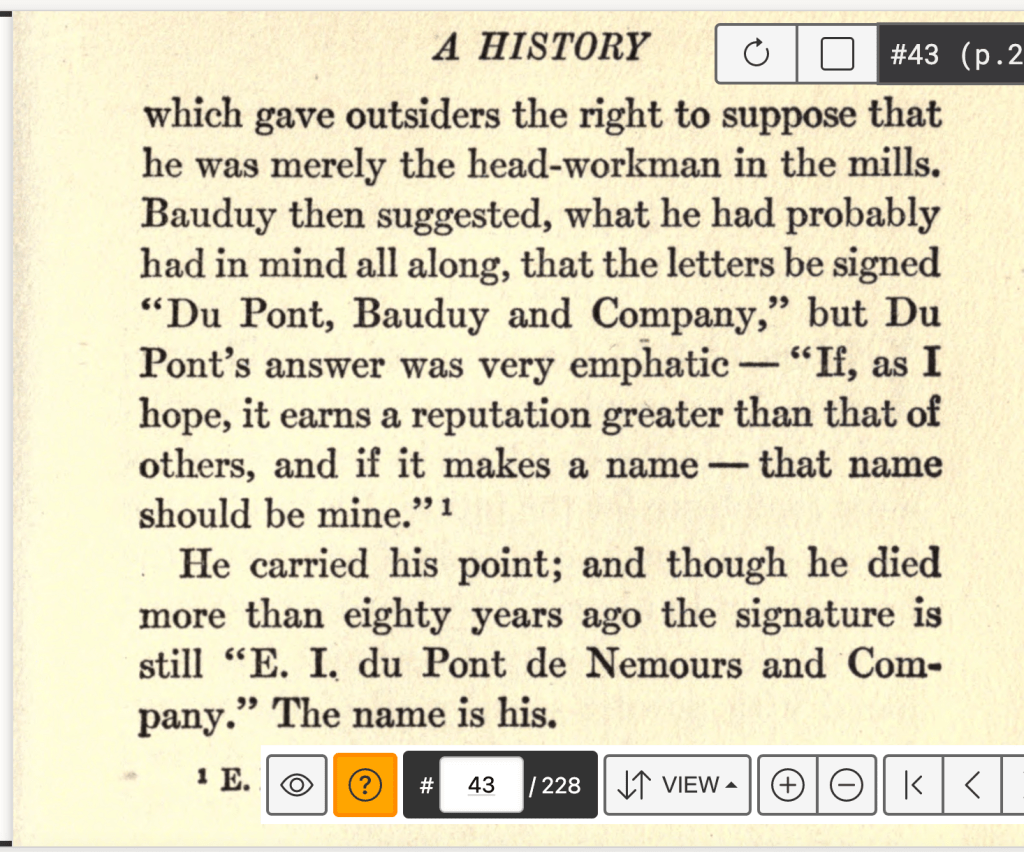
The stylings “du Pont” and “Du Pont” are most prevalent for the family name in published, copy-edited writings. In many publications, the styling is “du Pont” when quoting an individual’s full name and “Du Pont” when speaking of the family as a whole, although some individual Du Ponts have chosen to style it differently, such as Samuel Francis Du Pont. The name of the chemical company founded by the family is today styled solid as “DuPont” in the short form (but the long form is styled as E. I. du Pont de Nemours and Company); the stylings “Du Pont” and “DuPont” for the company’s short name coexisted in the 20th century, but the latter is now consistently used in the company’s branding. The solid styling “duPont” is less common, but the Nemours Alfred I. duPont Hospital for Children uses it, as does the duPont Registry. William S. Dutton’s mid-20th-century history of the family business[2] uses “Du Pont” both for the family mentioned generally and for the company’s short name but “du Pont” in an individual’s full name (for example, “Éleuthère Irénée du Pont“, “Henry du Pont“, “Alfred Victor du Pont“, “Lammot du Pont“); for example, “when he [Lammot du Pont] went to General Henry du Pont with the proposal that the Du Ponts manufacture dynamite, he was answered by a blunt and unqualified ‘No!’”[2]: 116 ) The first page of Dutton’s monograph[2]: 3 contains the following footnote about the surname’s styling (the mention of “Samuel Dupont” here refers to the 18th-century Parisian watchmaker, not to his 19th-century descendant): “Samuel Dupont used this form of the family name [i.e., Dupont], but beginning in 1763 his son signed himself ‘Du Pont.’ Later, he added ‘de Nemours’ to his name to prevent confusion with two other Duponts in the French Chamber of Deputies. Du Pont, in English, is pronounced with the accent on the second syllable. In French, neither syllable is accented.”[2]: 3
French orthographic tradition for the styling of de (or its inflected forms) as a surname particle, in either nobiliary or non-nobiliary form, is discussed at Nobiliary particle § France. In non-nobiliary form, the prevalent French styling of the name is “Dupont“, and thus the choice by Pierre Samuel du Pont de Nemours to begin styling himself so during the monarchical era hints at social ambition. But the influence of French orthography and prerevolutionary class structure on how English orthography styles surnames today is outweighed by how families and individuals so named style themselves.
https://en.wikipedia.org/wiki/Du_Pont_family
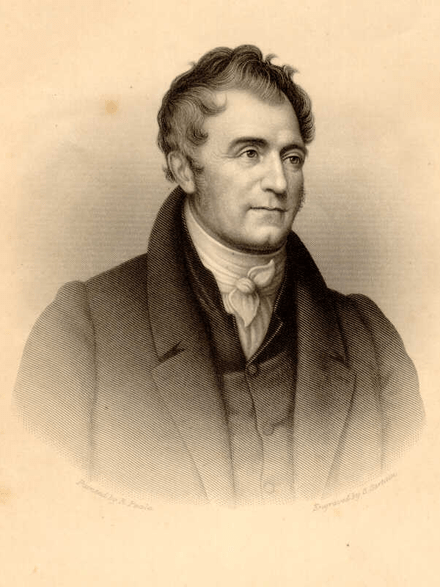
Éleuthère Irénée du Pont de Nemours (/djuːˈpɒnt, ˈdjuːpɒnt/;[1] French: [dypɔ̃]; 24 June 1771 – 31 October 1834) was a French-American chemist and industrialist who founded the gunpowder manufacturer E. I. du Pont de Nemours and Company. His descendants, the du Pont family, have been one of America’s richest and most prominent families since the 19th century, with generations of influential businessmen, politicians and philanthropists. In 1807, du Pont was elected a member of the American Philosophical Society in his adopted hometown of Philadelphia.[2]
Early life and family
Du Pont was born 24 June 1771, in Paris, the son of Pierre Samuel du Pont de Nemours and Nicole-Charlotte Marie-Louise le Dée de Rencourt. His father was a political economist who had been elevated to the nobility in 1784 by letters patent granted by King Louis XVI, allowing him to carry the honorable de Nemours suffix. Growing up on his father’s estate, “Bois des Fossés”, near Égreville, young du Pont was enthusiastic about his studies in most subjects, and showed particular interest in explosives. Du Pont married Sophie Dalmas (1775–1828) in 1791, and they had eight children.
Du Pont sailed before his family and landed at Newport, Rhode Island on 1 January 1800, along with his father and his brother’s family. By 1802, he had established both his business and his family home, Eleutherian Mills, on the Brandywine Creek in Delaware. 1 January is the anniversary of the arrival of the du Pont family in America, and this date is still celebrated by its descendants.[3]
Du Pont was a Huguenot.
Career in France
In the Fall of 1785, du Pont entered the Collège Royal in Paris. Two years later, he was accepted by the friend of his father and noted chemist Antoine Lavoisier as a student in the Régie des poudres, the government agency responsible for the manufacture of gunpowder. It was from Lavoisier that he gained his expertise in nitrate extraction and manufacture.[5] He studied “advanced explosives production techniques” [6]
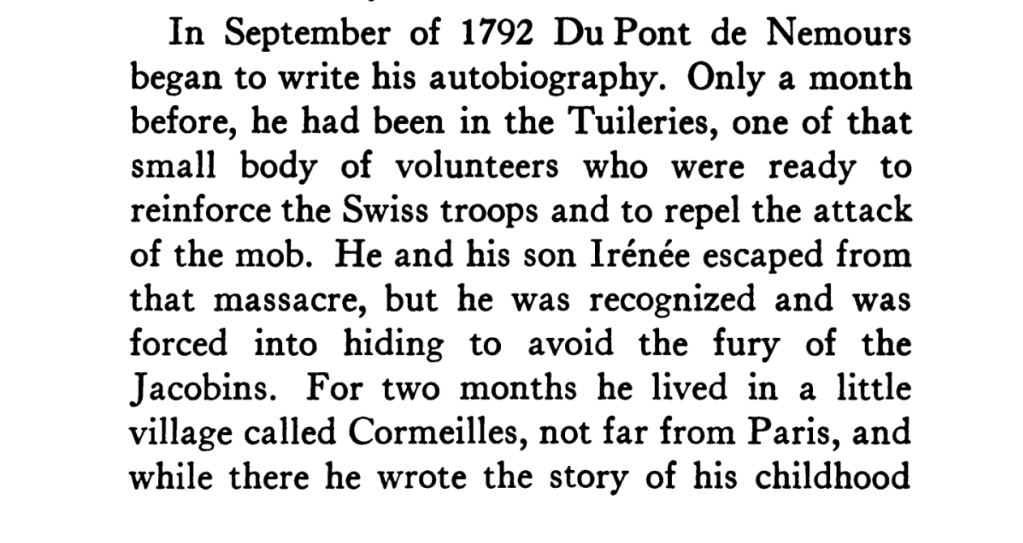
After a brief apprenticeship, he took a position at the government powder works in Essonne but quit after Lavoisier left.[7] In 1791, du Pont began to help his father manage their small publishing house in Paris, where they published a republican newspaper in support of governmental reforms in France. Du Pont was a member of the pro-Revolution national guard and supported the Jacobins. However, on 20 August 1792, both du Pont and his father participated in protecting the escape of Louis XVI and Marie Antoinette when the Tuileries Palace was stormed. His father angered fellow revolutionaries by refusing to go along with the guillotine execution of Louis XVI, and the two men’s moderate political views proved to be a liability in revolutionary France.
His father was arrested in 1794, only avoiding execution because of the end of the Reign of Terror. In September 1797, du Pont and his father spent a night in La Force prison while their home and presses were ransacked. These events led his father to lose hope in the political situation in France, and so he began making plans to move their family to America and aspired to create a model community of French émigrés. On 2 October 1799, the du Pont family sold their publishing house and set sail for the United States. They reached Rhode Island on 1 January 1800 and began to settle in the home the eldest du Pont had secured in Bergen Point, New Jersey.
They soon set up an office in New York City to decide what their new line of business would be, but Éleuthère Irénée was not included in much of these plans. However, he saw the possibilities that his earlier apprenticeship with Lavoisier would allow him and his family in America.[8]
In the Fall of 1785, du Pont entered the Collège Royal in Paris. Two years later, he was accepted by the friend of his father and noted chemist Antoine Lavoisier as a student in the Régie des poudres, the government agency responsible for the manufacture of gunpowder. It was from Lavoisier that he gained his expertise in nitrate extraction and manufacture.[5] He studied “advanced explosives production techniques” [6]
After a brief apprenticeship, he took a position at the government powder works in Essonne but quit after Lavoisier left.[7] In 1791, du Pont began to help his father manage their small publishing house in Paris, where they published a republican newspaper in support of governmental reforms in France. Du Pont was a member of the pro-Revolution national guard and supported the Jacobins. However, on 20 August 1792, both du Pont and his father participated in protecting the escape of Louis XVI and Marie Antoinette when the Tuileries Palace was stormed. His father angered fellow revolutionaries by refusing to go along with the guillotine execution of Louis XVI, and the two men’s moderate political views proved to be a liability in revolutionary France.
His father was arrested in 1794, only avoiding execution because of the end of the Reign of Terror. In September 1797, du Pont and his father spent a night in La Force prison while their home and presses were ransacked. These events led his father to lose hope in the political situation in France, and so he began making plans to move their family to America and aspired to create a model community of French émigrés. On 2 October 1799, the du Pont family sold their publishing house and set sail for the United States. They reached Rhode Island on 1 January 1800 and began to settle in the home the eldest du Pont had secured in Bergen Point, New Jersey.
They soon set up an office in New York City to decide what their new line of business would be, but Éleuthère Irénée was not included in much of these plans. However, he saw the possibilities that his earlier apprenticeship with Lavoisier would allow him and his family in America.[8]
E.I. du Pont de Nemours and Company
Du Pont’s wife, Sophie Madeleine Dalmas du Pont
Du Pont had no thought of becoming involved with gunpowder manufacture again upon his arrival in the United States, but he brought with him an expertise in chemistry and gunpowder making, during a time when the quality of American-made gunpowder was very poor. Delaware legend holds that he decided to go into the gunpowder business during a fateful hunting trip with Major Louis de Tousard, a former French artillery officer then employed by the United States Army to procure gunpowder supplies. Du Pont’s gun misfired as he attempted to shoot a bird, which caused him to reflect on his powder-making apprenticeship with Lavoisier as a youth in France. Du Pont commented on the inferior quality of the American-made powder they were using for hunting despite its high price.
At du Pont’s request, Tousard arranged a tour of an American powder plant. He quickly deduced that the saltpeter being used was of good enough quality; however, the American refining process was poor and inefficient compared with the techniques he had learned in France. He began to think that he could use his experience from France to manufacture gunpowder of a higher quality in the United States and reform the current industry standard for refinery. With his father’s blessing, he began to assemble capital for the construction of the first powder mills, and returned to France in the beginning of 1801 to procure the necessary financing and equipment.
The act of association was signed on 21 April 1801, and the company was christened E.I. du Pont de Nemours & Company since it was its namesake’s ingenuity that had created this venture.[8] His gunpowder company was capitalized at $36,000 with 18 shares at $2,000 each. He purchased a site on Brandywine Creek for $6,740. There were several small buildings and a dam with foundations for a cotton-spinning mill which had been destroyed by fire. The first gunpowder was produced in April 1804.
Death
Du Pont died on 31 October 1834 in Philadelphia, aged 63.[9] The cause of death was unspecified, due to “conflicting reports of either cholera or a heart attack.”[8] He was buried in the Du Pont de Nemours Cemetery on the family property in Wilmington.
Legacy
The company du Pont founded would become one of the largest and most successful American corporations. By the mid-19th century it was the largest supplier of gunpowder to the U.S. military, and supplied as much as 40 percent of the powder used by the Union Army forces during the Civil War.[10] His sons, Alfred V. du Pont (1798–1856) and Henry du Pont (1812–1889), managed the plant after his death, following three years of tutelage by his son-in-law, Jacques Antoine Bidermann. His grandson, Lammot du Pont I (1831–1884), was the first president of the United States Gunpowder Trade Association, popularly known as the Powder Trust
https://en.wikipedia.org/wiki/%C3%89leuth%C3%A8re_Ir%C3%A9n%C3%A9e_du_Pont
Du Pont: From French Exiles to the Toast of the Brandywine
26 July, 2021
Posted by: Natalie Burclaff
This is a guest post by 2021 Junior Fellow, Hannah Spring Pfeifer. Hannah is pursuing graduate degrees in American History and Nonprofit Management at Villanova University.
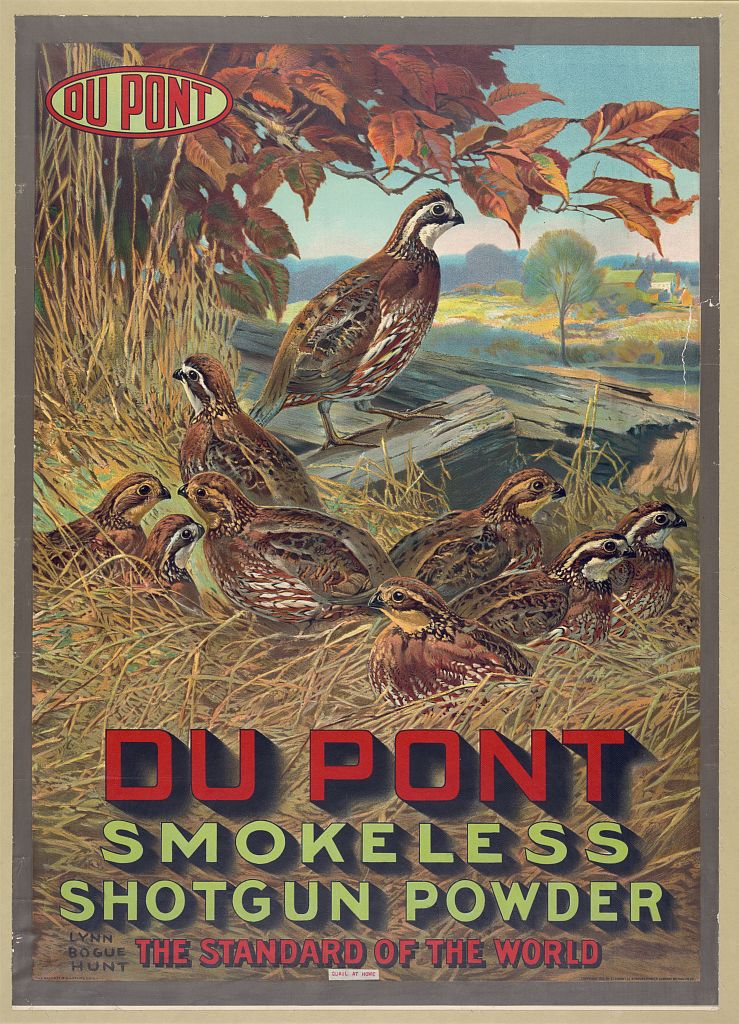
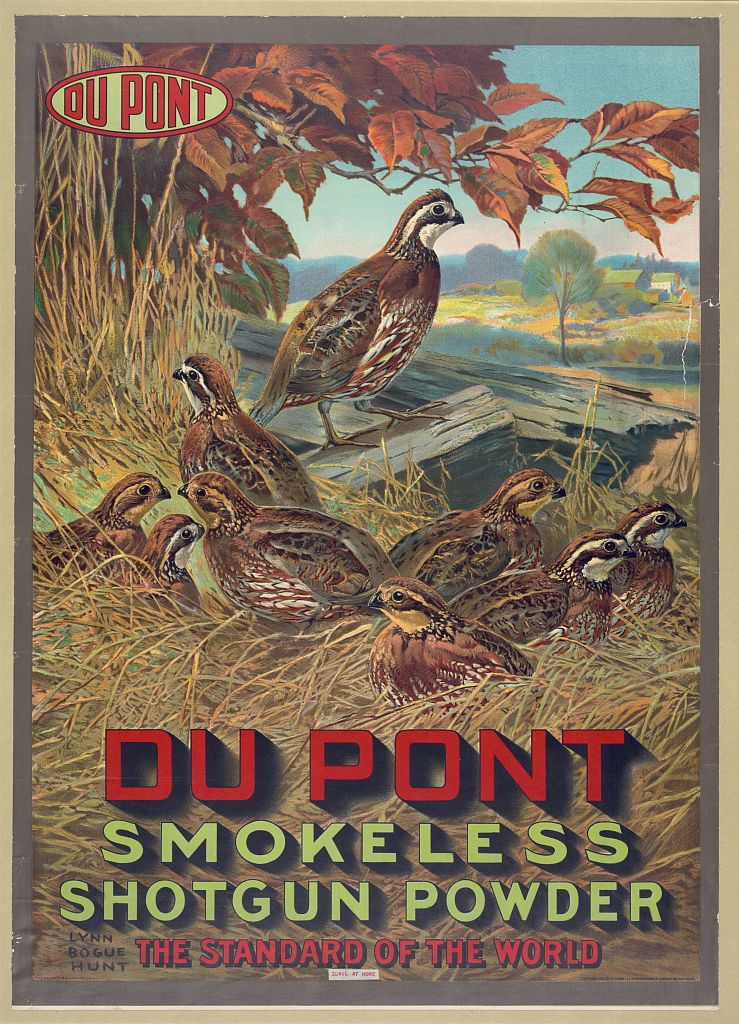
“Du Pont smokeless shotgun powder – the standard of the world.” c. 1913. Print: Lynn Bogue Hunt, artist. Library of Congress Prints and Photographs Division.
Along the serene Brandywine River in Delaware, the stone buildings of the Eleutherian Mills stand, some little more than ruins, others the same as they were in the mill’s nineteenth century heyday. It was here, in 1802, that Éleuthère Irénée du Pont de Nemours founded his powder works and began the legacy of a powerful and wealthy French American family.
Before coming to America, the du Pont family lived in a chaotic France. The French Revolution began in 1789 as a rebellion against monarchy and abuses of power. Many commoners and educated middle-class people joined the uprising, hoping to dethrone King Louis XVI and gain equal representation within a democratic society. E.I. du Pont was a young man during the revolution, working in his father’s print shop, although his passion and training was in manufacturing black powder and explosives. His father, Pierre Samuel du Pont de Nemours, was a nobleman who both worked for the monarchy and inspired liberal economic reforms, eventually becoming president of the National Constituent Assembly.

Revolution, or Johnny Bull in France. July 25, 1789. Image: W. Dent, publisher. British Cartoon Prints Collection. Library of Congress Prints and Photographs Division.
After he and E.I. defended Louis XVI and Marie Antoinette from an angry mob, Pierre was sentenced to be guillotined, but escaped punishment due to the Thermidorian Reaction. In 1800, Pierre, E.I., and his other son, Victor, immigrated on the American Eagle with their wives, children, and various other relations, to the United States, where they quickly became important players in the Industrial Revolution.
Arriving on January 1, 1800, the du Pont family made their way to New Jersey, Pierre and Victor’s minds spinning with all the potential this new home brought. They established Du Pont de Nemours Father & Sons & Company of New York, immediately brainstorming ideas for economic success. Pierre even received support from both Thomas Jefferson and Alexander Hamilton, leaders of the opposing Democratic-Republican and Federalist parties respectively. Meanwhile, E.I. du Pont explored the new country. On a hunting trip, he noticed that American gunpowder was poor quality yet expensive because it was the only option in the sparsely populated wilderness. E.I., with his chemistry and powder-making background, pitched an idea for a powder mill along the Brandywine River to his father and brother. Quality gunpowder was produced mainly by Great Britain, but the du Ponts, Jefferson, and French financial backers supported E.I., hoping to increase French influence on the United States and strengthen the Franco-American alliance. For $36,000, E.I. du Pont de Nemours and Company was founded in 1802.
The Brandywine River appealed to E.I. du Pont because it was short and steep. Often known just as DuPont, the company built dams and a mill race to harness the river’s potential water energy, which was controlled with water wheels, turbines, and gear shifts. Everything at the powder mill, from the roll mills to the millwright shops, was water-powered, which let DuPont function independently.

DuPont Powder Mill, Hagley Museum, on Brandywine River, Greenville, New Castle County, DE. c. 1933. Photo: Historic American Buildings Survey. Library of Congress Prints and Photographs Division.
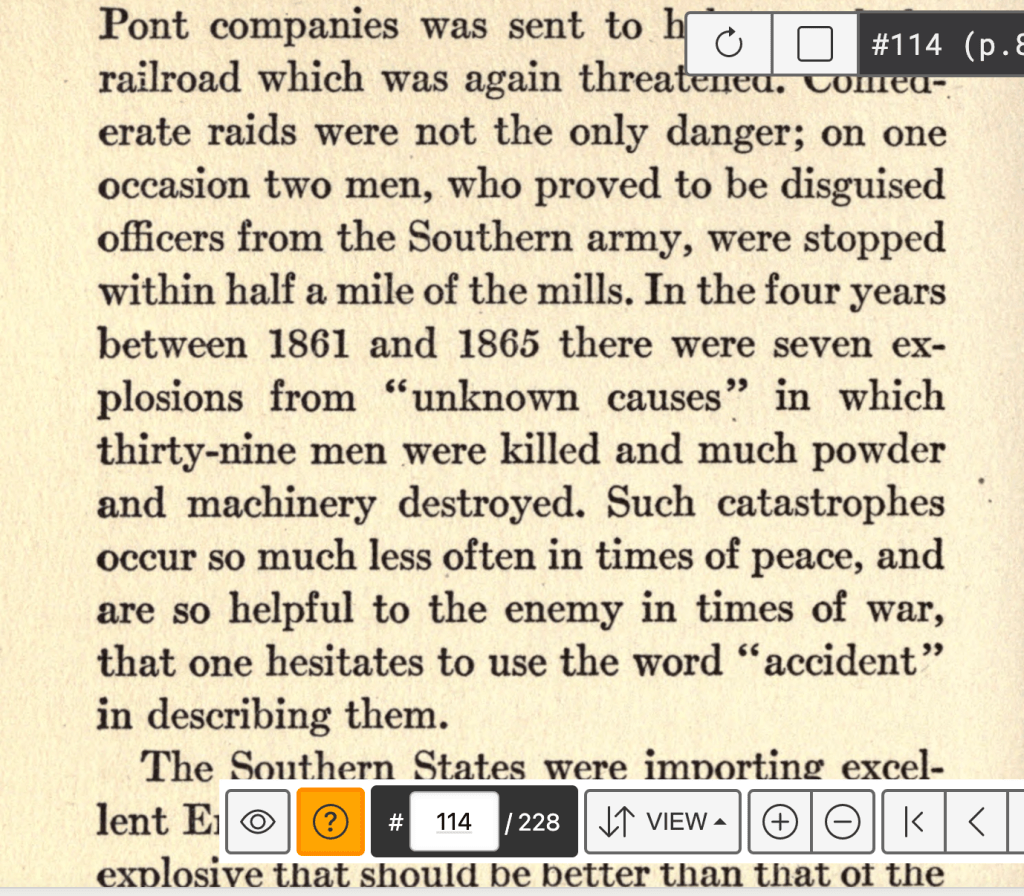
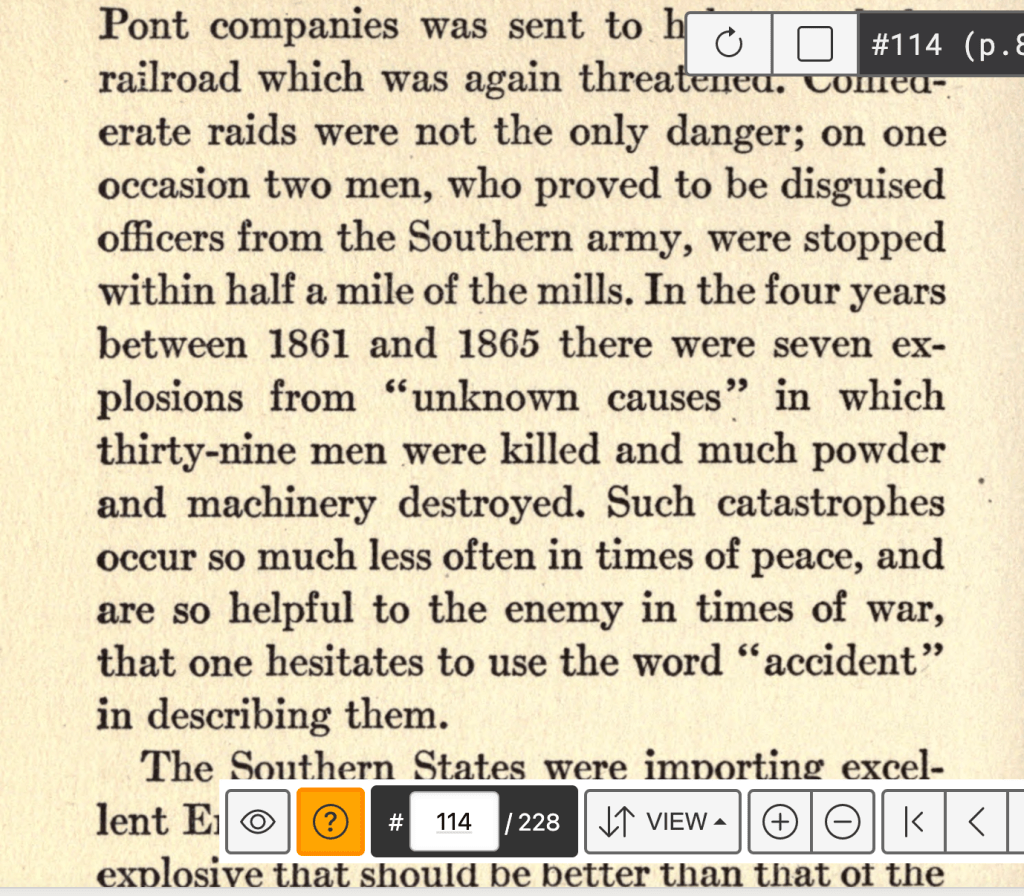
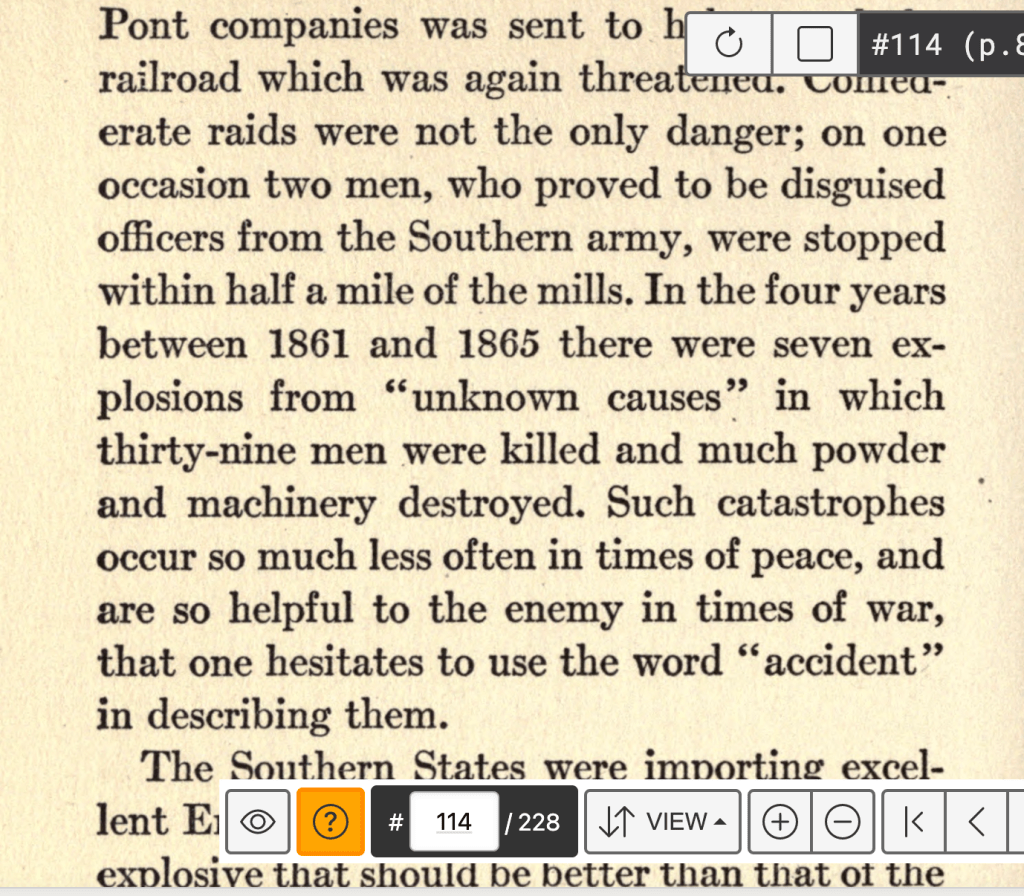
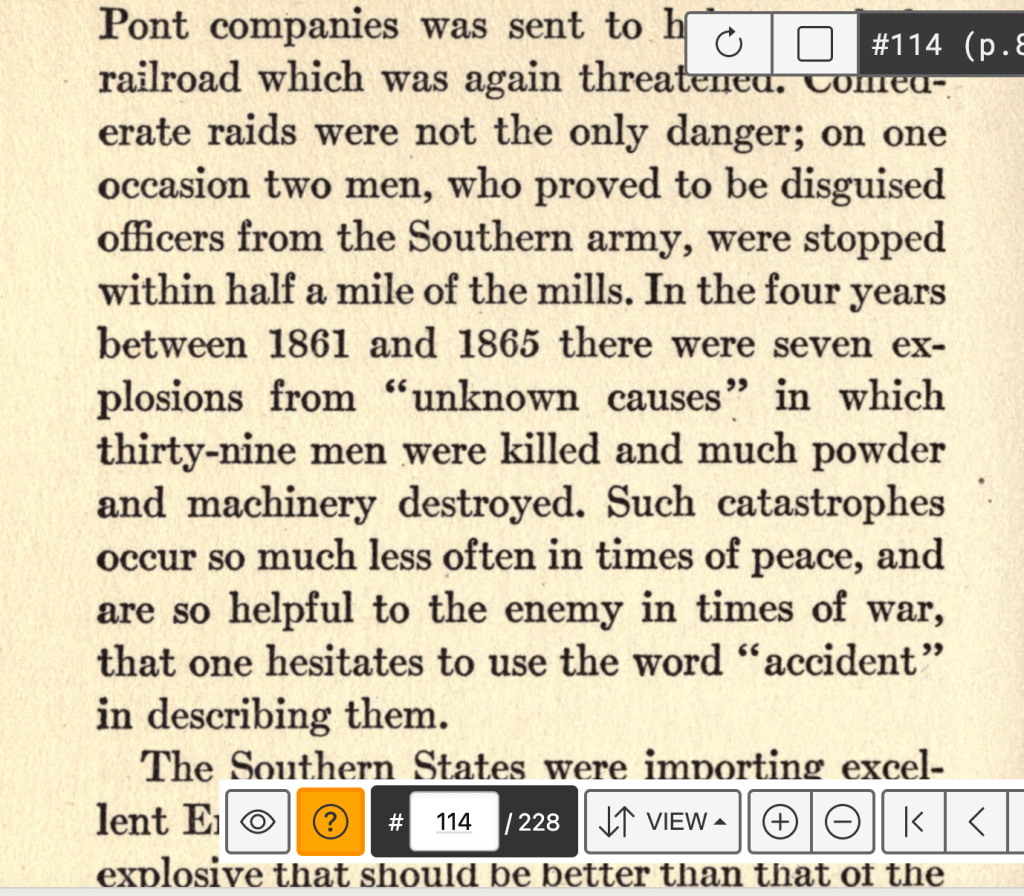
Another benefit of the river was the safety it provided the workers. Making gunpowder was a dangerous job, because when the ingredients were mixed together, they became explosive. The roll mills were pairs of stone buildings, closed on three sides and open on the side facing the river. The mill workers filled wooden vats with sulphur, charcoal, and saltpeter; they added bit water to reduce the chance of explosions. Turbines powered the mixing process, during which workers stood behind the stone walls because an explosion was most likely to be triggered when the ingredients were blended. The stone walls protected the workers while the explosion shot out across the river where no one could be injured. Even with these precautions, in over 119 years of making black powder, DuPont had 288 explosions and 228 deaths.
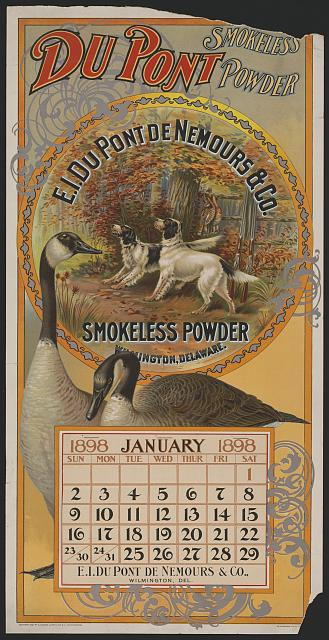
Du Pont smokeless powder, 1898. [Calendar.] Popular and Applied Graphic Art Print Filing Series. Library of Congress Prints and Photographs Division.
DuPont soon became the leading American manufacturer of black powder, making E.I. du Pont a valuable addition to his family’s business ventures. Black powder was a key part of early American settlement and conflict. Hunting meant survival, since furs from game were used for clothing and trading and meat was used for food. Even bones made useful tools and decorations. Historically, most firearms were muzzleloaders, meaning the powder charge and the projectile were loaded into the gun barrel from the open end, the muzzle. By the 1880s, however, breechloading personal firearms and guns that used smokeless powder became more popular. It was not until the early 1900s that militaries saw widespread use of smokeless weapons.
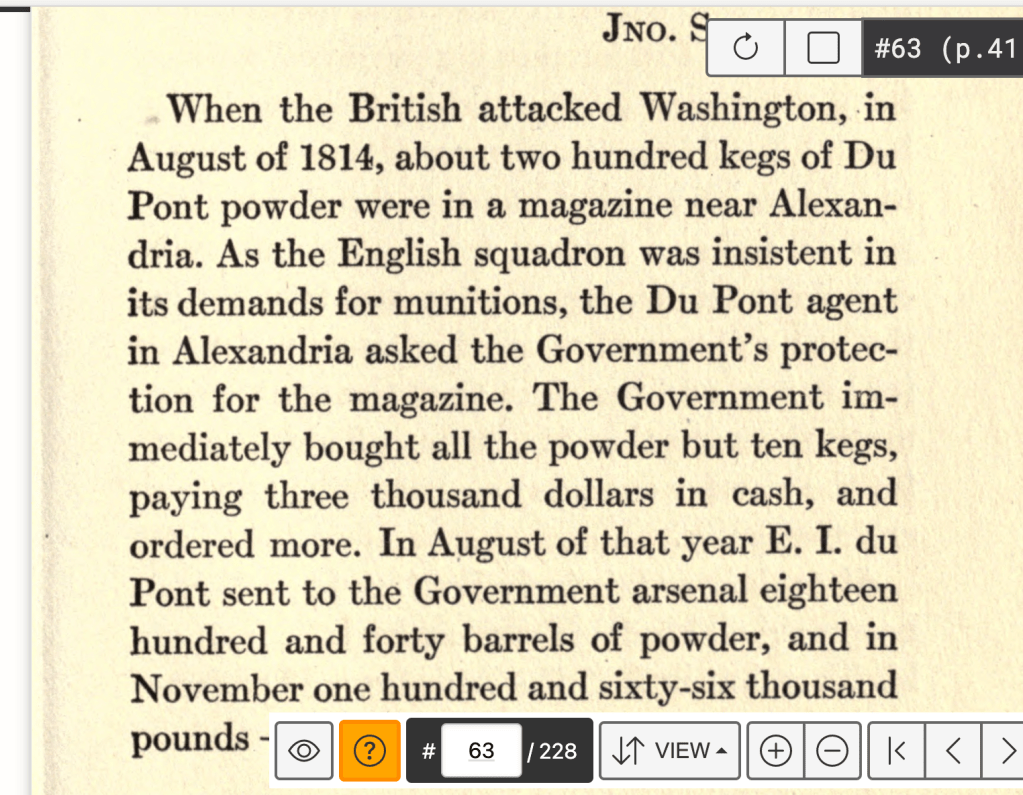
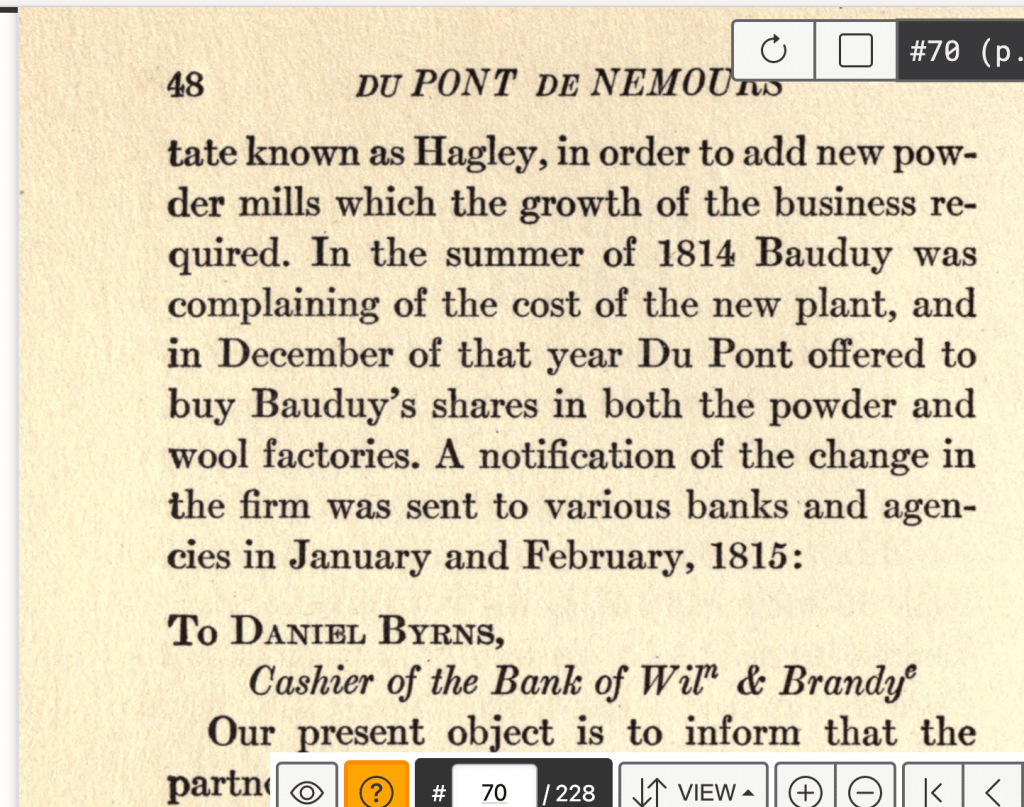
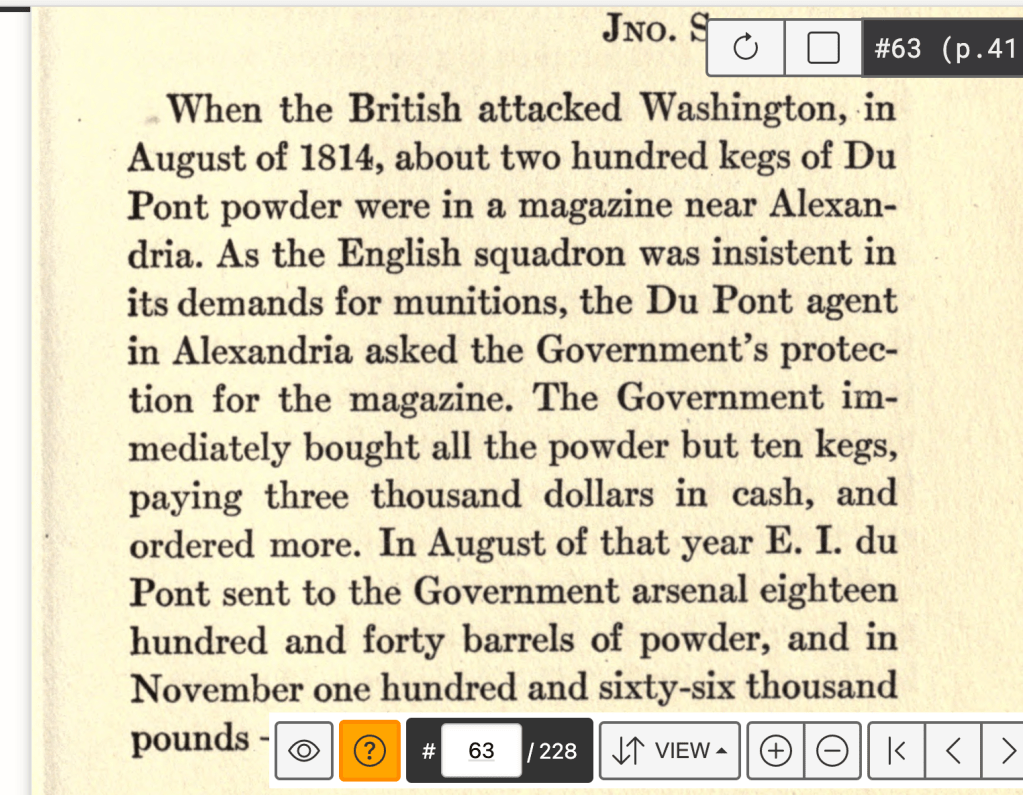
The issue with black powder is that it produces a large cloud of smoke when ignited. This was not as problematic for sport shooters and hunters, but it was a nightmare for military engagements. Battlefields quickly fogged over with powder clouds, rendering soldiers blind to friend and foe alike. Nevertheless, black powder was the only option. During the War of 1812, DuPont provided about 1 million pounds of black powder to the United States and even rallied their own militia in case Wilmington was attacked by the British. While they did not have to engage in battle, the company’s growing success and reputation meant expansion was needed. E.I. du Pont purchased the land known as Hagley, still along the Brandywine River and the perfect place to build roll mills. The company continued successfully under E.I. until his dying day in 1834.
Following his death, E.I. du Pont’s sons, Alfred, Henry, and Alexis, took over as partners. DuPont was a family business, with these men and their sons continuing the du Pont legacy and expanding the wares offered. Throughout the mid-nineteenth century, DuPont saw a boom due to events such as the California Gold Rush, the construction of Western railroads, the Crimean War, and the American Civil War. During the Civil War, Henry du Pont, a staunch Unionist with many relatives fighting for the North, ensured no gunpowder was sold to the Confederacy or to Confederate sympathizers. Approximately $110,000-worth of black powder was confiscated from DuPont agents during the war, but none was actively sold to the South.
An important member of the du Pont family during the late nineteenth century was Lammot du Pont I, son of Alfred and grandson of E.I. du Pont. Lammot was a chemist and began his career working to develop a cheaper way to make black powder, eventually realizing sodium nitrate was an adequate and cost-effective replacement for saltpeter. As DuPont continued to expand, buying out rival companies, Lammot turned his attention to dynamite production. He understood that this new product would have large consequences for the explosives industry, particularly as mining efforts and railroads pushed into all corners of the nation. In 1880, Lammot founded his own business in New Jersey, the Repauno Chemical Company, specifically to produce high-power explosives like dynamite. When Lammot died in an accidental factory explosion only four years later, DuPont acquired Repauno and incorporated their relative’s vision into their own production line.
The next DuPont invention was a cellulose-based smokeless gunpowder, patented in 1893. Since black powder creates such a fog when ignited, smokeless powder promised to be a big seller to hunters, target shooters, and national military powers looking for wartime advantages. In fact, DuPont became a major distributor of smokeless gunpowder for the allies during World War I, a war defined by intense and confusing trench-laden battlegrounds. DuPont even built a new factory specifically to produce mass quantities of smokeless gunpowder. Located near Nashville, Tennessee, the Old Hickory facility employed roughly 30,000 Americans who lived in the nearby company town. It cost the federal War Department $83 million to construct.
For the rest of the twentieth century, DuPont remained one of the top competitors in chemical-based business, with revenue dipping only during the Great Depression. DuPont chemists made their mark on the world by developing revolutionary substances like the following:
- Freon (1930) a substance for refrigeration
- Neoprene (1931) a synthetic rubber
- Lucite (1936) a clear, acrylic resin used for home furniture
- Nylon (1937) a synthetic material used to replace silk stockings and in World War II parachute production
- Teflon (1938) a lubricant and non-stick material
- Mylar (1952) a synthetic film
- Dacron (1953) a washable polyester batting and fabric
- Lycra (1958) a synthetic fiber used in athletic clothes due to high elasticity
- Kevlar (1973) a high-tensile strength fiber with heat resistant properties
DuPont’s rising power also came from various mergers and acquisitions of other companies. This was beneficial for business, but also brought public outcry against a lack of competitors. Laws such as the Sherman Antitrust Act of 1890 and the Clayton Antitrust Act of 1914 meant to ensure fair business competition and decrease the chance of monopolies. Few companies in the twentieth century had the funding or the employees to match the materials DuPont invented, let alone market them to consumers. For DuPont, their buying practices resulted in continual antitrust trials during the 1960s and 70s in particular.
After a long and storied history of business success, starting with E.I. du Pont’s vision for a powder works on the Brandywine River and ending with a position as a global power in chemical innovation, DuPont merged with Dow Chemical in 2015. The historic competitors split and merged again within the next two years, a reminder that business is always in flux. Even with the ups and downs DuPont experienced over its 200 years of existence, there is no doubt Pierre Samuel du Pont de Nemours would be proud of the business legacy ignited by his son’s knowledge, skill, and dissatisfaction with American gunpowder.
Moodboard



Leave a Reply